“I’d love to work with my hands, but I was terrible at math.” If that sentence has ever stopped you from looking seriously at the skilled trades, this guide is for you — and the news is better than you think, with one honest caveat we’ll get to.
Here’s the truth most trade-school marketing won’t spell out: the trades are not math-free, but most of them are algebra-free. There is a real difference between the math on a high school exam — abstract equations, proofs, trigonometry — and the math on a job site, which is mostly measuring, adding fractions of an inch, and estimating how much material covers how much area. Plenty of people who froze up in algebra class handle job-site math without a second thought, because it’s concrete: you can see the board you’re measuring.
This guide sorts trades into three honest tiers: trades where math stays at tape-measure level, trades with moderate everyday math, and trades where you genuinely need algebra and should know that going in. Every wage figure comes from the BLS Occupational Outlook Handbook, May 2024 data.
TL;DR: Key Takeaways
- Most trades use measurement math, not classroom math. Fractions on a tape measure, material estimates, and unit conversions cover the bulk of daily work in many trades.
- Low-math trades pay real wages: flooring installers earn a $52,000 median, roofers $50,970, painters $48,660 — all typically requiring no formal educational credential.
- The honest caveat: electricians, plumbers, and HVAC technicians do use algebra-level math (load calculations, pipe sizing). Some states require a year of high school algebra for electrical licensure.
- Trade programs teach applied math differently than high school did — in context, on real materials, with a purpose. Many people who struggled with abstract math do fine.
- Math anxiety is not math inability. If a trade you want sits in the “real math” tier, aptitude-test prep courses exist specifically to close that gap.
What “Trade Math” Actually Looks Like
Before the list, it’s worth being concrete about what math you’ll actually encounter, because “math” is doing a lot of vague work in most people’s fears.
On a typical job site, math means:
- Reading a tape measure — knowing that 3/8” is smaller than 1/2”, and adding the two
- Material estimation — a room is 12 feet by 14 feet; flooring comes in boxes covering 20 square feet; how many boxes?
- Unit conversion — feet to yards for concrete, square feet to “squares” for roofing
- Percentages — adding a 10% waste factor to a material order
What it almost never means: solving for x, graphing functions, proofs, or anything from the second half of your algebra textbook. As one Australian education-department guide for aspiring tradespeople puts it, the core toolkit is fractions, percentages, and decimals applied to physical dimensions — arithmetic in work boots.
If you can follow a recipe that says “use ¾ cup, then double it,” you can do the daily math in the trades listed below.
Tier 1: Trades Where Math Stays at Tape-Measure Level
Flooring Installation and Tile Setting
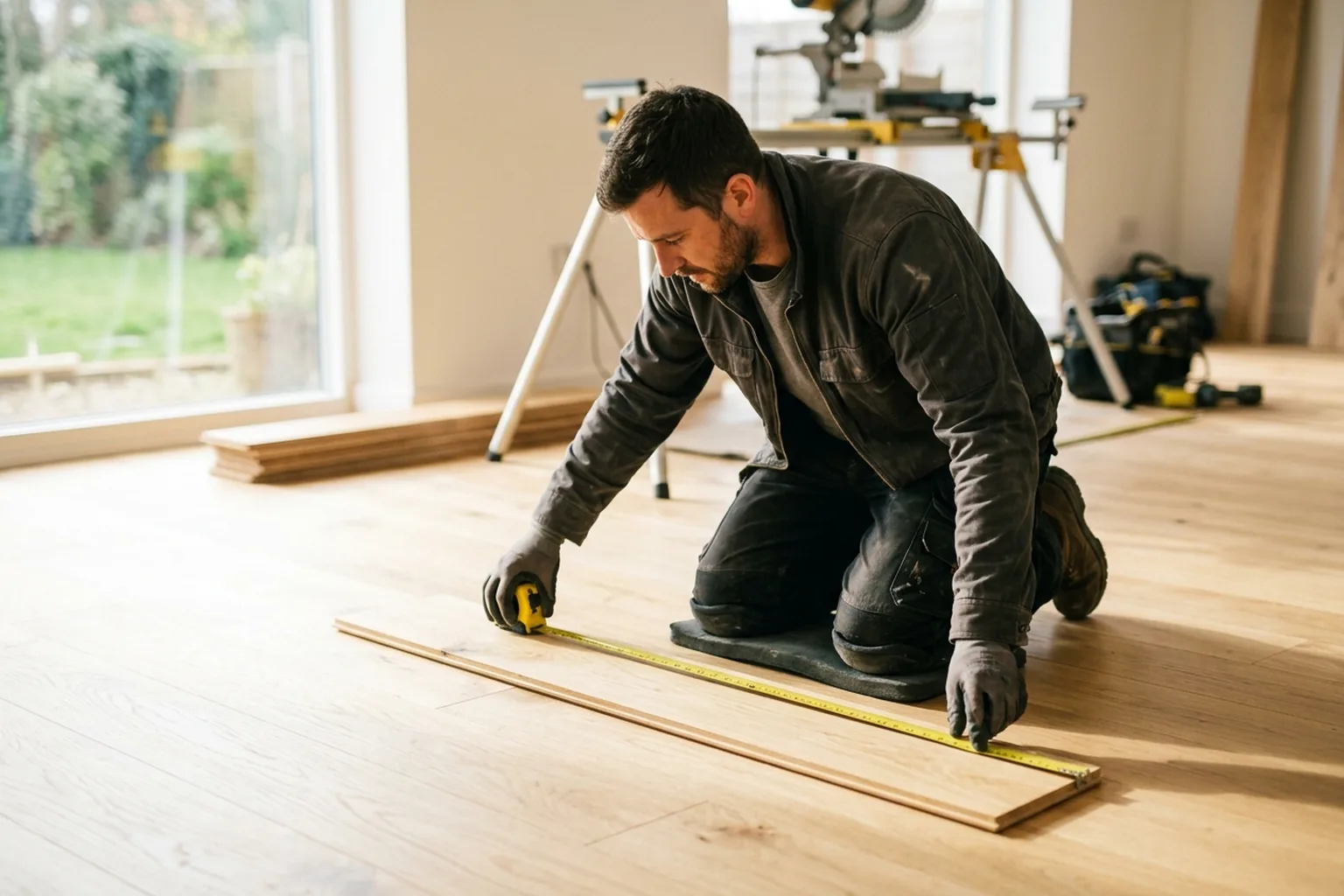
Flooring installers and tile setters measure rooms, calculate square footage, and cut materials to fit. That’s the math ceiling. The BLS reports a median annual wage of $52,000 (May 2024), typically no formal educational credential required, and 6 percent projected employment growth from 2024 to 2034 — faster than the average for all occupations. You learn on the job, starting as a helper.
Painting
Professional painters estimate surface area to quote jobs and calculate paint coverage — gallon covers ~350 square feet, wall is X by Y, done. The median wage is $48,660 (May 2024), with no formal educational credential typically required. Painting also ranks among the most accessible trades for career changers starting later in life.
Roofing
Roofers work in “squares” (100 square feet), and the estimating math is learned in weeks on the job. Median wage: $50,970 (May 2024), no formal educational credential, 6 percent projected growth through 2034. The trade-off here isn’t math — it’s physical: roofing is hard on the body, so if that’s a concern, see our guide to trades without heavy physical labor.
Cosmetology and Barbering
Cosmetology is a licensed trade with essentially no job-site math beyond mixing ratios for color (which are printed on the product) and basic bookkeeping if you rent a booth. Training is measured in state-mandated program hours, not math prerequisites. The BLS reports a median hourly wage of $16.95 (May 2024) with 5 percent projected growth and roughly 84,200 openings per year through 2034 — earnings climb well above the median for stylists who build a clientele or move into booth rental.
CDL Truck Driving
Commercial driving involves hours-of-service logs, weight limits, and fuel planning — all handled by apps and simple arithmetic. No algebra appears anywhere in CDL training or testing. It’s also one of the fastest trades to enter, with training programs measured in weeks.
Massage Therapy
Massage therapy is anatomy-heavy, not math-heavy: licensure exams test body systems and technique, and the only recurring numbers are appointment scheduling and session pricing. If memorizing muscle groups sounds better than solving equations, this licensed trade rewards exactly that kind of learner.
Tier 2: Moderate, Learnable-on-the-Job Math
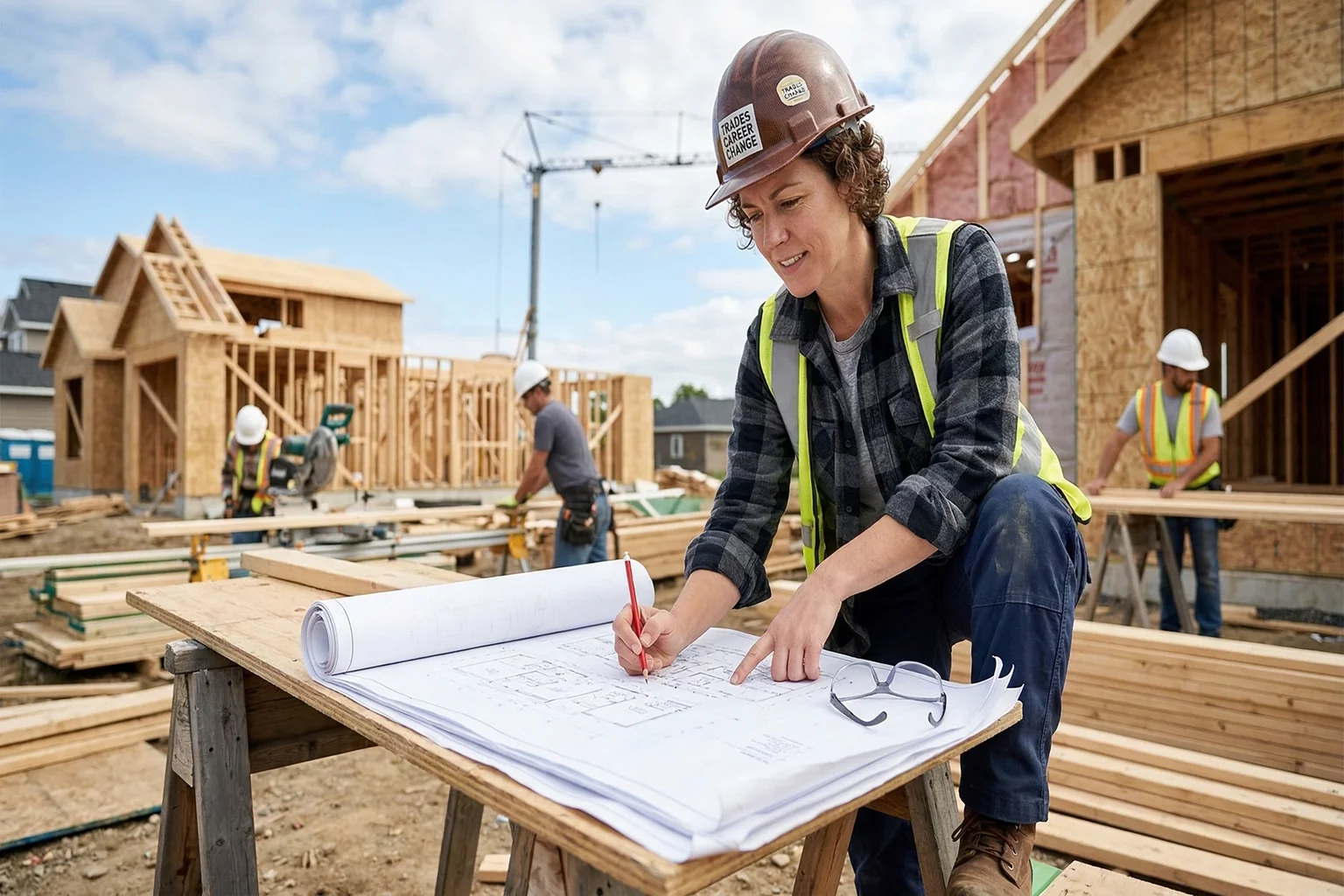
Carpentry sits a step up: reading plans, calculating rafter angles and stair rises. It’s still concrete, visual math — and carpenters earn a $59,310 median (May 2024). Most of it is taught with framing squares and speed squares that do the trigonometry for you.
Welding requires reading blueprints and measuring joint angles, but the math is geometric and visual rather than algebraic. See our welding programs directory for training options.
Landscaping and grounds work involves area calculations for sod, mulch, and irrigation coverage — recipe-level math.
The Honest Tier: Trades That Genuinely Use Algebra
This is the section most “no-math trades” articles skip, and skipping it sets people up to wash out of programs they weren’t warned about.
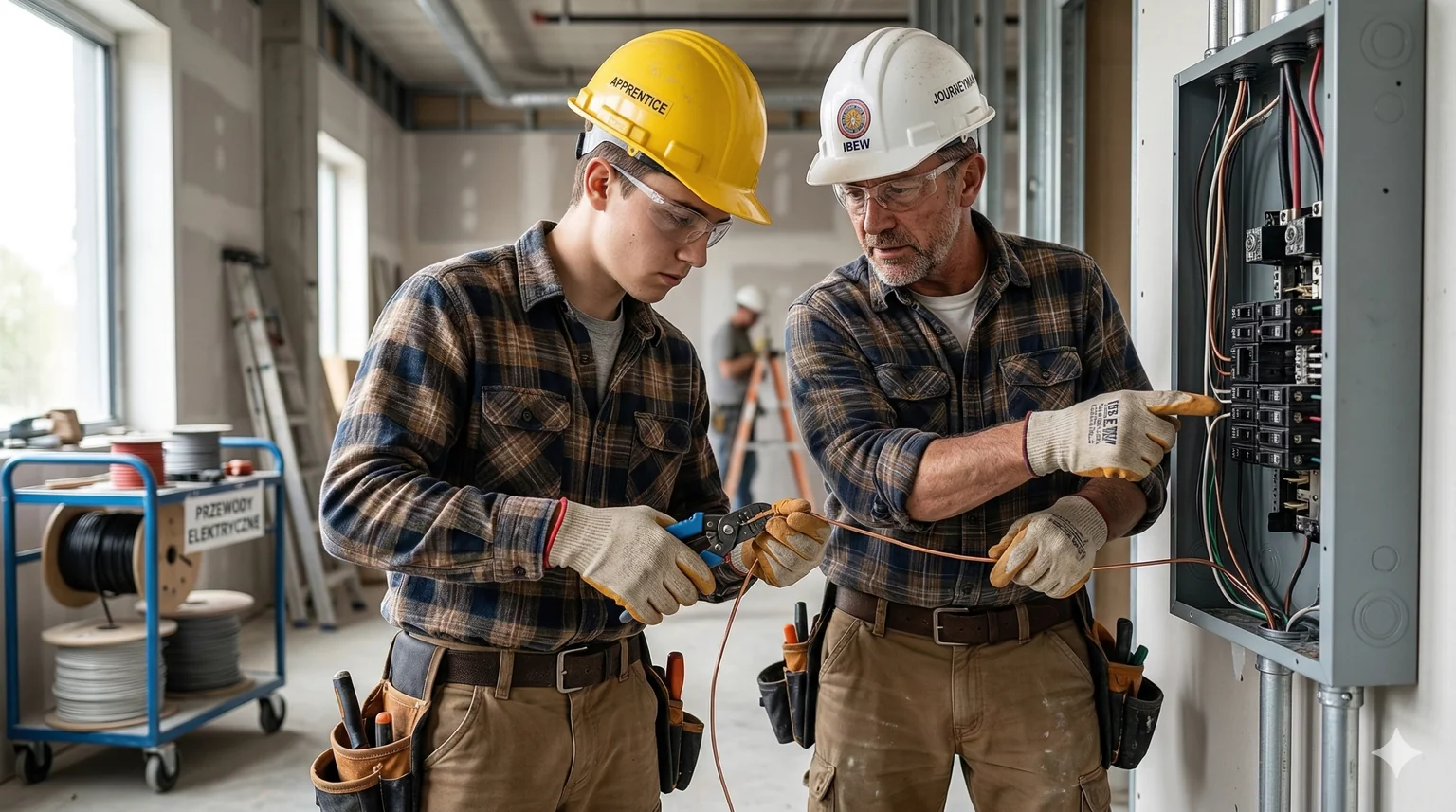
Electricians use real math: Ohm’s law is literal algebra (solve for amps given watts and volts), and load calculations for panel sizing are daily work. Union electrical apprenticeships typically require one full year of high school algebra with a passing grade just to sit the entrance exam — our IBEW apprenticeship guide details the requirement. Electricians also earn accordingly — a $62,350 median (May 2024) with 9 percent projected growth. If the wage draws you but the math scares you, don’t self-reject: see the bridge section below, and our electrician programs directory.
Plumbers calculate pipe slope, flow rates, and volumes — applied geometry, per the BLS occupational profile.
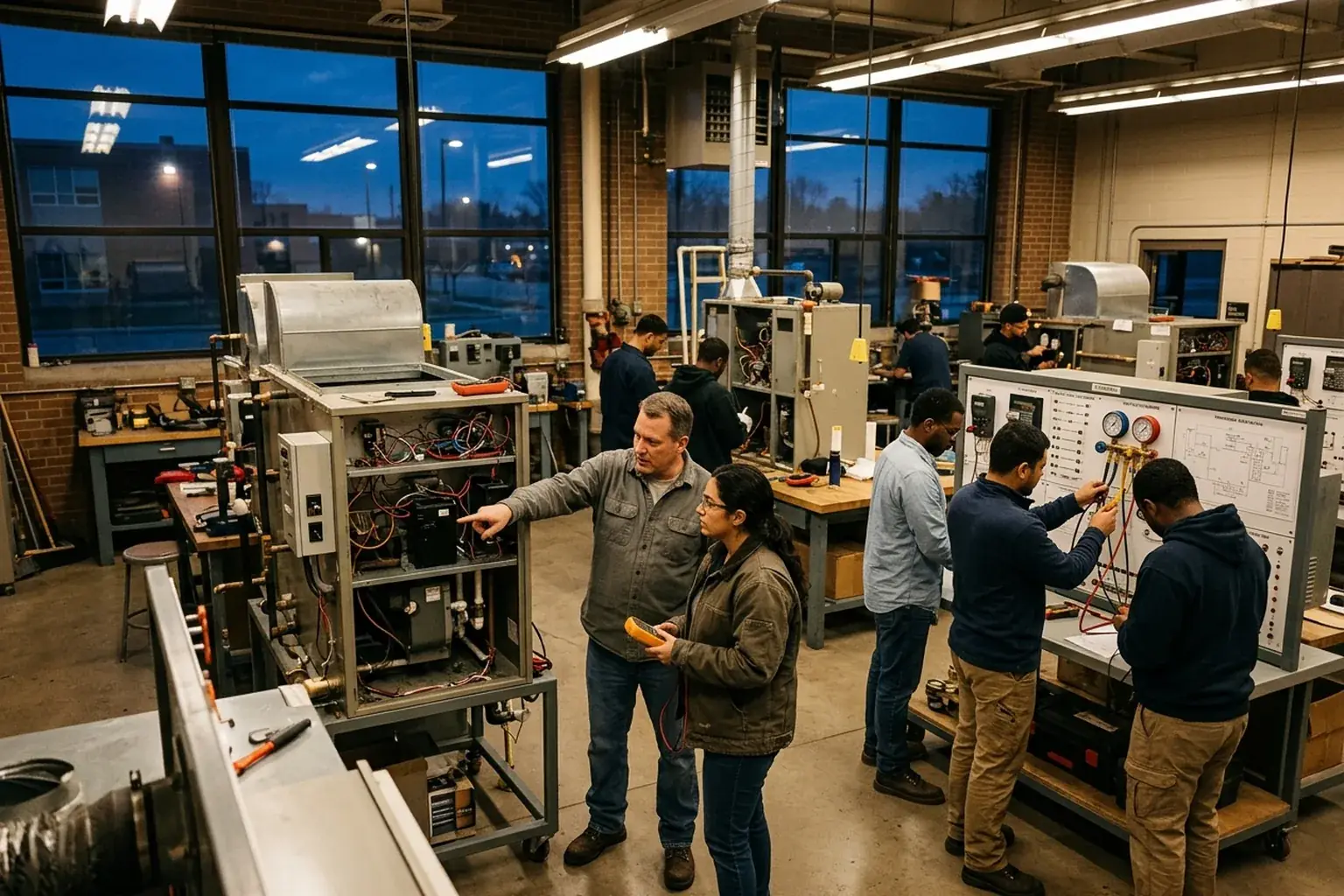
HVAC technicians perform heating and cooling load calculations and refrigerant pressure-temperature work. Manageable, but it’s genuine technical math taught throughout HVAC programs.
The Bridge: How Trade Programs Teach Math Differently
Here’s the part that changes the calculus for a lot of readers: even the “real math” trades teach their math in context. You don’t learn Ohm’s law from a textbook chapter; you learn it wiring an actual circuit and watching the numbers mean something. Community college trade programs and apprenticeship classroom hours build the math in gradually, applied to materials in front of you.
Union apprenticeships (like the IBEW electrical apprenticeship) screen applicants with an aptitude test that includes algebra — and there’s a whole ecosystem of prep resources for exactly that hurdle. Our apprenticeship aptitude test prep guide covers what’s on the test and how people who haven’t touched algebra in 20 years get back up to speed in 6–8 weeks.
Math anxiety from a bad high school experience is not the same thing as math inability. Thousands of tradespeople who hated math class use trade math every day without noticing, because it stopped being abstract.
How to Choose
- Start with interest, not avoidance. Pick the trade you actually want, then check its math tier — don’t pick a trade solely because it’s low-math.
- Take our Find Your Trade quiz to shortlist trades matching how you like to work.
- If your trade is Tier 1 or 2: apply directly to programs or helper jobs. The math will take care of itself.
- If it’s the honest tier: spend 6–8 weeks with an aptitude prep course before the apprenticeship exam. That small investment unlocks the highest-paying tier of the trades.
- Compare programs using our guide to choosing the right trade program and rankings of the best trade colleges.
The trades reward people who show up, learn steadily, and take pride in physical work. A shaky history with algebra disqualifies you from almost none of that.
Sources
- U.S. Bureau of Labor Statistics — Occupational Outlook Handbook — “Flooring Installers and Tile and Stone Setters” — accessed July 2026 — https://www.bls.gov/ooh/construction-and-extraction/tile-and-marble-setters.htm
- U.S. Bureau of Labor Statistics — Occupational Outlook Handbook — “Roofers” — accessed July 2026 — https://www.bls.gov/ooh/construction-and-extraction/roofers.htm
- U.S. Bureau of Labor Statistics — Occupational Outlook Handbook — “Painters, Construction and Maintenance” — accessed July 2026 — https://www.bls.gov/ooh/construction-and-extraction/painters-construction-and-maintenance.htm
- U.S. Bureau of Labor Statistics — Occupational Outlook Handbook — “Barbers, Hairstylists, and Cosmetologists” — accessed July 2026 — https://www.bls.gov/ooh/personal-care-and-service/barbers-hairstylists-and-cosmetologists.htm
- U.S. Bureau of Labor Statistics — Occupational Outlook Handbook — “Plumbers, Pipefitters, and Steamfitters” — accessed July 2026 — https://www.bls.gov/ooh/construction-and-extraction/plumbers-pipefitters-and-steamfitters.htm
- NSW Department of Education — “What maths skills do you need to become a tradie?” — accessed July 2026 — https://education.nsw.gov.au/teaching-and-learning/curriculum/mathematics/everyday-maths/careers/what-maths-skills-do-you-need-to-become-a-tradie