
The most common reason working adults give for not switching into the trades isn’t money or interest — it’s the assumption that training means quitting. Twelve to eighteen months without a paycheck is a fantasy for anyone with rent and a family, so the whole idea gets shelved.
But the assumption is wrong, and the numbers prove people figure this out at scale: roughly two-thirds of community college students attend part-time, per AACC analysis of federal enrollment data, and NCES has long reported that about three-quarters of undergraduates have at least one “nontraditional” characteristic — working full-time while enrolled chief among them. The training infrastructure for employed adults already exists. You just have to pick the right door.
There are three doors: evening/weekend trade school, registered apprenticeship, and hybrid programs. This guide compares all three honestly — including the weekly hour cost nobody puts in the brochure.
TL;DR: Key Takeaways
- You don’t need to quit. About two-thirds of community college students already attend part-time; evening/weekend trade programs are built for employed adults.
- Evening/weekend trade school: typically 6–12 months compressed, 2–4 evenings or Saturdays per week, in trades like HVAC, electrical, plumbing, and welding.
- Registered apprenticeship is the strongest play: the job is the training. GAO reports completers earned average first-year wages of about $80,000, and you’re paid from day one.
- Budget 12–20 hours per week on top of your job for school-based paths. It’s a hard 6–12 months, not a hard 4 years.
- Employer tuition benefits and Workforce Pell can cover much of the cost — check before you pay anything out of pocket.
Path 1: Evening and Weekend Trade School
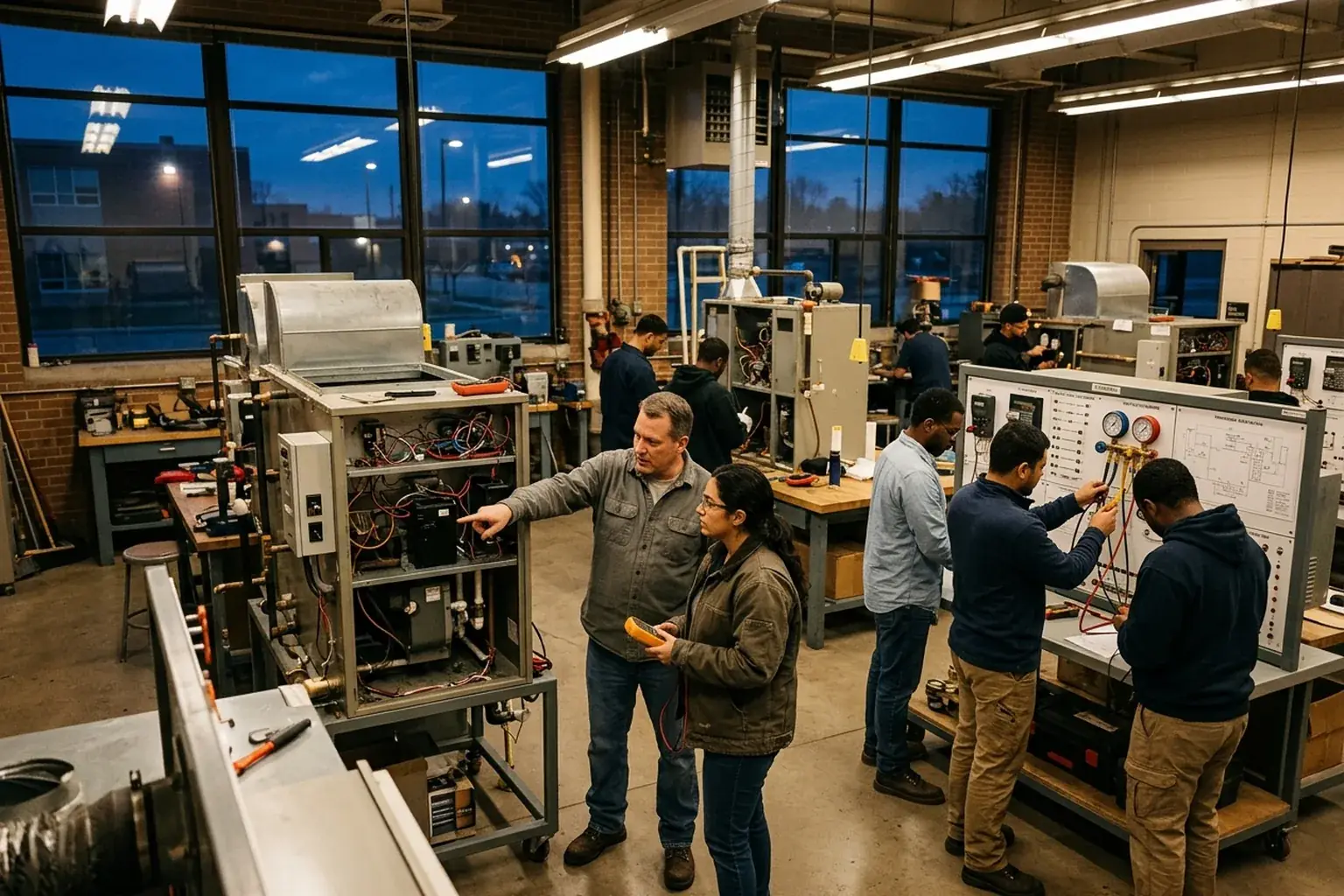
Community colleges and technical schools run parallel evening tracks in the high-demand trades precisely because employed adults are their core market. County vocational-technical schools like Ocean County VTS in New Jersey run adult evening classes across electrical, HVAC-R, plumbing, maintenance, and heavy equipment; Atlanta Technical College publishes a dedicated evening/weekend program catalog. Your local equivalents almost certainly exist — search your community college’s continuing-education page before assuming otherwise.
What the schedule actually looks like: a typical evening certificate meets 2–4 sessions per week, 3–4 hours each, for 6–12 months. Weekend-intensive formats compress hands-on lab time into Saturdays. Accelerated private programs (like National Technical Institute’s HVAC/plumbing/electrical tracks) run shorter but more intense.
Which trades fit this path best: HVAC, electrical fundamentals, plumbing, welding, and medical/dental support trades — anything where a certificate plus entry-level hire is the norm. For trades where the credential alone gets you working fast, cross-reference our shortest-training trades guide.
The honest cost: tuition ($3,000–$16,000 depending on trade and school) plus 12–20 hours weekly of class and study on top of your job. That’s the price of keeping your paycheck.
Path 2: Registered Apprenticeship — The Job Is the Training
This is the path most working adults overlook, and it’s often the best one: in a registered apprenticeship, you don’t train around a job — you switch jobs, and the new job trains you. Over 667,000 people are active apprentices in the U.S. right now.
The structure: full-time paid work under a journeyworker, wages that step up on a published schedule (typically starting at 40–50 percent of journeyworker rate), plus a few hours of classroom instruction per week — usually evenings, funded by the program. You earn a Department of Labor credential at completion.
The payoff is documented, not promised: a 2025 GAO report found registered apprenticeship completers earned average annual wages of about $80,000 in their first year after exiting — and the DOL reports roughly 90 percent of completers retain employment.
The trade-off: you leave your current job, so this only works if apprentice starting pay covers your floor. For a $38,000-a-year retail or warehouse worker, first-year electrical apprentice pay is often comparable — you switch paychecks, not sacrifice one. For a $75,000 office worker, the early years are a real cut, and the evening-school path may fit better. Our apprenticeships explained guide covers how to apply, and the IBEW guide walks through the most-searched program specifically. Competitive programs may take months from application to start — apply while you keep working.
Path 3: Hybrid and Online-Theory Programs
Several trades split cleanly into theory (learnable online, at your pace, after the kids are asleep) and hands-on skills (labs and field work). Hybrid programs exploit that split: online coursework plus scheduled weekend labs.
Where hybrid works well: HVAC theory and EPA 608 prep, electrical code coursework, medical billing and coding (fully remote-friendly — see our EPA 608 certification guide for the HVAC certification specifics).
Where it doesn’t: welding, cosmetology, and anything where the skill is the hand skill. No online course teaches a bead; state licensing boards mandate in-person hours for a reason. Treat “100% online welding certificate” as the red flag it is — our guide to evaluating a trade school covers vetting programs.
Building a Schedule That Survives Contact With Real Life
The failure mode for working students isn’t intelligence — it’s a schedule that assumed a perfect week, then met a sick kid and a mandatory overtime shift. Plan for the realistic week:
- Class time: 8–12 hours (evening program)
- Study/practice: 4–8 hours
- Buffer: schedule study blocks you can drop without failing, so bad weeks bend instead of break
- Duration reality: this pace is sustainable for 6–12 months. It is miserable for 4 years — which is why the evening path suits certificate trades, while multi-year licensed trades favor apprenticeship (where the 40 hours are paid).
Tell your employer if the relationship allows it. Some adjust shifts for students; many mid-size companies offer tuition assistance that goes unclaimed — HR paperwork worth an awkward conversation.
Paying for It Without Draining Savings
- Employer tuition benefits — ask HR first, before enrolling
- Workforce Pell Grants now cover qualifying short-term programs — our Workforce Pell guide explains eligibility
- WIOA funding through your state workforce office can cover certificate programs for career changers
- Apprenticeship: costs nothing; it pays you
The full menu, including payment plans and what debt is worth taking, lives in our financing trade school guide.
Which Path for Which Person
| Your situation | Best path |
|---|---|
| Earning near apprentice starting pay, want the licensed trades | Apprenticeship — switch paychecks, get paid to train |
| Earning well above apprentice pay, need to keep it | Evening/weekend certificate, then transition |
| Self-disciplined, targeting HVAC/electrical/billing | Hybrid — online theory + weekend labs |
| Under 1 year of runway, need fastest credential | Evening certificate in a short-training trade |
If you’re mid-career and weighing whether the switch itself makes sense, our guides for career changers in their 30s and 40s cover that decision. This guide’s job was narrower: to kill the myth that training requires quitting. It doesn’t. Two-thirds of your future classmates already know that.
Sources
- U.S. Government Accountability Office — “Apprenticeship: Earn-and-Learn Opportunities Can Benefit Workers and Employers” (GAO-25-107040) — 2025 — https://www.gao.gov/products/gao-25-107040
- U.S. Department of Labor — Apprenticeship.gov — “Data and Statistics” — accessed July 2026 — https://www.apprenticeship.gov/data-and-statistics
- U.S. Department of Labor Blog — “Registered Apprenticeship: Earn While You Learn” — November 14, 2023 — https://blog.dol.gov/2023/11/14/registered-apprenticeship-earn-while-you-learn
- Community College Daily (AACC) — “DataPoints: Part-time students in community colleges (Part 1)” — December 2024 — https://www.ccdaily.com/2024/12/datapoints-part-time-students-in-community-colleges-part-1/
- National Center for Education Statistics — “Nontraditional Undergraduates: Highlights” — https://nces.ed.gov/pubs/web/97578a.asp
- Ocean County Vocational Technical School — “Adult Evening Classes” — accessed July 2026 — https://www.ocvts.org/adultevening
- Atlanta Technical College — “Evening & Weekend Programs” — accessed July 2026 — https://www.atlantatech.edu/programs/evening-weekend-programs/