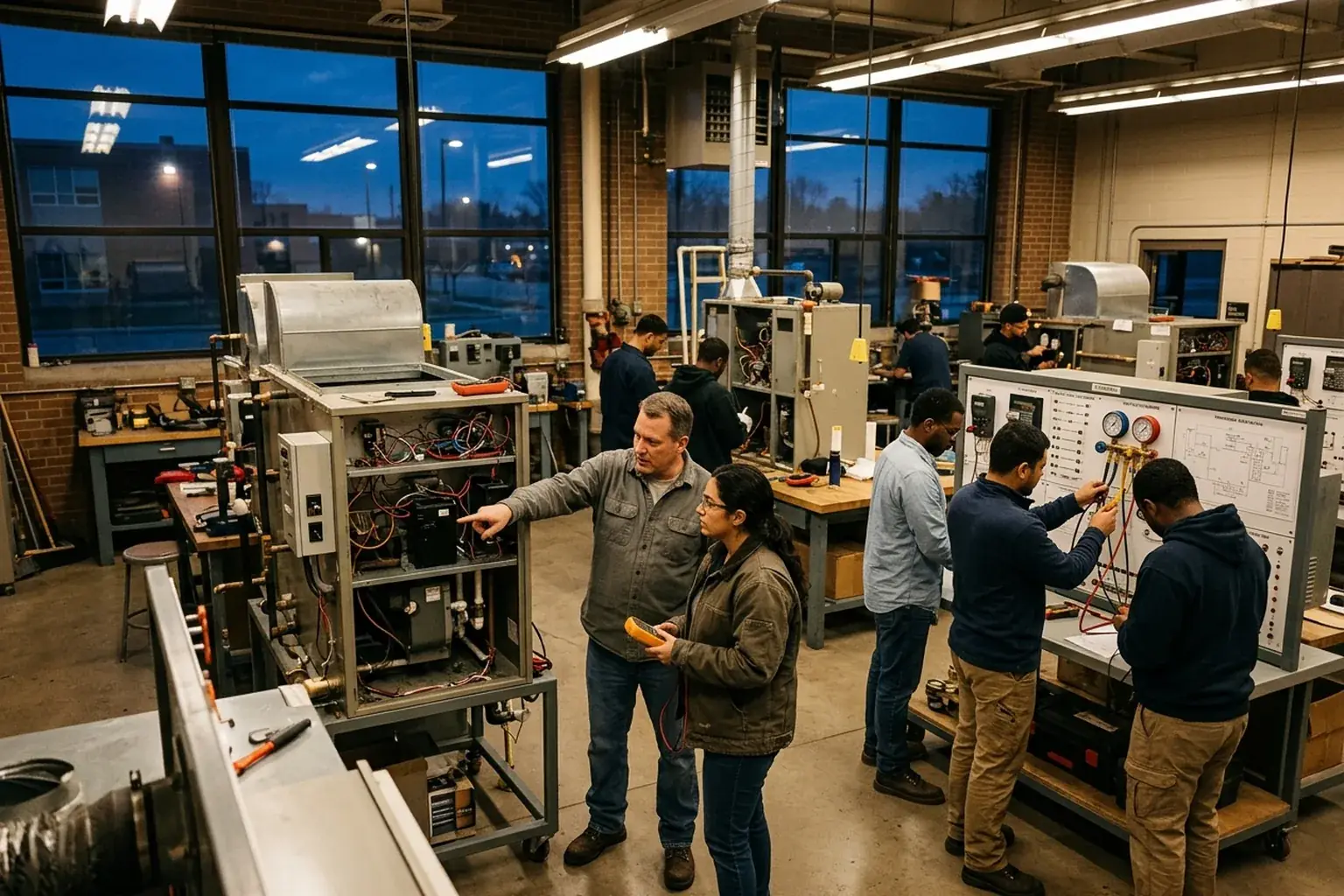

Here is the question, stated the way people actually type it into Google at 1 a.m.: my grades were bad — can I still get into trade school?
The marketing answer is a warm “absolutely, we look at the whole person!” That answer is useless, because it is what every school says regardless of whether it’s true. So we went to the federal data instead. Every institution in the country reports its admissions requirements to the U.S. Department of Education through IPEDS, and those filings are public. We pulled the 2024 records for all 3,199 institutions whose highest award is below a bachelor’s degree — the community colleges, technical colleges, and certificate schools where trade training actually happens — and counted.
The real answer is more useful than the marketing one, and it comes with a catch worth knowing before you sign anything.
TL;DR: Key Takeaways
- 2,875 of 3,199 sub-baccalaureate institutions (89.9%) have an open admission policy. They never see your transcript, because there is nothing to compete for.
- Among the 211 selective ones that report requirements, only 65 (30.8%) require a GPA. Half of them — 109 schools — don’t consider it at all.
- What they require instead is proof you finished: 77.3% require your high school record. They want the diploma, not the grades on it.
- The real screen is a test you take at the school: 54.5% require an aptitude or placement exam like the Wonderlic. At four-year colleges, only 6.5% do.
- The catch: “we don’t check grades” is a genuine feature of good community colleges and the pitch of schools that will happily take your loan money and graduate 30% of you. Open admission is not a quality signal in either direction.
- Grades do still matter in two places: competitive allied-health programs (nursing, dental hygiene) and the algebra clause in electrical apprenticeships.
The Short Answer: Nine Out of Ten Schools Never See Your Transcript
Start with the steelman for the “grades don’t matter” claim, because on the numbers it is mostly correct.
Of the 3,199 U.S. institutions that top out at a two-year degree or a certificate, 2,875 — 89.9% — report an open admission policy to the Department of Education. Federal definition: an admission policy where the school accepts any student who applies. IPEDS is explicit that this still counts as open admission even when a diploma is involved — per the survey methodology, “if the only requirement for admission is a high school diploma or GED/other equivalent, your institution is still considered open admission.”
Break it down by school type and the picture gets sharper:
| Institution type | Open admission | Share |
|---|---|---|
| Less-than-2-year (certificate/trade schools) | 1,570 of 1,659 | 94.6% |
| 2-year (community & technical colleges) | 1,305 of 1,479 | 88.2% |
| All sub-baccalaureate | 2,875 of 3,199 | 89.9% |
| 4-year and above (for contrast) | 651 of 2,825 | 23.0% |
There’s a second-order tell buried in how this data gets collected. NCES only collects the IPEDS Admissions component from “institutions that do not have an open admissions policy.” An open-admission school files nothing about admissions considerations — because there are no considerations. The absence of the paperwork is the answer.
So for roughly nine out of ten trade-adjacent schools, the honest response to “what GPA do I need” is: there isn’t one. Apply, provide a diploma or GED, enroll.
What the Selective Minority Actually Screens
Now the interesting part. Strip away the open-admission schools and you’re left with 219 sub-baccalaureate institutions that do screen applicants; 211 of them filed requirement details for 2024. If grades were the gate, this is where you’d see it.
You don’t.
| Requirement | Required | Not considered at all | Considered if submitted | % Required |
|---|---|---|---|---|
| High school record | 163 | 30 | 18 | 77.3% |
| Aptitude/placement test (Wonderlic, etc.) | 115 | 87 | 9 | 54.5% |
| Letters of recommendation | 77 | 100 | 34 | 36.5% |
| High school GPA | 65 | 109 | 37 | 30.8% |
| Work experience | 5 | 119 | 87 | 2.4% |
| SAT/ACT scores | 4 | 194 | 13 | 1.9% |
Read the top row against the fourth row, because that gap is the whole story. 77.3% require your high school record. Only 30.8% require your GPA. More than half — 109 of 211 — explicitly do not consider your GPA even if you volunteer it.
Those two rows are not contradictory once you understand what a school is asking for. The “record” requirement is a request for documentation that you completed secondary school. It’s a checkbox: diploma or equivalent, yes or no. It is not a request for your grades in it. (If you don’t have that documentation, that’s a different problem with different solutions — see our guide on trade careers without a high school diploma.)
And note what’s at the bottom of the table. SAT and ACT scores are required by four schools out of 211 — under 2% — while 194 of them (91.9%) don’t consider standardized test scores at all. If you spent high school believing a bad test day had closed doors on you, it closed almost none of these.
The Comparison That Explains Everything
Run the identical query against four-year institutions and the inversion is clean:
| Requirement | Trade & 2-year (n=211) | 4-year (n=1,745) |
|---|---|---|
| High school GPA required | 30.8% | 84.8% |
| High school record required | 77.3% | 87.3% |
| Aptitude/placement test required | 54.5% | 6.5% |
Two screening philosophies, and they point in opposite directions.
Four-year colleges screen your past. 84.8% require a GPA — a four-year running average of how you performed between ages 14 and 18, treated as a proxy for how you’ll perform later.
Trade schools screen your present. 54.5% require an aptitude or placement test — a two-hour exam you sit for now, measuring the math and reading you can do today. Only 6.5% of four-year schools bother with one.
This is not charity, and it isn’t a lowered bar. It’s a different bet. A program teaching you to size conductors or read a caliper needs to know whether you can handle algebra and technical reading in the next eighteen months. Your sophomore-year English grade is close to irrelevant to that question, and a placement test answers it directly.
The practical consequence: the thing you should be preparing for is the test, not defending your transcript. These exams are studyable in a way a GPA never was — Wonderlic’s Scholastic Level Exam, for instance, measures general cognitive ability for admission and placement, and the format is consistent enough to practice. Our apprenticeship aptitude test prep guide covers the question types that actually show up.
The Catch: “We Don’t Look at Grades” Is Also a Sales Pitch
Here is where a consumer-advocate hat goes on, because everything above cuts both ways.
Open admission describes two completely different kinds of institution, and the phrase itself doesn’t distinguish them:
- A well-run community or technical college that keeps its doors open on principle, because a 19-year-old’s transcript is a poor predictor of whether they’ll be a good welder — and that then teaches, supports, and graduates them.
- A school with no incentive to screen you because your enrollment is its revenue, whether or not you finish, and whether or not the credential places you anywhere.
Both truthfully advertise “no GPA requirement.” Only one of them is a good use of two years and a loan balance.
So if grades aren’t the filter, you have to be. Replace the screen the school isn’t running with your own, and check the outcomes rather than the admissions page:
- Completion rate. What share of entering students actually finish this program? A school that admits everyone and graduates a third of them has transferred its selectivity onto you — you just find out at the end instead of the beginning.
- Job placement, in the field. Not “employment rate.” Placement in the trade you trained for.
- Accreditation and licensure eligibility. Does finishing this program actually make you eligible to sit for the license your state requires? For several trades the answer is program-specific, and it is the single most expensive thing to get wrong. Our guide to trade certifications and licenses maps which trades gate on this.
- Cost against the local wage. BLS puts the national median at $63,190 for electricians and $61,010 for HVACR technicians (OEWS, May 2025). A program that costs more than a year of that median, for a credential the employers in your metro don’t ask for, is a bad trade regardless of how easy it was to get into.
We wrote a longer version of this screen in how to evaluate a trade school, and the money side in financing trade school. If you take one thing from this article, take this: easy admission is a neutral fact. Treat it as neither a green light nor a red flag, and go look at the completion numbers.
Where Your Grades Genuinely Do Matter
Two real exceptions. Both are narrow, and both are worth knowing before you’re surprised by them.
1. Competitive allied-health programs. The 30.8% figure covers whole institutions. Individual programs inside an open-admission college can be fiercely selective, and health programs usually are — the seat count is capped by clinical placements, not by classroom space.
Central Piedmont Community College publishes its numbers, and they’re representative: Dental Hygiene admits 30 students each fall and requires a TEAS score of at least 75%; the associate degree nursing program requires TEAS Advanced or a total ≥74 with reading ≥80 and math ≥70; Cytotechnology takes six students and two alternates a year and requires an overall GPA ≥2.75 plus a science GPA ≥3.0. The college states plainly that “top applicants are selected based on the highest scores for that admission period; there is no waitlist.”
Note which GPA that is, though. It’s your college GPA in the prerequisite courses — anatomy, physiology, chemistry — not your high school one. That distinction is the most actionable fact in this article, and we’ll come back to it in a second. The payoff is real: dental hygienists earn a national median of $98,100 and LPNs $64,400 (BLS OEWS, May 2025). Start with how to become an LPN or the dental hygiene program guide if that’s the direction.
2. The algebra clause in electrical apprenticeships. Union apprenticeships don’t ask for a GPA, but several ask for one specific grade. IBEW Local 340’s Notice of Apprenticeship Opportunity lists the full slate: be 18 or older, provide a high school diploma or GED, pass the NJATC aptitude test ($25, about 2½ hours), interview, and pass a physical and drug test. No minimum GPA appears anywhere. What does appear is a requirement to show “completion of 1 year of high school algebra or 1 semester of college algebra with a grade of C or better.”
One course. One grade. And if you didn’t clear it in high school, a single community college algebra class fixes it permanently — which is a far cheaper repair than it sounds. More detail in how to get into an IBEW apprenticeship and the electrician program guide.
What to Do If Your Transcript Is Weak
Five steps, cheapest first.
- Finish the credential, if you haven’t. The record requirement (77.3%) is about completion, not performance. A GED opens the same 2,875 open-admission doors a 4.0 diploma does.
- Prepare for the aptitude test, not the transcript. It’s required by more than half of selective trade schools and by essentially every union apprenticeship, and unlike your GPA it is entirely within your control this month. Algebra I and reading comprehension are the whole battlefield.
- Take one prerequisite course and ace it. This is the highest-leverage move on the list. Competitive health programs rank on your college GPA. Enrolling in a single open-admission college course and earning an A starts a new transcript that outranks the old one — and it simultaneously satisfies the algebra clause if you take algebra.
- Document work experience. Only 2.4% of schools require it, but 87 of 211 will consider it if you submit it. If you’ve held a job, especially a hands-on one, put it in the application. It’s low-cost upside.
- Apply early to anything capped. For seat-limited programs, application timing routinely matters more than the marginal GPA point. Central Piedmont’s language is typical: applications submitted after the deadline aren’t considered unless spots remain unfilled.
If you’re not yet sure which trade you’re aiming at, find your trade narrows it in a few minutes, and trade careers with the shortest training is the right starting point if you need income sooner rather than later.
The Verdict
Your high school GPA is not the obstacle you think it is. 89.9% of trade-relevant institutions never look at it. Of the selective 10%, fewer than a third require it and over half discard it outright. The gate is a diploma and, more than half the time, a test you can study for between now and next month.
Worth acting on if: you have a diploma or GED, you’re willing to prepare for a two-hour aptitude exam, and you screen the school yourself on completion and placement rates since it isn’t screening you.
Slow down if: you’re targeting a capped allied-health program — nursing, dental hygiene, cytotechnology — where a points-based ranking on prerequisite college GPA and TEAS scores really does decide who gets a seat. Budget a semester to build that college GPA first. It’s the difference between applying and competing.
And be skeptical if: a school’s main selling point is how easy it is to get in. That’s not an outcome. Ask what share of students finish, and what share are working in the trade a year later. A school that won’t answer those two questions has told you what you needed to know.
Sources
- National Center for Education Statistics — IPEDS Admissions (ADM) Survey Component; data collected only from institutions without an open admissions policy — https://nces.ed.gov/ipeds/survey-components/6
- National Center for Education Statistics — IPEDS Survey Methodology; definition of open admissions and the diploma/GED clarification — https://nces.ed.gov/ipeds/ReportYourData/IpedsSurveyMethodology
- U.S. Department of Education, IPEDS — 2024 Institutional Characteristics and Admissions components; open-admission and ADMCON requirement counts computed by Trade Colleges across 3,199 sub-baccalaureate institutions — https://nces.ed.gov/ipeds/use-the-data
- IBEW/NECA Local 340 JATC — Notice of Apprenticeship Opportunity; minimum qualifications including the one-year algebra “C or better” clause and NJATC aptitude test — https://www.340jatc.org/notice-of-apprenticeship-opportunity
- Central Piedmont Community College — Healthcare Programs Admission Information; cohort caps, TEAS thresholds, and prerequisite GPA minimums for Dental Hygiene, Nursing, Cytotechnology, and PTA — https://www.cpcc.edu/admissions/apply/healthcare-programs/program-information
- Wonderlic — Scholastic Level Exam; cognitive ability assessment used for academic admission and placement — https://wonderlic.com/student-admission-assessment/scholastic-level-exam/
- Bureau of Labor Statistics — Occupational Outlook Handbook: Electricians (median $63,190, OEWS May 2025) — https://www.bls.gov/ooh/construction-and-extraction/electricians.htm
- Bureau of Labor Statistics — Occupational Outlook Handbook: HVAC Mechanics and Installers (median $61,010, OEWS May 2025) — https://www.bls.gov/ooh/installation-maintenance-and-repair/heating-air-conditioning-and-refrigeration-mechanics-and-installers.htm
- Bureau of Labor Statistics — Occupational Outlook Handbook: Dental Hygienists (median $98,100, OEWS May 2025) — https://www.bls.gov/ooh/healthcare/dental-hygienists.htm
- Bureau of Labor Statistics — Occupational Outlook Handbook: Licensed Practical and Licensed Vocational Nurses (median $64,400, OEWS May 2025) — https://www.bls.gov/ooh/healthcare/licensed-practical-and-licensed-vocational-nurses.htm