
Graduates of private nonprofit colleges leave school owing an average of $39,510 in student loans, per Education Data Initiative. Public four-year graduates owe $31,960. Incoming freshmen this year are on track to borrow $43,000 each before they walk the stage, per NerdWallet.
There is a parallel labor market that gets you to comparable — sometimes higher — earnings without borrowing a dollar. Registered apprentices average $80,700 in earnings one year after completion, per the U.S. Department of Labor. In skilled trades like inside-wireman electrical work, journey-level wages in dense metros routinely exceed $100,000. Apprentices are paid from day one — in actual W-2 wages, with health insurance and pension contributions.
This guide is specifically about pathways to a trade career with $0 borrowed. It is not a general “trades vs. college” debate (see our trade school debt comparison) or a list of trade school financial aid options (covered in our financing trade school guide). What follows are the four specific structures that get you trained and earning without debt — the math, the named programs, and an honest read on which paths have the longest queues.
TL;DR: Key Takeaways
- Four real $0-debt paths exist: registered apprenticeships, employer-sponsored programs, military SkillBridge transitions, and state free-tuition programs (TN Promise, Oklahoma’s Promise, others).
- Apprentices start at 40–50% of journey-level wages, with structured raises every 6–12 months. Many top out at $50–$70/hour journeyman plus benefits.
- The 10-year math favors trades by roughly $200,000 when you include foregone wages, tuition saved, and interest avoided on a typical bachelor’s debt load.
- IBEW JATC programs are competitive — some locals see 400+ applicants for 40–50 slots. Plan for 6–24 months on an eligibility list, and have a backup path.
- Military SkillBridge lets active-duty service members do a civilian trade apprenticeship during their final 180 days while still drawing full military pay.
- TN Promise and Oklahoma’s Promise pay full tuition at technical colleges (TCATs in Tennessee, CareerTech centers in Oklahoma) for eligible residents — last-dollar coverage after Pell.
The Math: Bachelor’s vs. Apprenticeship Over 10 Years
The “is trade school worth it?” question is usually framed as a hourly-wage comparison. That misses the bigger number — the opportunity cost of four years out of the labor market plus the compounding cost of debt.
Here is a realistic 10-year comparison, using median figures and conservative trade wage assumptions:
Path A — Bachelor’s degree at a public four-year college
- Years 1–4: $0 earned, $31,960 borrowed on average
- Years 5–10: Six years of work at the bachelor’s-holder median of roughly $80,000/year = $480,000 gross
- Debt service: ~$340/month at standard 10-year repayment (6.5% interest), about $40,800 total paid
- Net 10-year position: $480,000 earned, minus debt service paid, plus whatever is still owed = roughly $439,200 in earned income
Path B — IBEW inside-wireman apprenticeship (representative mid-cost metro)
- Years 1–5 apprentice scale (40% → 80% of journey): ~$45,760 → $91,520, totaling ~$345,000
- Years 6–10 at ~$55/hour journey rate: $572,000
- Tuition borrowed: $0
- Net 10-year position: roughly $917,000 in earned income, with employer-paid health insurance and pension contributions throughout
The gross gap is over $470,000 in this scenario, before benefits, before overtime, and before any tools-and-living costs the degree path would actually incur on top of base tuition. Even adjusting aggressively — assume the degree-holder earns 30% above the bachelor’s median, and the apprentice never earns overtime — the apprenticeship still finishes ahead by six figures. The “no debt” trade story isn’t just about avoiding loans. It’s about getting paid during the four years your degree-pursuing peers are paying to attend.
Path 1: Registered Apprenticeships — The Largest $0-Debt Pipeline
A registered apprenticeship is a paid job that includes formal classroom instruction (usually 144+ hours per year) and on-the-job training. The federal government oversees roughly 600,000 active apprentices nationwide across construction, manufacturing, healthcare, and IT.
Wage structure: Apprentices start at 40–50% of journeyman rate, with scheduled raises every 6 or 12 months tied to completed hours. By the final year, most earn 80–90% of journey scale. Health insurance and pension contributions are typically included from day one or after a 90-day qualifying period.
Real named programs and their pay scales (current as of 2026):
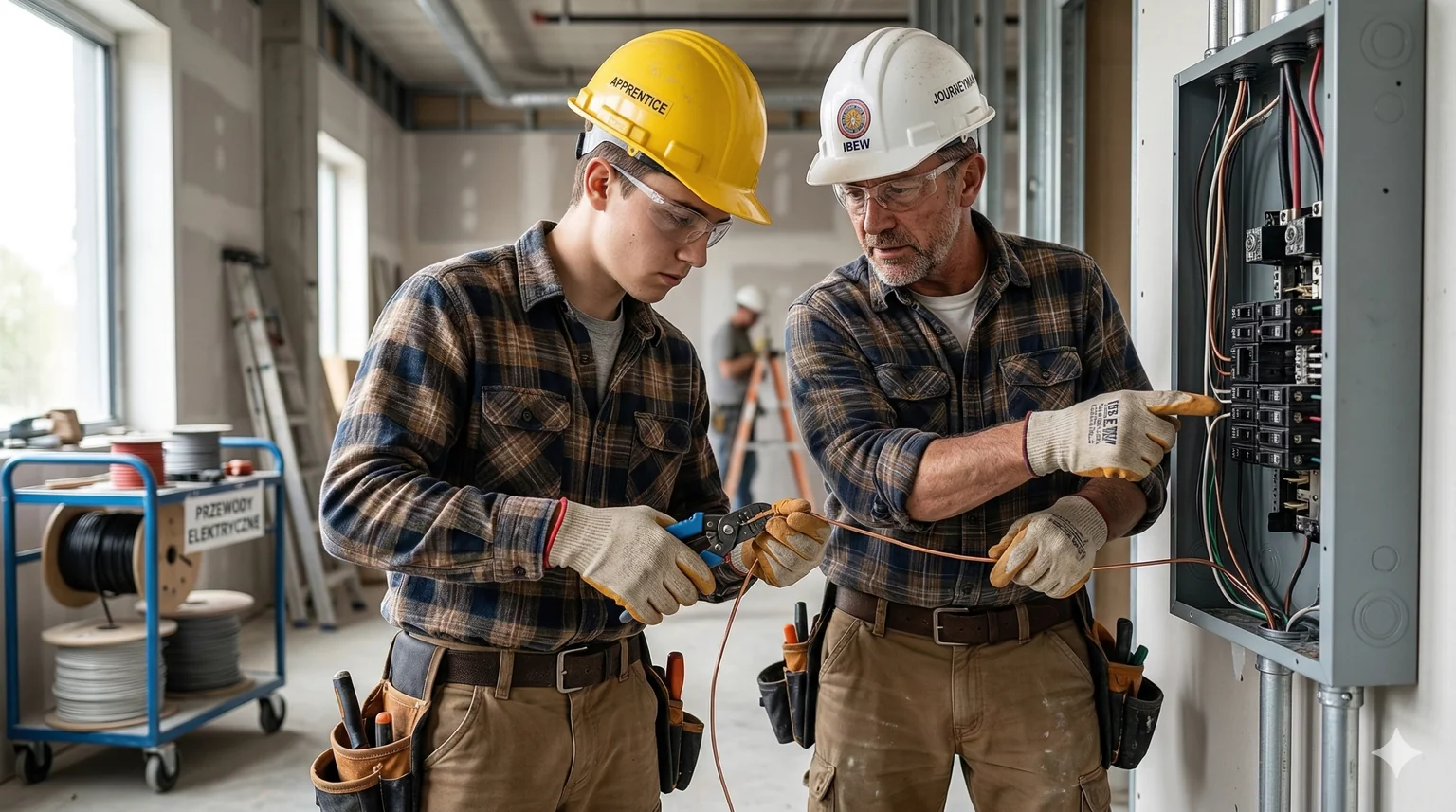
- IBEW (International Brotherhood of Electrical Workers) Local JATCs: Inside-wireman apprentices in major metros start in the $22–$28/hour range. Journey rate ranges from $42/hour in lower-cost markets to $65+/hour in places like NYC, San Francisco, and Boston. See IBEW Local 11 in Los Angeles and Local 197 in Illinois for published scales. Our deep dive on the application process: how to get into an IBEW apprenticeship.
- United Association (UA) Plumbers and Pipefitters: 5-year programs across roughly 300 local training centers. Journey wages run $35–$60/hour depending on local. See UA Local 9 (NJ) for a published 2025–2026 wage package.
- SMART (Sheet Metal Workers): Combination HVAC ductwork and architectural sheet metal. Journey rates typically $40–$55/hour in unionized markets.
- Operating Engineers (IUOE): Heavy-equipment operators — cranes, excavators, paving. High journey rates, often $50+/hour, but unpredictable seasonal hours in colder climates.
The honest caveat: registered apprenticeships in the building trades are competitive. The IBEW JATC in some metros sees 400+ applicants for 40–50 slots per intake, per discussion in industry forums. Most programs maintain a ranked eligibility list good for 2 years; you can wait 6–24 months between making the list and being called. Programs in slower markets fill more quickly, but the rule of thumb is: apply to multiple locals, prep seriously for the aptitude test (see our apprenticeship aptitude test prep guide), and have a non-union backup such as an open-shop ABC apprenticeship or a community-college pre-apprenticeship while you wait.
For a broader explainer on how apprenticeships work, see our apprenticeships explained post.
Path 2: Employer-Sponsored Training Programs
Several large employers have built their own debt-free training pipelines. Not all are technically “apprenticeships,” but they share the structure: hired first, trained second, no tuition charged.
- Utility lineman programs (Duke Energy, Southern Company, PG&E, ConEd): hire ground-hand apprentices off the street, pay $25–$30/hour during training, progress to journey lineman at $45–$60/hour. Storm and on-call multipliers push annual totals into six figures.
- Toyota T-TEN, Honda PACT, BMW STEP, Subaru-U: dealer-sponsored auto-tech programs that pay tuition at participating community colleges, provide tools, and place graduates in dealer service bays. $0 out of pocket if you meet GPA and attendance terms.
- CSX, Norfolk Southern, BNSF Railway: conductor and signal-maintainer trainees typically earn $55,000–$80,000 in their first 2–3 years.
- Power-plant operator trainee programs at major nuclear and combined-cycle generators (Constellation, Vistra, Duke): paid training, NERC certification covered, journey wages $90,000–$130,000.
These programs hire fewer people than the union halls but don’t run an eligibility-list bottleneck — pass the assessments and physical, and you start.
Path 3: Military-to-Civilian via SkillBridge
If you are within 180 days of separating from active duty, the DoD SkillBridge program lets you do a full-time civilian internship, apprenticeship, or training program with a participating employer while still drawing your full military pay and benefits.
Trade-relevant SkillBridge partners include the IBEW Code of Excellence Veterans-in-Construction track, Helmets to Hardhats (which places vets into union construction apprenticeships across 14 building trades), and dozens of welding, HVAC, and CDL programs registered as SkillBridge providers.
Veterans who complete a registered apprenticeship after separation can also use GI Bill apprenticeship benefits to draw a monthly housing allowance on top of their apprentice wage during their entire 4–5 year apprenticeship. This stacks. A Boston-area IBEW apprentice in year 2 making $60K from the local can collect another $20K+ tax-free from the VA simultaneously.
Path 4: State Free-Tuition Programs at Technical Colleges
For high-school students and many adult learners, several states fully cover tuition at technical colleges — the kind of programs that lead to industry certifications (welding, electrical, HVAC, dental hygiene, surgical tech) in 12–24 months.
- Tennessee Promise (tnachieves.org) is a last-dollar scholarship covering tuition and mandatory fees at the state’s 13 community colleges or 27 Tennessee Colleges of Applied Technology (TCATs) for graduating high school seniors. It has funded over 150,000 students since 2014. Adults 24+ can use the parallel Tennessee Reconnect for the same coverage.
- Oklahoma’s Promise (okpromise.org) covers full tuition at Oklahoma public two-year colleges and CareerTech centers for students whose families earn $60,000 or less. Applicants enroll during 8th–10th grade.
- Other states: Indiana’s Workforce Ready Grant, Arkansas Future, Kentucky’s Work Ready Scholarship, and Michigan Reconnect all cover tuition at in-state community/technical colleges for high-demand programs.
These programs cover tuition and mandatory fees — not living costs, books, or tools. A welding cert from a TCAT under TN Promise can put you in the labor market in 12 months at $20–$25/hour with $0 in tuition debt, but you still need to cover rent during training. WIOA funds at your local American Job Center, plus part-time work, are how most students close that gap.
Comparison Table: $0-Debt Paths to a Journey Wage
The table below summarizes the four pathways. “Time to first paycheck” means the time from program acceptance to the first W-2 paycheck or stipend. “Median journeyman pay” uses 2024 BLS Occupational Employment data unless noted.
| Trade | Training path | Time to first paycheck | Median journeyman pay |
|---|---|---|---|
| Electrician (inside wireman) | IBEW JATC apprenticeship | 0 days (paid from day 1) | $62,350/yr; $100K+ in major metros |
| Plumber / pipefitter | UA local apprenticeship | 0 days (paid from day 1) | $63,420/yr; $90K+ unionized |
| HVAC technician | Employer-sponsored (Trane Tech, Carrier, local contractors) | 0–30 days | $59,810/yr |
| Sheet metal worker | SMART local apprenticeship | 0 days (paid from day 1) | $58,780/yr per BLS; $80K+ unionized |
| Lineman (utility) | Duke / PG&E / ConEd in-house programs | 0 days (paid from day 1) | $93,000/yr per BLS for power-line installers |
| Automotive technician | Toyota T-TEN, Honda PACT (tuition paid by mfr) | 30–60 days | $48,640/yr per BLS; $70K+ at dealer master tech |
| Welder | Tennessee TCAT under TN Promise | 12 months (first job post-cert) | $50,510/yr per BLS; $70K+ with travel/rig |
| Railroad conductor | CSX / BNSF / Norfolk Southern trainee | 0–60 days | $65,860/yr per BLS |
| Construction equipment operator | IUOE local apprenticeship | 0 days (paid from day 1) | $59,640/yr per BLS; $80K+ unionized |
| Any building trade (veteran) | SkillBridge + GI Bill on-the-job training | 0 days (military pay continues) | Same as civilian counterparts, plus VA MHA |
BLS medians understate union-market wages — they blend non-union and low-cost-of-living regions. In major metros with strong union density (Chicago, Boston, NYC, Bay Area, Seattle, Minneapolis), inside-wireman journey rates are commonly $50–$70/hour with total package compensation over $150,000. The trade-off: those same markets have the longest apprenticeship waiting lists.
The Practical Sequence: How to Land One of These Slots
1. Pick your trade, then your path. Decide what you want to do — electrical, plumbing, HVAC, lineman, welding — before choosing union, employer-sponsored, or technical college. Trade drives path.
2. Apply to multiple programs in parallel. If you want electrical, apply to your local IBEW JATC, two open-shop ABC contractors, and a non-union industrial-electric employer. Take the first solid offer.
3. Prep for the aptitude test. The IBEW uses the NJATC aptitude battery; UA uses a similar test. A focused two-week review of high-school algebra and ratio problems materially improves your rank-list position.
4. Stack a CDL or OSHA-10 first. Sheet metal, ironwork, operators, and lineman programs give preference points for candidates who arrive with a CDL or OSHA-10/30. Both cost under $1,500 and are typically WIOA-fundable.
5. Veterans: run SkillBridge before terminal leave. Full military pay while interning at a civilian employer that often hires you on the back end is the single highest-leverage move in a military-to-trade transition.
6. High schoolers in TN, OK, IN, AR, KY, MI: file your state-promise application and a FAFSA. State programs are last-dollar; Pell pays first, then the state covers the rest — usually reaching 100% of tuition at the technical college tier.
Honest Caveats
This is not a “trades are always better than college” article. It is a “here is how to enter a trade with $0 debt” article. A few things deserve to be said directly.
Apprenticeship pay in years 1–2 is real but not extravagant. First-year apprentices earn $22–$28/hour in most building trades. In a high-cost metro that won’t support independent living without roommates, a partner’s income, or savings.
Some trades have brutal physical demands. A 25-year-old taking a roofing or ironworker apprenticeship should think about what their knees and back look like at 45. The trades with the best long-term physical sustainability (electrical service, HVAC controls, inspection) are also the most oversubscribed.
Waiting lists are real. Your local IBEW JATC might call you in 6 months or 30. Plan to work as a construction laborer, in a warehouse, or in a pre-apprentice program while on the list.
Free-tuition state programs cover tuition only — not housing, food, transportation, or tools. WIOA dislocated-worker funds, Pell, and part-time work usually close that gap, but it has to be closed.
For a head-to-head financial comparison between four-year college and trade school, our trade school debt comparison goes deeper on the lifetime ROI math.
Tools on This Site That Can Help
Compare Schools — Side-by-side comparison of trade colleges on tuition, financial aid, and outcomes. Useful for evaluating technical colleges in states with free-tuition programs.
Programs Directory — Browse accredited programs by specialty (electrical, HVAC, welding, plumbing, lineman) and filter by state to find programs covered by your state’s tuition guarantee.
Rankings — Best Value — Identifies schools delivering the strongest outcomes per dollar of tuition, with weighting toward low-cost public technical colleges.
Sources
- U.S. Department of Labor — Earn While You Learn — Registered Apprenticeship Fact Sheet — 2024
- U.S. Department of Labor — Apprentices by State Dashboard — Apprenticeship.gov, 2026
- Department of Defense — DoD SkillBridge Program Overview — Military OneSource, 2026
- Tennessee Higher Education Commission — TN Promise Marks a Decade of Success — 150,000+ Students Enrolled — 2024
- Oklahoma State Regents for Higher Education — Oklahoma’s Promise Program Benefits — 2026
- Bureau of Labor Statistics — Electricians: Occupational Outlook Handbook — May 2024 data
- Bureau of Labor Statistics — Plumbers, Pipefitters, and Steamfitters: Occupational Outlook Handbook — May 2024 data
- Bureau of Labor Statistics — HVAC Mechanics and Installers: Occupational Outlook Handbook — May 2024 data
- Education Data Initiative — Average Student Loan Debt for a Bachelor’s Degree — 2025 update
- IBEW Local 11 — Contracts and Wage Rates — 2026
- UA Local 9 — 2025-2026 Commercial Division Economic Package
- Helmets to Hardhats — Veterans Into Union Building Trades Apprenticeships
- VA Education — GI Bill Apprenticeship and On-the-Job Training Benefits