Walk onto any electrical job site and you’ll notice something right away: every experienced electrician has a tool belt that’s clearly been broken in over years of work. The tools are worn but well-maintained, organized in a way that makes sense to that specific person, and chosen through a mix of apprenticeship requirements and personal preference built up over hundreds of jobs.
If you’re just starting out — whether you’re entering a trade school program, applying to an apprenticeship, or making a career change into the electrical trades — you don’t need all of that on day one. But you do need to show up with the right basics. Showing up without the right tools is one of the fastest ways to get off on the wrong foot with a foreman or instructor.
This guide breaks down exactly what you need at each stage of your electrical career, what to look for when you’re buying, how much to budget, and how to keep your gear in good shape so it lasts.
Day-One Essentials
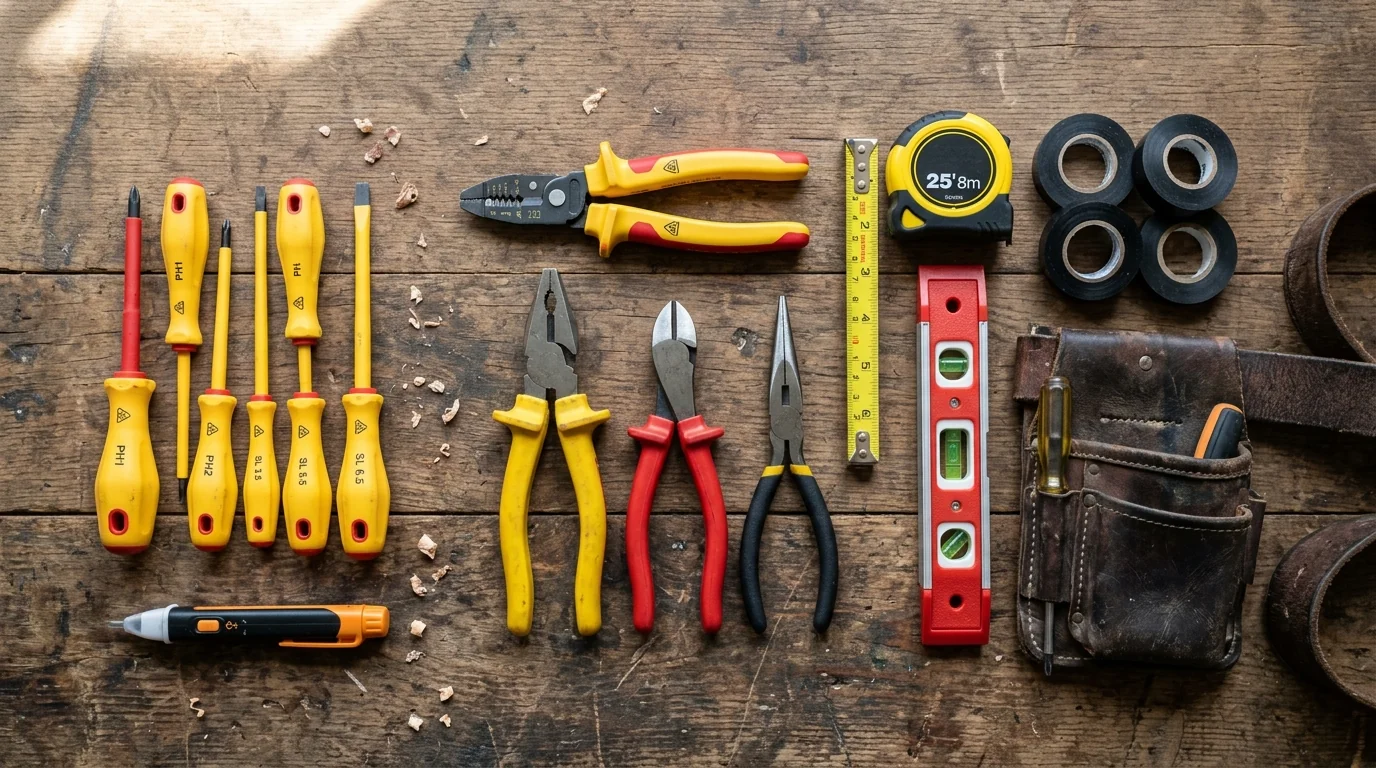
These are the tools you’ll need from your first day in an apprenticeship or trade school electrical program. Your program may have a required tool list — always follow that first — but the items below appear on nearly every apprentice list.
Wire Strippers
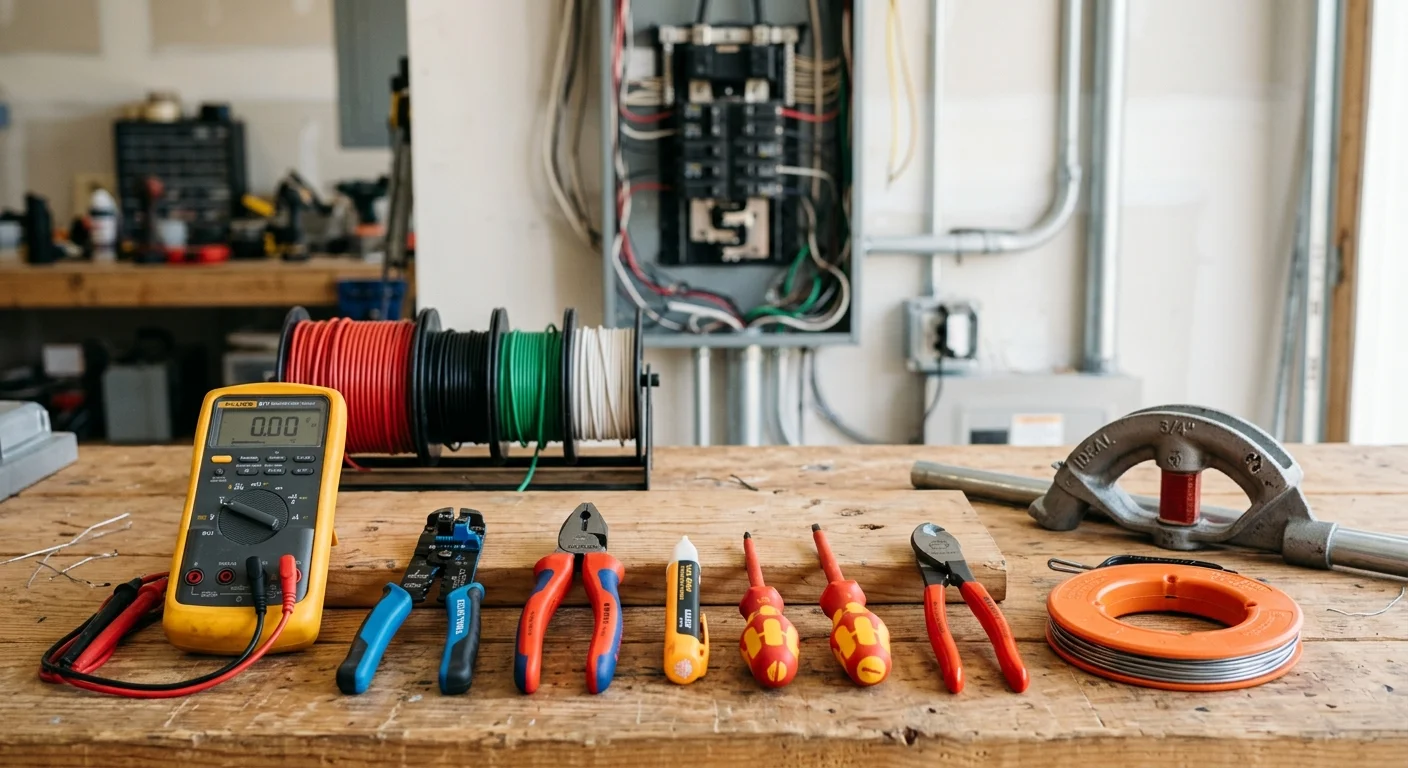
You’ll use wire strippers constantly. They remove insulation from conductors without nicking or cutting the copper underneath, which matters because a damaged conductor can fail or create a hazard inside a wall or panel. Look for a pair that handles a range of wire gauges (typically 10–22 AWG for residential work), has a comfortable grip, and includes a built-in cutter.
Lineman’s Pliers
Also called combination pliers, these do the heavy lifting: cutting wire, twisting conductors together, pulling cable. They’re one of the most frequently reached-for tools on the job. The ones rated for electrical work have insulated handles.
Needle-Nose Pliers
For getting into tight spots, bending wire leads, and working inside electrical boxes where space is limited. A must-have alongside lineman’s pliers.
Diagonal Cutting Pliers (Dikes)
These are for cutting wire flush and snipping small fasteners. The angled jaw lets you cut in tight areas where lineman’s pliers won’t fit well. Electricians use these constantly.
Insulated Screwdrivers
Standard screwdrivers are not safe for electrical work. You need insulated screwdrivers rated to at least 1,000 volts (look for the VDE rating mark). A combination set with flathead and Phillips in multiple sizes will cover most panel, outlet, and switch work.
Non-Contact Voltage Tester
Before you touch anything, you test it. A non-contact voltage tester lets you verify whether a wire or outlet is live without touching it directly. These are inexpensive and arguably the single most important safety tool in your pouch. Never skip this step.
Tape Measure
A 25-foot tape measure handles most residential and commercial measuring tasks. Look for one with a magnetic tip — it’ll stick to metal boxes while you’re working alone.
Torpedo Level
Used to make sure electrical boxes, panels, and conduit runs are plumb and level. A small magnetic torpedo level (8–9 inches) clips to conduit and frees your hands.
Electrical Tape
Keep several rolls. It’s used for insulating splices, marking wire, bundling cables, and dozens of small tasks throughout the day.
Tool Bag or Tool Belt
How you carry your tools matters. A well-organized belt or bag keeps everything within reach without digging through a pile. Most apprentice programs specify either a bag or a pouch-and-belt combination. Start with whatever fits the work environment — tool belts work well on job sites, bags are easier to transport.
Power Tools & Specialty Equipment
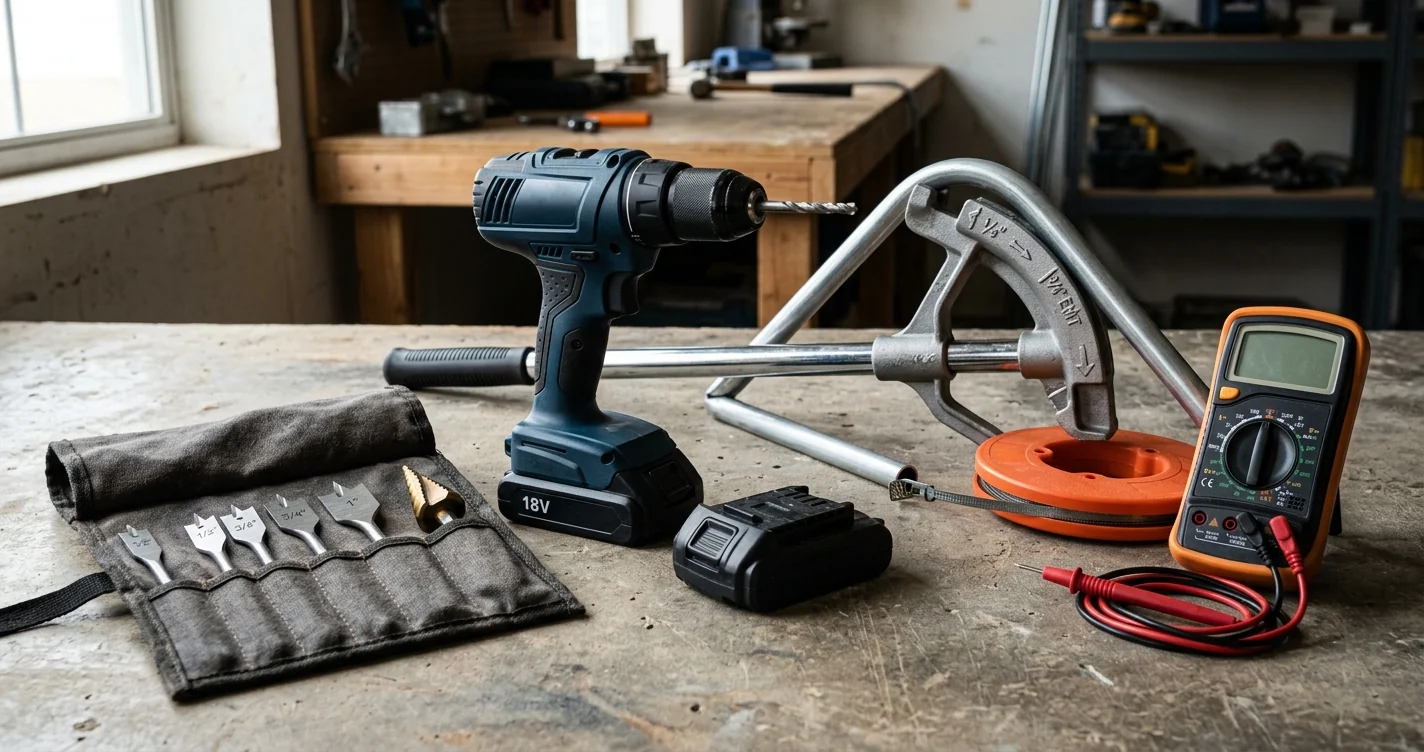
Once you’re past the first few months and taking on more varied work, you’ll need to expand your kit. These tools handle tasks that hand tools can’t — or can’t do efficiently.
Cordless Drill/Driver
You’ll drill through wood framing, drive screws into boxes, and bore holes for conduit runs. A cordless drill with at least two batteries lets you keep working while one charges. Get a set of spade bits and a step bit for drilling through different materials.
Conduit Bender
Once you’re working with conduit, you need to know how to bend it accurately. Conduit benders come in sizes matched to the conduit you’re bending (1/2” and 3/4” EMT are the most common starting points). Learning to read the bender’s markings and make accurate 90-degree bends, offsets, and saddles is a skill you’ll develop over time.
Fish Tape
Running wire through finished walls, ceilings, and conduit requires fish tape — a long, coiled strip of steel or fiberglass you feed through a conduit or wall cavity and then attach wire to for pulling. Fiberglass fish tape is safer around energized systems. Steel is more rigid and easier to push through long conduit runs.
Multimeter
While a non-contact tester tells you whether voltage is present, a multimeter tells you what that voltage actually is, measures current (amps), and checks resistance. Electricians use multimeters to troubleshoot circuits, verify correct voltage at receptacles, and test continuity. A basic digital multimeter is fine when you’re starting out; as you advance into industrial or HVAC-adjacent work, you’ll want a more capable model with true RMS measurement.
Reciprocating Saw
For rough-in work, cutting through lumber, removing old conduit, or making wall openings. Not day-one gear, but you’ll reach for it regularly once you’re working on full job sites.
Safety Gear & PPE

Electrical work has real hazards — shock, electrocution, and arc flash are all potential risks on the job. Your PPE is not optional equipment. It’s the difference between going home in one piece and not going home at all.
Safety Glasses
Rated ANSI Z87.1 or better, worn any time you’re cutting, drilling, or working near energized equipment. This is non-negotiable on any legitimate job site.
Insulated Gloves
Rubber insulating gloves are rated by voltage class. Class 00 and Class 0 gloves cover low-voltage work (up to 500V and 1,000V respectively). They’re worn with leather or synthetic protectors over them to prevent punctures. The NFPA 70E standard governs their use and inspection requirements. Inspect gloves before every use — any crack, hole, or embedded debris means the gloves come out of service.
Class E Hard Hat
Electricians need a hard hat rated Class E (Electrical), which is tested to 20,000 volts. Don’t buy a general construction hard hat and assume it’s appropriate for electrical work — check the rating on the brim.
Arc Flash PPE
Arc flash is a rapid release of electrical energy that creates a blast of heat, light, and pressure. It’s one of the most severe hazards electricians face. OSHA released updated arc flash safety guidance in November 2024 that applies to all workers on or near energized electrical parts, including residential. The NFPA 70E 2024 standard defines PPE categories based on incident energy — at minimum Category 1 (4 cal/cm² arc-rated clothing) is required even for work on 240V panels. As you advance into commercial and industrial work, you’ll need higher-rated FR (flame-resistant) clothing and a face shield.
Non-Conductive Footwear
Electrical hazard (EH) rated boots provide a secondary layer of protection against ground faults. Look for the EH rating stamp on the boot.
Knee Pads
Not a safety item in the electrical sense, but an investment in your body. Electricians spend significant time kneeling on concrete and rough flooring. Quality knee pads pay for themselves in reduced joint wear over a career.
What to Look For When Buying
This section is intentionally brand-agnostic. The goal is to help you evaluate tools on their merits, so you can make good decisions regardless of what’s on sale or what your program recommends.
Wire Strippers
What they do: Remove insulation from wire without damaging the conductor.
Key features to compare: Wire gauge range (broader is more versatile), blade material (hardened steel lasts longer), handle comfort and grip, whether they include a built-in cutter and crimper.
Price range: $15–$40 for a quality pair. Avoid the very cheapest options — dull blades nick conductors.
Pliers (Lineman’s, Needle-Nose, Diagonal)
What they do: Cut, grip, bend, and manipulate wire.
Key features to compare: Insulation rating (look for 1,000V rating), jaw finish (hardened cutting edges vs. standard), handle material (cushion grip vs. dipped). For lineman’s pliers specifically, weight matters — a heavier pair is more fatiguing over a long day.
Price range: $15–$70 per pair. A starter set of three pairs can run $65–$90.
Insulated Screwdrivers
What they do: Drive and remove fasteners on electrical hardware safely.
Key features to compare: VDE rating (1,000V rated), handle diameter (wider handles = more torque), magnetized tips (helpful for fishing screws into tight boxes), set variety (flathead + multiple Phillips sizes).
Price range: $30–$70 for a set.
Non-Contact Voltage Tester
What it does: Detects the presence of AC voltage without contact.
Key features to compare: Voltage range detection (24V–1,000V covers most applications), audible + visual alert (both is better), auto-shutoff to preserve battery.
Price range: $15–$40. Even the lower end of this range gets you a reliable tester from reputable tool makers.
Multimeter
What it does: Measures voltage, current, resistance, and continuity.
Key features to compare: True RMS vs. average responding (true RMS is more accurate for non-sinusoidal loads, matters more as you advance), CAT rating (CAT III or CAT IV for work near electrical panels), display readability, auto-ranging vs. manual ranging.
Price range: $20–$40 for a basic apprentice model. $80–$200+ for professional true RMS models used in commercial/industrial settings.
Fish Tape
What it does: Pulls wire through walls and conduit.
Key features to compare: Material (steel for long rigid runs, fiberglass for safety near energized circuits), length (50–100 feet covers most residential and light commercial), case quality and rewind mechanism.
Price range: $30–$80.
Conduit Bender
What it does: Bends EMT, IMC, or rigid conduit to precise angles.
Key features to compare: Size compatibility (1/2” and 3/4” are most common starting points), handle length (longer = more leverage, less effort), casting quality (a warped bender produces inaccurate bends), clear degree markings.
Price range: $30–$80 per bender head. Combo kits with handle run $50–$120.
Safety Glasses
Key features to compare: ANSI Z87.1 rating (required), wraparound protection, anti-fog coating (valuable in temperature-varying environments), comfort for all-day wear.
Price range: $5–$25 per pair. Buy several.
Insulated Gloves
Key features to compare: Voltage class matched to your work, glove size fit (poorly fitting gloves reduce dexterity and are more dangerous), condition of the rubber (inspect every time), protector gloves included.
Price range: $50–$150 per pair depending on class rating.
Budget Guide
The honest answer is that your starter tool costs depend heavily on your program’s required list and whether you’re entering a union or non-union apprenticeship (some union halls provide certain tools).
Apprentice Starter Kit: $200–$500
This covers the day-one hand tools: wire strippers, three pairs of pliers, insulated screwdrivers, a non-contact tester, tape measure, torpedo level, electrical tape, and a basic tool bag or belt. At this budget level, you’re buying functional mid-grade tools — not the cheapest option, but not professional-tier either. That’s appropriate when you’re still developing preferences.
Adding Power Tools: $300–$600 additional
A cordless drill, fish tape, and basic multimeter round out your kit for most apprenticeship work. If you’re in a program that provides a drill, you can defer that cost.
Journeyman Setup: $1,500–$3,000+
A fully equipped journeyman carries a broader and higher-quality set: professional-grade pliers and strippers, a true RMS multimeter, a complete conduit bending set, a full PPE kit including arc-rated clothing, and power tools from professional tool lines. Costs scale further if you’re working in industrial or high-voltage environments requiring specialized equipment.
The good news: you build this over time. Most electricians add to their kit gradually as they encounter new types of work. Don’t feel like you need everything on the journeyman list before you start your first week.
Tool Care & Maintenance Tips
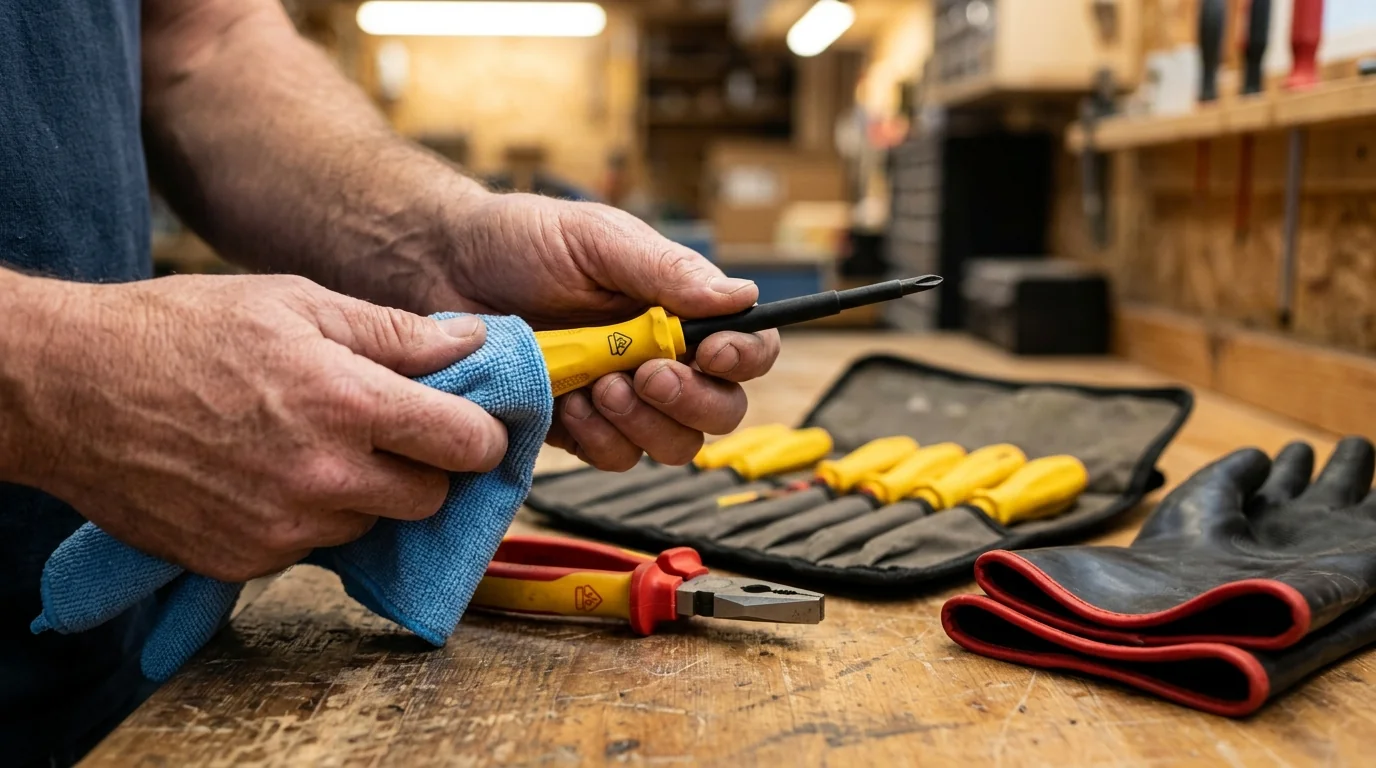
Good tools last years when they’re taken care of. Here’s how electricians keep their gear in working order:
Inspect insulated tools before every use. Even a small crack or nick in the insulation on a screwdriver handle or plier grip compromises its protective rating. According to Electrical Contractor Magazine, insulated tools with damaged insulation should be taken out of service immediately. Don’t tape over damage and call it fixed.
Clean tools after use. Wipe down insulated handles with a mild cleanser — dish soap works. Avoid solvents, which can degrade rubber insulation. For metal components, a light wipe removes grime and prevents rust from forming at pivot points.
Store tools properly. Keep insulated tools in a bag or case, away from direct sunlight, extreme heat, and sharp objects that can nick insulation. Don’t throw them loose in the back of a truck bed.
Get insulated tools recertified annually. A qualified professional can inspect and recertify insulated tools to confirm they still meet voltage rating standards. This is particularly important for rubber insulating gloves, which should be regularly tested (most manufacturers and labs offer this service).
Keep multimeter batteries fresh. A low-battery multimeter can give inaccurate readings. Check the battery indicator before important diagnostic work.
Sharpen or replace blades on wire strippers. Dull cutting edges mean you’re sawing through insulation instead of cleanly cutting it, which increases the chance of nicking the conductor. Most wire strippers aren’t worth resharpening — replace them when cutting quality drops.
Inspect power tool cords and connections. Cracks in cord insulation on corded tools are a shock hazard. For cordless tools, store batteries at room temperature and avoid fully depleting lithium-ion batteries before recharging.
Start Your Electrical Career
Knowing your tools is a good foundation, but the real question is what happens after you have them. If you’re weighing whether the electrical trade is the right fit — what the work actually looks like day to day, what the earning potential is, and how licensing and advancement work — read our full guide on electrical career opportunities.
If you’re still deciding between a union apprenticeship and a trade school program, our apprenticeships explained article walks through how each path works and what to expect from both. And if you’re wondering what licenses and certifications matter in the trades, trade certifications and licenses breaks down what you’ll need at each stage.
The electrical trade rewards people who take the craft seriously — and that starts with understanding your tools before you ever set foot on a job site.
Sources
- ExpertCE — “10 Essential Electric Tools Every Apprentice Should Own” — https://expertce.com/10-essential-electrician-tools/
- Workiz — “Top 15 Essential Electrician Tools for Pros — 2026 List” — https://www.workiz.com/blog/electrical-work/top-20-essential-electrician-tools-for-pros/
- Tyndale USA — “BREAKING: OSHA Issues New Arc Flash Safety Guidance” — November 2024 — https://tyndaleusa.com/blog/2024/11/25/breaking-osha-issues-new-arc-flash-safety-guidance/
- ExpertCE — “NFPA 70E 2024: Arc Flash PPE Categories Explained” — https://expertce.com/nfpa-70e-2024-arc-flash-ppe-categories-explained/
- Electrical Contractor Magazine — “Insulated Hand Tools: Keeping them in shape keeps you safe” — https://www.ecmag.com/magazine/articles/article-detail/insulated-hand-tools-keeping-them-in-shape-keeps-you-safe
- Getjobber — “Electrician Tools List: 45 Professional Tools to Buy in 2025 (With Prices)” — https://www.getjobber.com/academy/electrical/electrician-tools-list/