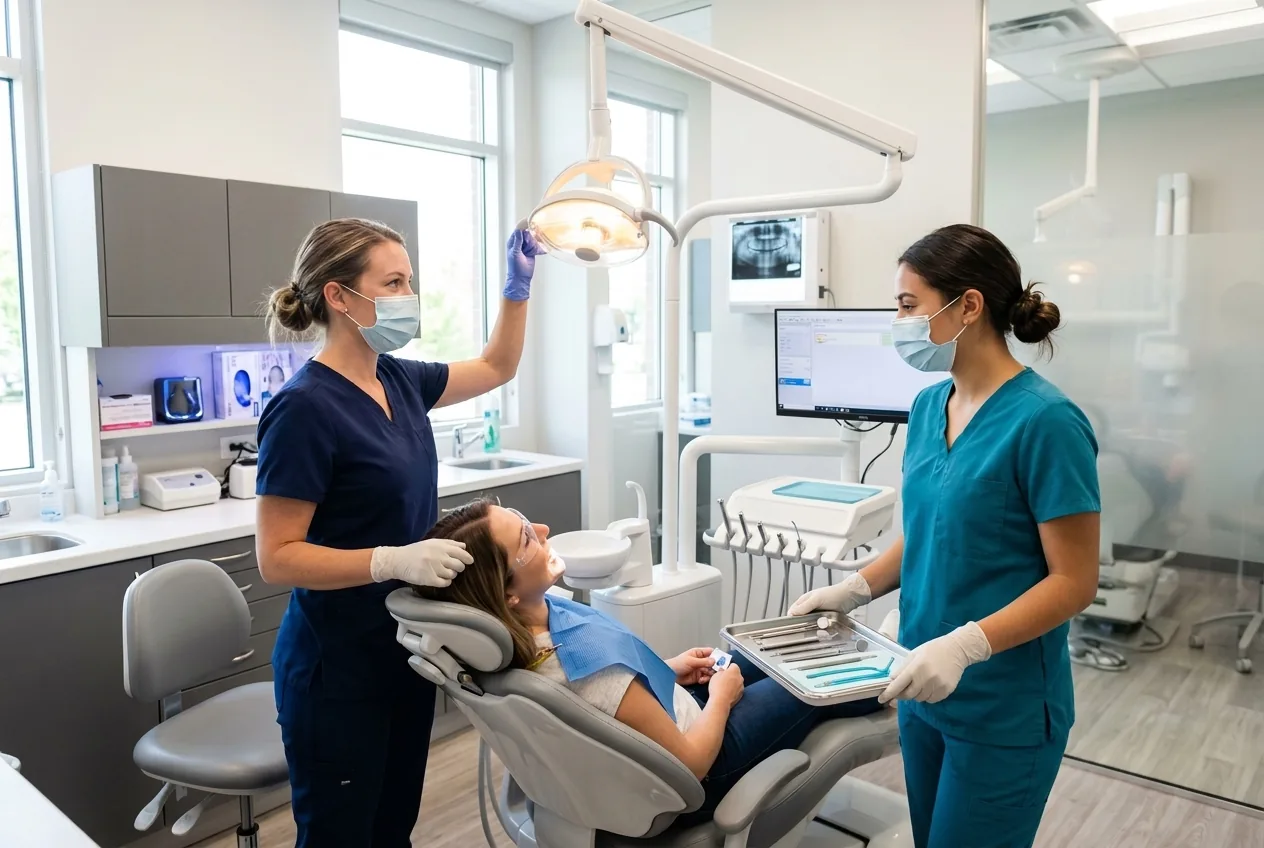

Stand in any dental operatory and you’ll see both jobs at once: the dental assistant passing instruments and running suction while the dentist works, and the dental hygienist down the hall with their own patient schedule. In May 2024, median pay for one was $47,300; for the other, $94,260 — almost exactly double, per the Bureau of Labor Statistics.
So the question you’re really asking isn’t “which job is better.” It’s this: what does the second paycheck cost, and is that price worth it for you?
Here’s the claim you’ll hear from hygiene programs: double the pay for a little more school. And the claim from assisting programs: chairside and earning in under a year. Both are basically true — and both leave out the part that should drive your decision. Let’s run the numbers.
At a Glance
| Dental Assistant | Dental Hygienist | |
|---|---|---|
| Typical training | Certificate/diploma, ~1 year | CODA-accredited associate degree, typically 3 years |
| Also possible | On-the-job training (some states) | Bachelor’s or master’s in dental hygiene |
| Credential | CDA certification (required in some states, optional in others) | State license, mandatory everywhere |
| Exams | DANB CDA (three components), where required | NBDHE written boards + regional/state clinical exam |
| Median pay (May 2024) | $47,300 | $94,260 |
| Top 10% earned more than | $61,780 | $120,060 |
| Projected growth (2024–34) | 6% (faster than average) | 7% (much faster than average) |
| Projected openings per year | ~52,900 | ~15,300 |
Sources: BLS — Dental Assistants and BLS — Dental Hygienists.
Two numbers in that table deserve a second look. The pay gap is the obvious one. The less obvious one is the openings row: dental assisting produces more than three times as many job openings per year. One field pays far more; the other has a far wider door.
What Would You Actually Be Doing All Day?
The jobs share a room but not a role.
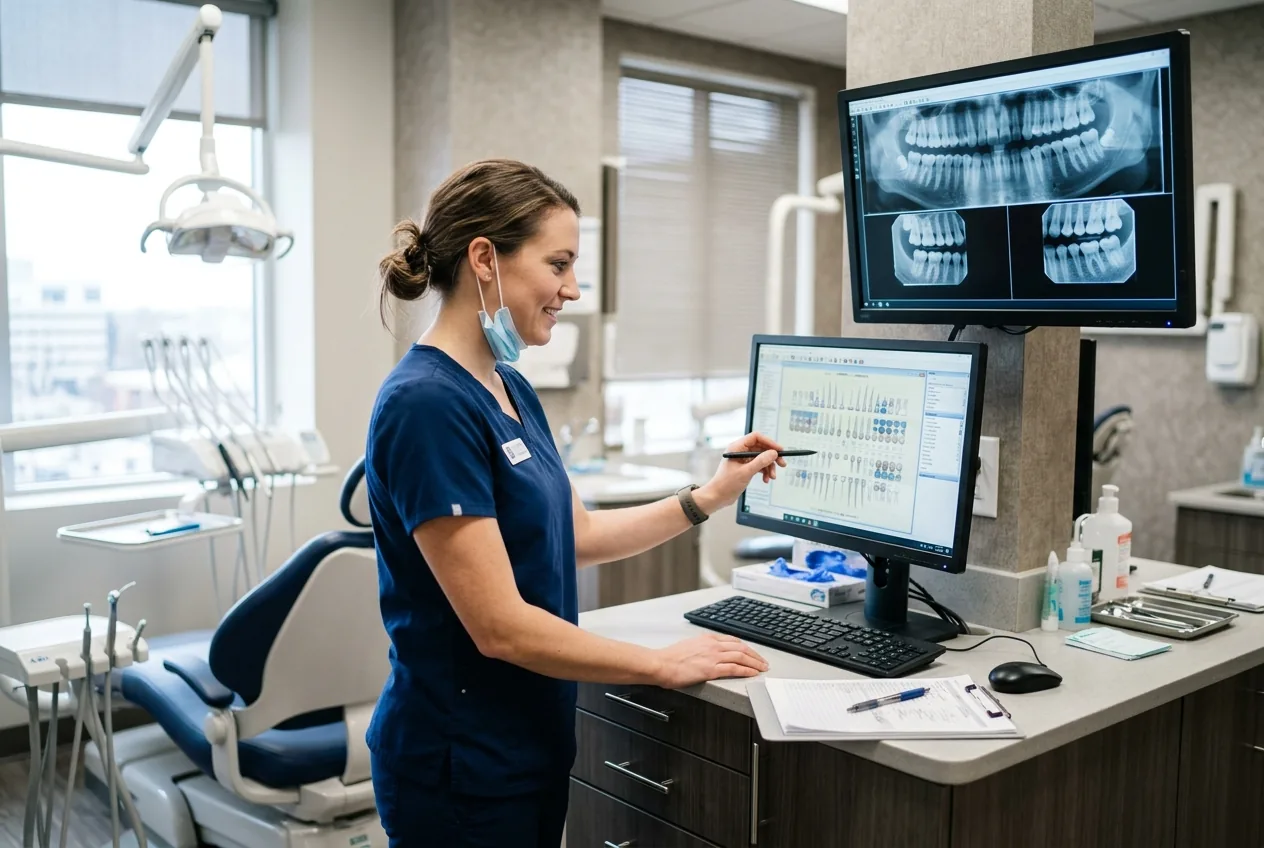
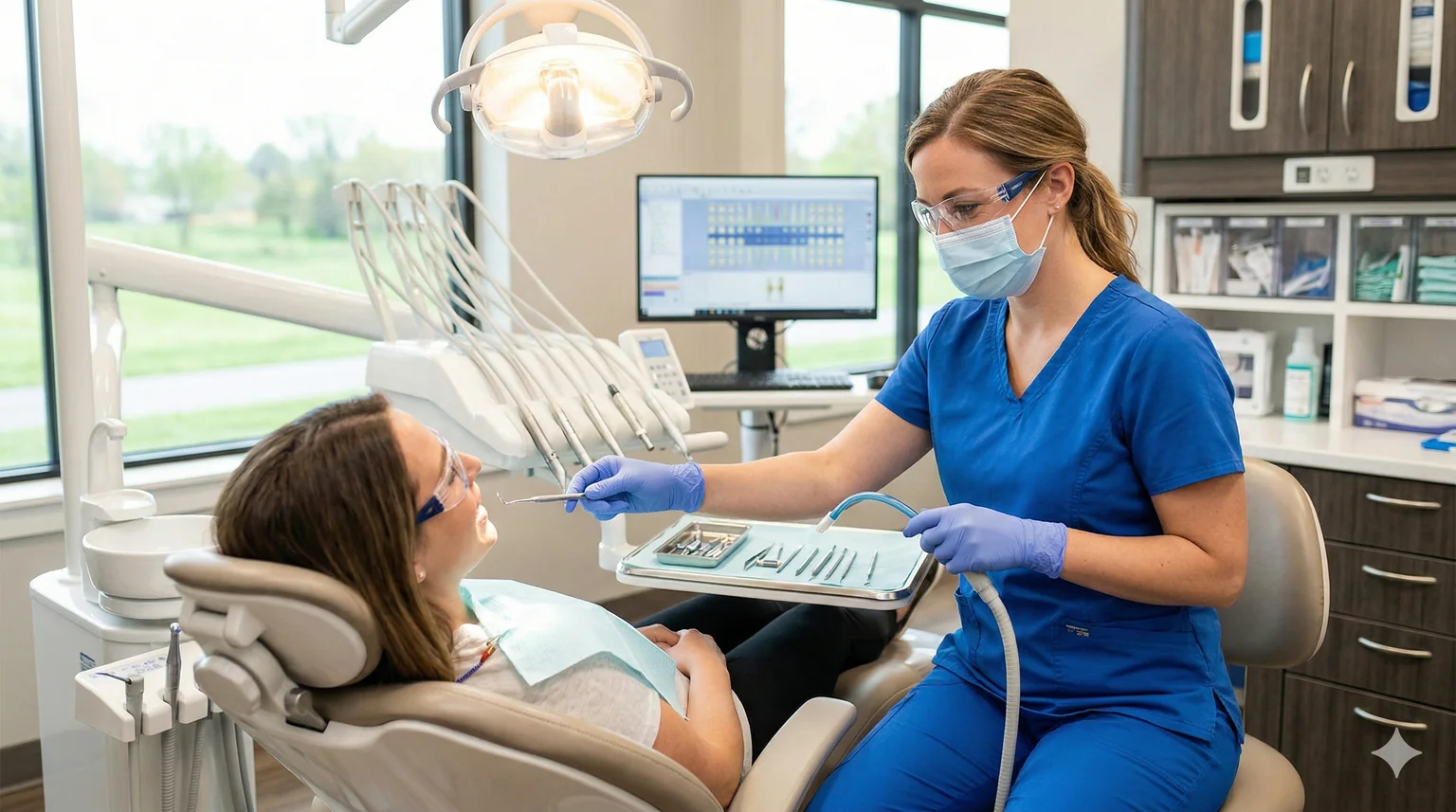
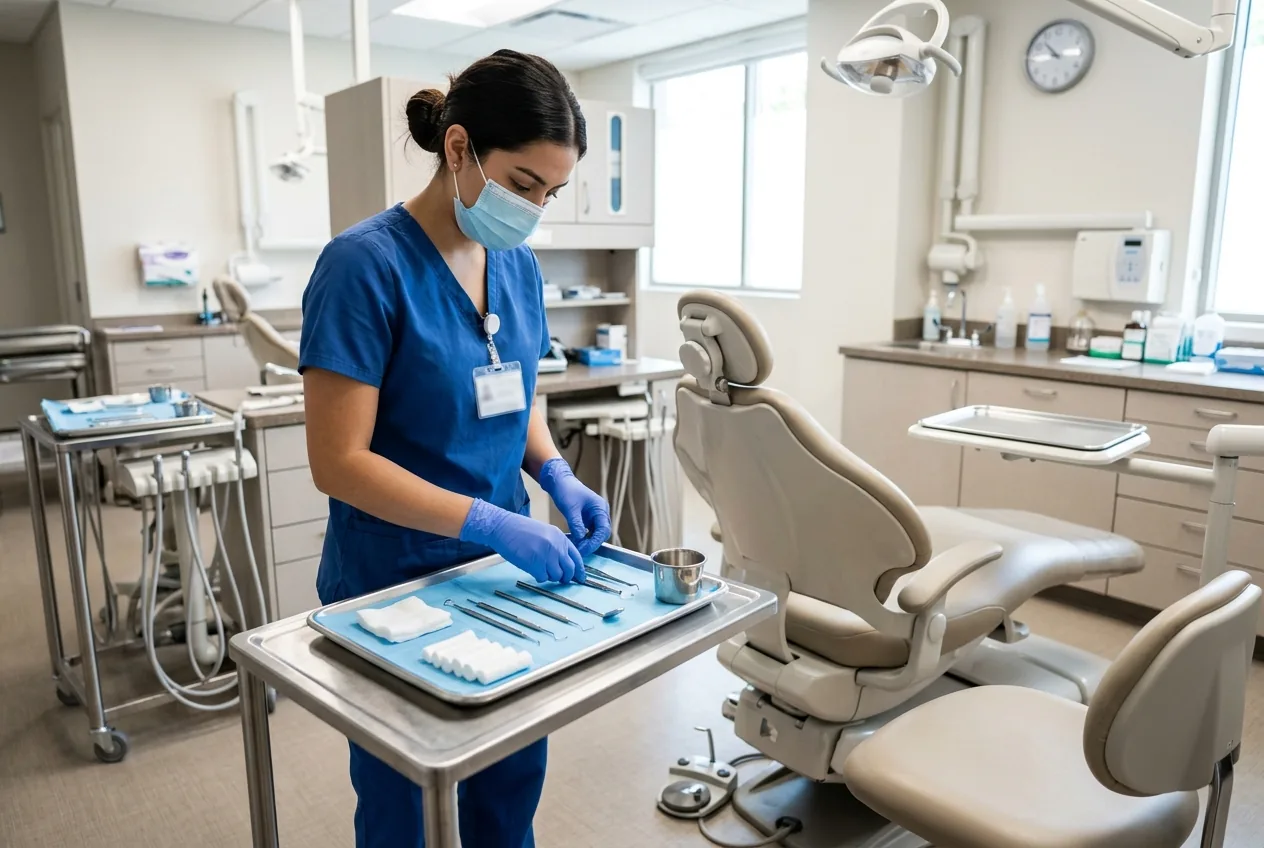
A dental assistant works alongside the dentist: preparing patients and trays, sterilizing instruments, handing off tools and suctioning during procedures, taking X-rays where state rules allow, making impressions, and handling scheduling and records between patients. It’s a support role in the best sense — the practice runs on it — but you’re rarely working a patient on your own. Our dental assistant career page breaks down the duties and wage data by state.
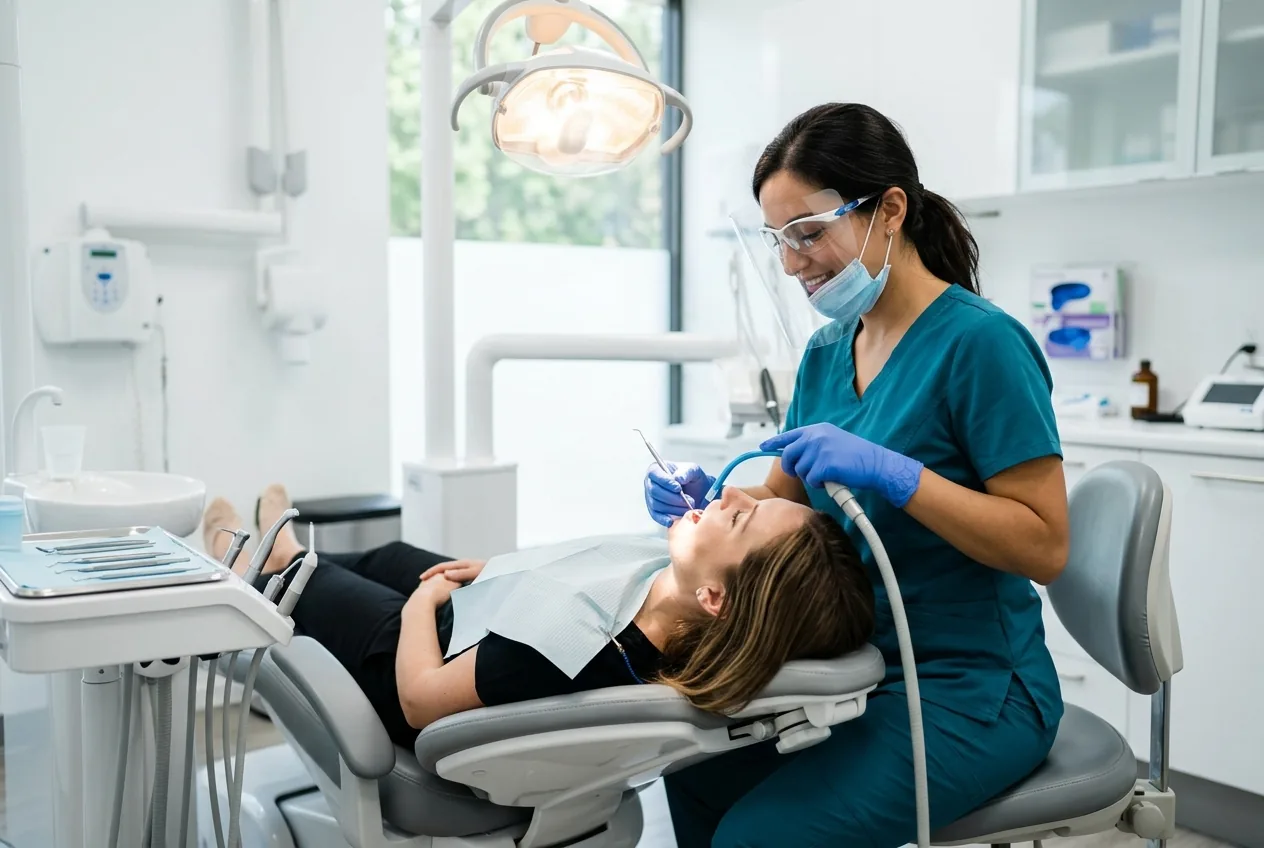
A dental hygienist carries their own patient schedule: cleanings, scaling away plaque and tartar, periodontal charting, taking and reading X-rays, applying sealants and fluoride, screening for signs of oral disease, and educating patients — then reporting findings to the dentist. The dentist oversees the practice, but for most of the day the hygienist is the clinician in the chair. The dental hygienist career page has the full occupational profile.
That autonomy difference is the honest explanation for the pay difference. A hygienist is licensed to deliver billable clinical care independently; an assistant amplifies someone else’s.
The Assistant Path: About a Year, Sometimes Less
The pitch for dental assisting is speed, and the evidence backs it up. Per BLS, dental assistants typically hold a postsecondary certificate or diploma — most programs run about one year at community colleges or technical schools — and in some states there are no formal education requirements at all, with assistants learning on the job. You can browse accredited options in our dental assisting program directory.
The credential to know is the CDA (Certified Dental Assistant) from the Dental Assisting National Board. There are two main routes to qualify: graduate from a CODA-accredited dental assisting program, or skip the program and log 3,500 hours of approved work experience with a high school diploma. Either way, you sit the same three-part exam (general chairside, radiation health and safety, infection control) and hold current CPR certification. Whether the CDA is legally required depends on your state and on which duties — X-rays especially — you want to perform.
Notice what that structure implies: the certificate program is a fast on-ramp, not a gate. Some states will let you start working with zero tuition spent. For what the role grows into from there, see our guide to dental assistant career opportunities.
The Hygienist Path: A Degree, Two Board Exams, and a License
Here the marketing tends to undersell the commitment, so let’s state it plainly. Per BLS, dental hygienists typically need an associate degree in dental hygiene from a program accredited by CODA — and those programs typically take three years to complete once you count science prerequisites like anatomy, chemistry, and microbiology. Admission is competitive at many schools, which can add a waitlist year the brochures don’t mention.
The degree alone doesn’t let you practice. Per the American Dental Hygienists’ Association, every state requires licensure, which means graduating from an accredited program, passing the written National Board Dental Hygiene Examination (NBDHE), and passing a regional or state clinical exam where you perform procedures on a live patient while examiners watch. Then you apply to your state board, often with a jurisprudence exam on top.
That’s the real price of the $94,260 median: roughly three years, a science-heavy curriculum, two sets of boards, and ongoing license requirements. If you’re going to pay it, pay it at a strong school — start with our dental hygiene program directory and the ranked dental hygiene programs list, and see the step-by-step in how to become a dental hygienist.
Pay: Running the Numbers
The May 2024 BLS figures, laid out as a decision rather than trivia:
- The median gap is $46,960 per year. $94,260 for hygienists versus $47,300 for assistants. Over a decade, that’s roughly $470,000 in median-wage difference — before raises.
- The ranges barely overlap. The top 10% of dental assistants earned more than $61,780; the bottom 10% of hygienists earned less than $66,470. Read that again: a hygienist near the bottom of the field earns about what an assistant near the top of it does. This is not a gap you close by being an exceptional assistant.
- The opportunity cost is real but recoverable. Choose assisting and you might earn around $141,900 (three years at the $47,300 median) while a hygiene student is paying tuition instead. Simple arithmetic on the medians: at a ~$47,000 annual advantage, a newly licensed hygienist makes up those forgone earnings within about three to four years of practice, with tuition adding some months to the payback. This is an illustration using national medians — your program cost and local wages will move it — but the direction is hard to argue with.
Steelmanning the assistant case anyway: the earnings start now, the training debt is minimal to zero, and if you discover you hate dentistry after eight months, you’ve lost very little finding out. That last point is worth actual money.
Outlook: The Wider Door vs the Better Room
Growth rates are nearly identical — 6% for assistants, 7% for hygienists over 2024–34, both above the all-occupation average, per BLS. The difference is volume: about 52,900 assistant openings projected per year against 15,300 hygienist openings.
In practice that means assistant jobs are generally easier to land, in more places, with less competition. Hygienist positions pay better but hiring is thinner, and in some metro areas new graduates compete for part-time slots before assembling full-time hours across practices. If you’re tied to one small town, check who’s actually hiring there before committing to either program.
The Physical Reality Nobody Puts in the Brochure
Both jobs are performed with your hands in a small, poorly lit workspace — someone’s mouth — and both carry a physical bill.
Assistants spend the day on their feet, retracting, reaching across patients, and turning over operatories between appointments. Hygienists have it worse in a specific way: hours of static, seated posture with a bent neck and precise, repetitive hand motions. One 2022 peer-reviewed study of dental hygienists found musculoskeletal complaints reported in the neck by 85%, the shoulder by 70%, and the lower back by 68% of hygienists surveyed.
That doesn’t make the career a bad deal — it makes ergonomics, loupes, and instrument selection part of protecting a six-figure-adjacent income. But if you already have neck, shoulder, or wrist problems, weigh this section as heavily as the salary table.
The Bridge Myth: Why Assisting Rarely Shortcuts Into Hygiene
Here’s the claim that sells a lot of assisting programs: “Start as an assistant, then bridge to hygienist — your experience counts.” The evidence says: mostly, it doesn’t count the way you’re hoping.
There is no exam or experience route into dental hygiene the way there is into assisting. Every state requires graduation from a CODA-accredited dental hygiene program — at minimum an associate degree — before you can sit the boards, as career-change guides like Herzing University’s assistant-to-hygienist pathway page spell out. And because most assisting credentials are nondegree certificates, that coursework generally doesn’t transfer into a degree program. College-level credits (an anatomy course, English composition) may transfer; your certificate hours and your 3,500 chairside hours typically do not shave time off hygiene school.
What assisting experience does do: strengthen your hygiene school application, confirm you actually like dentistry, and pay you while you complete prerequisites at night. If hygiene is the endgame, do it deliberately — take your prerequisite sciences for college credit at the same institution that houses the hygiene program, and treat the assisting job as funded reconnaissance, not as a head start on the degree.
The Verdict: Which Should You Choose?
Conditions, not cheerleading:
Choose dental assisting if you need income within a year, want minimal training cost and risk, live where openings are plentiful (they usually are — 52,900 a year nationally), or you’re genuinely unsure dentistry is for you. It’s the cheapest possible test of the field, and in some states it costs nothing but effort to enter.
Choose dental hygiene if you can commit roughly three years including prerequisites, can handle a competitive, science-heavy program and two board exams, and your body can sustain the posture the work demands. The reward is a median wage double the assistant’s, real clinical autonomy, and unusual scheduling flexibility — per BLS, many hygienists work part time, sometimes just a few days a week across more than one practice.
Choose the sequence — assistant first, hygienist later — only with open eyes. It’s a legitimate way to fund and de-risk the longer path, but budget the full three years of hygiene school anyway, because your assisting credential won’t shorten it.
The two-times pay difference is real. So is the price of crossing it. Decide based on which cost you’d rather pay — years up front, or ceiling forever.
Frequently Asked Questions
Can a dental assistant become a dental hygienist? Yes, but there’s no shortcut: every state requires graduating from a CODA-accredited dental hygiene program (at minimum an associate degree) and passing the NBDHE plus a clinical board exam, per the ADHA. Assisting experience strengthens an application but doesn’t replace the degree.
How much more does a dental hygienist make than a dental assistant? The May 2024 medians were $94,260 for hygienists and $47,300 for assistants, per BLS — a gap of about $47,000 a year, or roughly double.
How long does each path take? Dental assisting programs typically take about one year, and some states allow on-the-job training with no formal program. Dental hygiene programs are CODA-accredited associate degrees that typically take three years including prerequisites, per BLS.
Do dental assistants need certification? It depends on the state and the duties. The DANB CDA — earned by graduating from a CODA-accredited program or logging 3,500 hours of work experience, then passing a three-part exam — is required for certain functions (especially radiography) in some states and optional in others, per DANB.
Which career has better job security? Both are projected to grow faster than average through 2034 (6% for assistants, 7% for hygienists). Assisting generates over three times as many annual openings (~52,900 vs ~15,300, per BLS), so first jobs come easier — but hygienists’ licensure and clinical scope make their higher wage durable.
Sources
- U.S. Bureau of Labor Statistics — Dental Hygienists: Occupational Outlook Handbook (May 2024 wage data; 2024–34 projections) — Accessed July 2026 — https://www.bls.gov/ooh/healthcare/dental-hygienists.htm
- U.S. Bureau of Labor Statistics — Dental Assistants: Occupational Outlook Handbook (May 2024 wage data; 2024–34 projections) — Accessed July 2026 — https://www.bls.gov/ooh/healthcare/dental-assistants.htm
- Dental Assisting National Board (DANB) — Earn Dental Assistant Certification — Accessed July 2026 — https://www.danb.org/certification/earn-dental-assistant-certification
- American Dental Hygienists’ Association (ADHA) — Becoming a Dental Hygienist — Accessed July 2026 — https://www.adha.org/students/becoming-a-dental-hygienist/
- Commission on Dental Accreditation (CODA) — About CODA — Accessed July 2026 — https://coda.ada.org/about-coda
- Herzing University — Going From Dental Assistant to Dental Hygienist: What You Must Know — Accessed July 2026 — https://www.herzing.edu/pathway/dental-assistant-to-hygienist
- PMC / National Library of Medicine — Musculoskeletal disorders related to dental hygienist profession — 2022 — https://pmc.ncbi.nlm.nih.gov/articles/PMC9543870/