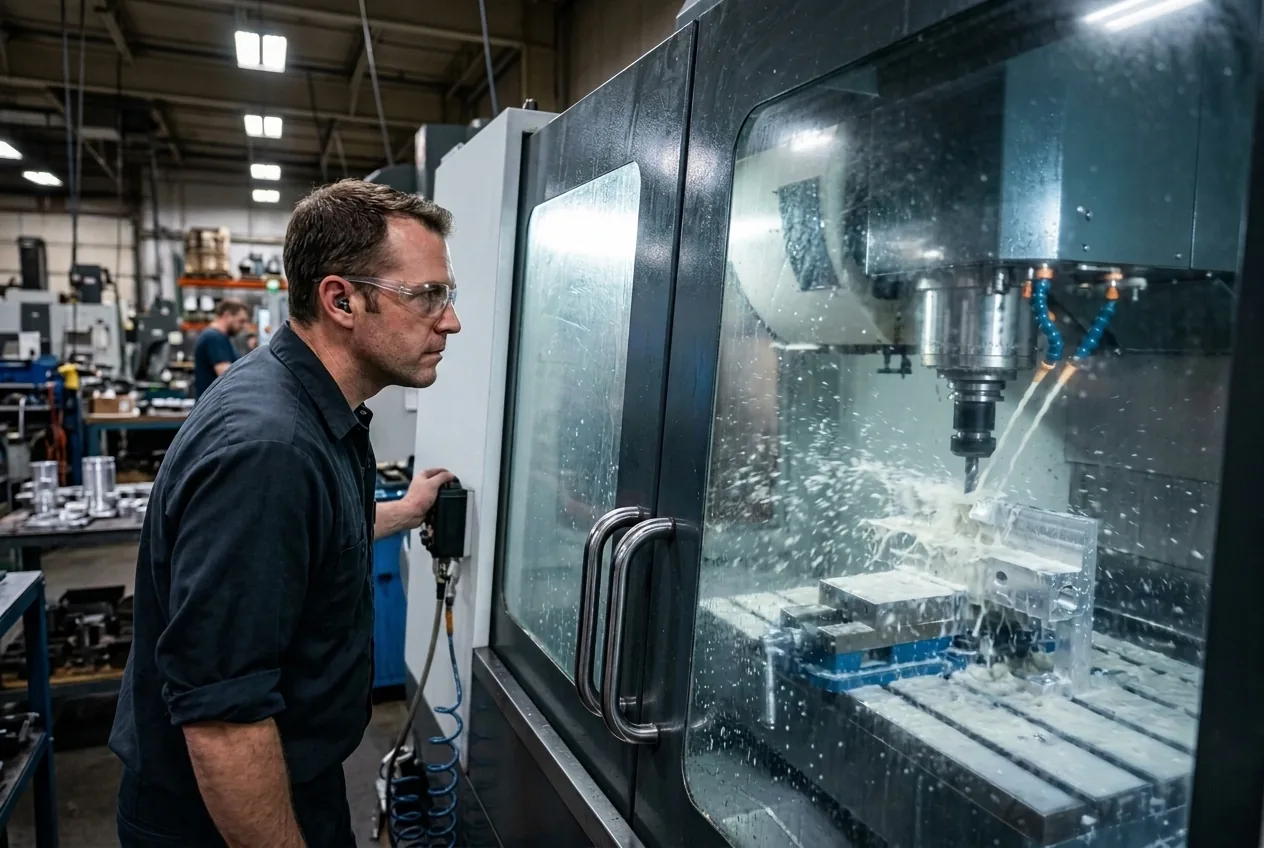

Picture your first morning in a machine shop. Two people are standing at the same machine — a vertical machining center the size of a garden shed, coolant fog drifting out every time the door opens. One of them loads a part, closes the door, presses the green button, and checks the finished piece with a gauge. The other one is inside the enclosure with an indicator, sweeping in a vise, touching off tools, and squinting at a program on the control.
They might both have “CNC machinist” on their badge. They are not doing the same job, and they are not making the same money.
That distinction — operator versus setup machinist versus programmer — is the single most useful thing to understand before you spend a dollar or an hour on training. The BLS Occupational Outlook Handbook puts the May 2024 median wage for machinists at $56,150. O*NET’s 2025 wage data shows CNC tool operators — the button-and-gauge job — at a $50,690 median, against $58,750 for machinists. Same building, same machines, a different skill set, an $8,000-a-year gap.
This guide covers the three ways in, the NIMS credentials employers recognize, and what the first-year checks really look like.
The Three Jobs Hiding Inside “CNC Machinist”
CNC stands for computer numerical control — the machine follows a coded program instead of a human turning handwheels. That program still has to be written, proven out, and set up by somebody. Which somebody you become determines your pay.
- CNC operator. You load parts, run a proven program, deburr (grind off the sharp edges the cutter leaves), and check dimensions with gauges someone else chose. It’s honest work and the standard first rung — but O*NET counts it as a separate, lower-paid occupation, and it’s the tier most exposed to automation.
- Setup machinist. You build the job from a print: mount and indicate the workholding (the vise, chuck, or fixture that grips the part), load and touch off tools, set work offsets — the coordinates that tell the machine where the part actually sits — and cut the first article, the first piece off a new setup that inspection checks before production runs. When something starts cutting oversize at 2 p.m., you’re the one who figures out why. This is the job the $56,150 median actually describes.
- CNC programmer. You write the toolpaths in CAM software — computer-aided manufacturing, where you model the cuts on a screen before metal moves — pick the tools and speeds, and hand proven programs downstream. Most programmers were setup machinists first, and the ones who can run five-axis work sit near the top of the shop’s pay scale.
One sentence to tattoo somewhere: operators run parts; machinists make parts happen. Everything below is about getting from the first group to the second as fast as possible.
Step 1: Check the Baseline Requirements
The entry gates are lower than most trades:
- High school diploma or GED — the typical entry-level education BLS lists for machinists, with the real skills built afterward through training.
- Shop math. Fractions, decimals, and eventually right-angle trig — used to find hole positions on a bolt circle, not to pass a test. Rusty is fixable; every machine tool program starts with a refresher.
- Attention that doesn’t drift. The trade works in thousandths of an inch; a human hair is about three thousandths thick. Machining rewards the person who checks twice.
- Tolerance for standing on concrete through a full shift, with occasional lifting.
- A clean drug test — near-universal in aerospace, medical, and defense shops.
No license, no state exam. The barrier in machining is skill, not paperwork.
Step 2: Pick Your Entry Route
There are three realistic doors in. They lead to the same floor; they differ in calendar time, cost, and how fast you touch a setup.
Community College Machine Tool Program (9 months–2 years)
The classic route: a certificate or associate degree in machine tool technology or CNC machining at a community or technical college. You learn manual milling and turning first — because you cannot diagnose what a CNC machine is doing wrong if you’ve never felt a cutter load up by hand — then move to CNC setup, programming basics, and print reading.
Community college pricing generally lands well under private trade schools, and many programs qualify for federal student aid. What matters more than the tuition line:
- Machine hours. Ask what percentage of the program is on machines versus in a classroom. Seat time doesn’t cut chips.
- NIMS credentialing on site — the strongest programs test you against national standards before you graduate (more below).
- Employer pipeline. Programs that host job fairs with local shops place their graduates. Programs that can’t name their employer partners don’t.
Compare schools in our CNC machining program directory and the broader machine tool technology directory — the machine tool listings skew toward heavier manual and toolroom coverage, which is a strength, not a throwback.
Registered Apprenticeship (typically 4 years / 8,000 hours)
Machinist is a registered apprenticeship occupation on Apprenticeship.gov, and the traditional standard runs about four years and 8,000 hours of paid on-the-job training plus classroom instruction. You’re an employee from day one, paying zero tuition.
A concrete example: AJAC, the aerospace apprenticeship consortium in Washington State, runs its machinist program at 4 years / 8,000 hours, cites a $31.82/hour average starting wage for the occupation in its region, and stacks 60 college credits plus a journey-level card on top. That wage is a Washington aerospace-market average, not a national promise — but the structure is the point: paid the whole way, credentialed at the end.
The catch is supply. Machinist apprenticeships are far scarcer than electrician or plumber slots, concentrated around aerospace corridors, defense contractors, and union shops. If one exists within commuting distance, it is almost always the best deal on this page. Most people don’t have one.
The Operator-to-Setup Ladder (on the job)
The third route skips school entirely: hire on as a CNC operator — many production shops will take a green candidate with a good attitude and a tape measure — and climb.
This route is real — plenty of working machinists came up this way. But go in with open eyes. A shop earns money when your machine is making parts, not when a setup person is training you. In a busy production plant, it is entirely possible to load parts for five years and never be taught an offset.
If you take this door, pick the employer, not the job title. In the interview, ask how operators become setup machinists there, and ask them to name someone who did it recently. A shop that promotes from within will answer in ten seconds. A shop that hesitates is telling you the ladder is painted on the wall.
The strongest version is a hybrid: run parts on second shift, take machine tool classes on your own time. Employers notice, and tuition reimbursement is common in manufacturing.
Step 3: Put NIMS Credentials on Paper
Machining has no license, so the industry built its own yardstick. NIMS — the National Institute for Metalworking Skills — writes national, industry-validated standards and issues stackable credentials against them.
The structure that matters to a beginner:
- Machining Level I is aligned to entry-level skills. It’s modular — separate credentials across duty areas like measurement, materials and safety; job planning, benchwork, and layout; manual milling; turning; and CNC milling and turning — earned one at a time.
- Machining Level II is aligned to journey-level skills, the benchmark a four-year apprentice is working toward.
- Earning one isn’t a multiple-choice quiz. NIMS credentials pair a theory exam with a performance requirement: you machine an actual part to a NIMS-specified print, and it has to measure in tolerance. You can’t talk your way past a part that doesn’t gauge.
Now the employer-weight question, honestly. NIMS credentials are nationally recognized, endorsed by The Manufacturing Institute, and embedded in school and apprenticeship curricula; a Level I on a new graduate’s resume says a third party watched you make a part that passed. That gets interviews. It does not replace the shop’s own test — most shops will still hand you a print and a micrometer to see whether the paper tells the truth. NIMS gets you to the tryout; it doesn’t skip it. Favor schools that test NIMS in-house: it means their bar is the industry’s bar, not their own.
Step 4: Learn to Read Prints — Then GD&T
Ask any shop owner what’s rarer than a good machinist and they’ll say a good machinist who can really read a print.
A print (blueprint, engineering drawing) tells you what the part must be: every dimension, every tolerance — the allowable wiggle room. Basic print reading is taught everywhere. The separator is GD&T — geometric dimensioning and tolerancing — the symbolic language that controls geometry, not just size: how flat a surface must be, how true a hole pattern must sit relative to datums, the reference surfaces everything is measured from.
This is a pay issue, not an academic one. Aerospace and medical prints are written almost entirely in GD&T. A machinist who can read them can work in the highest-paying corners of the trade; one who can’t is locked out regardless of how well they cut metal.
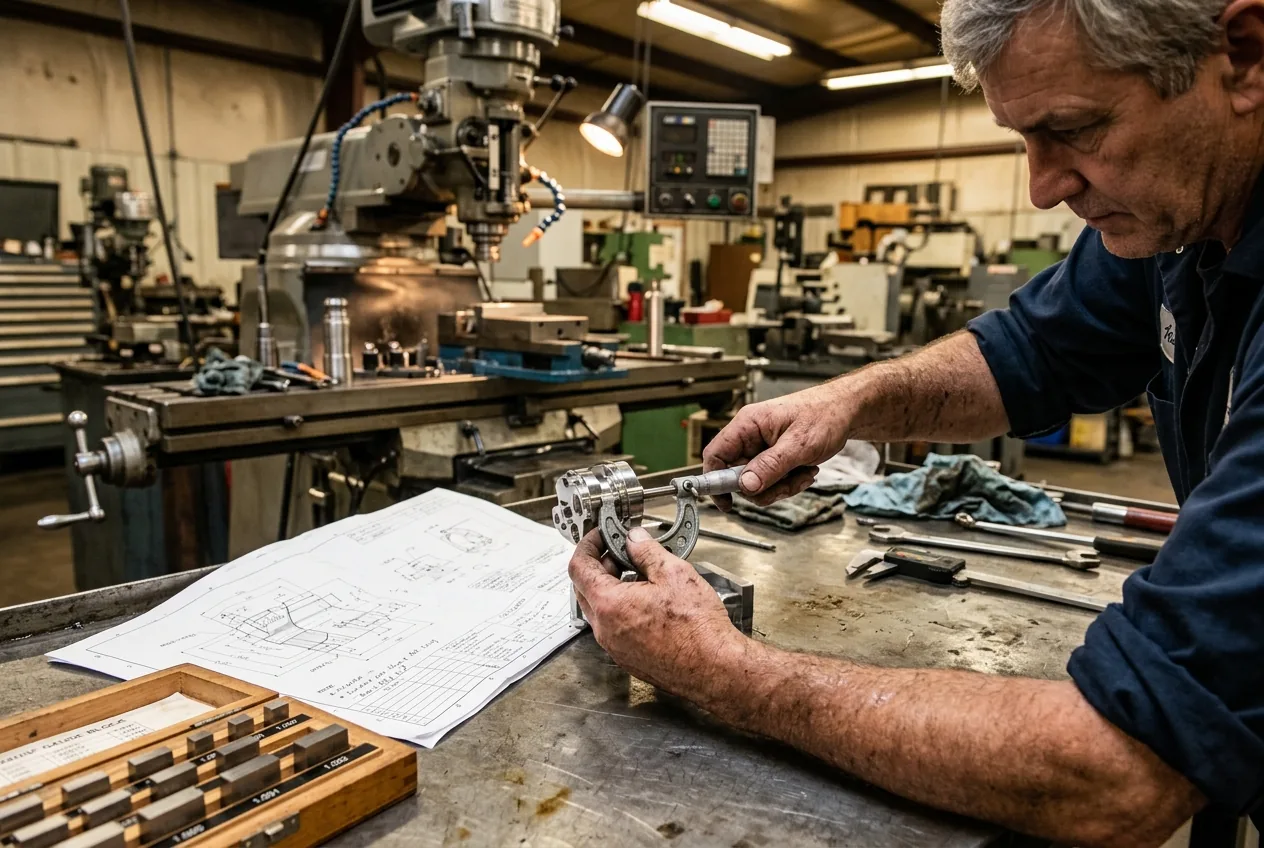
Measurement is the other half of the same literacy. Micrometers, calipers, indicators, gauge pins, and eventually CMMs — coordinate measuring machines — are how you prove a part is good. A first-year machinist who buys their own basic measuring kit and learns it cold gets handed better work.
What You’ll Actually Earn in Year One
Numbers first, from the BLS Occupational Outlook Handbook (May 2024) and O*NET’s 2025 data:
| Benchmark | Figure |
|---|---|
| Machinists, median | $56,150 (2024) / $58,750 (2025) |
| CNC tool operators, median | $50,690 (2025) |
| Machinists, bottom 10% | under $38,100 |
| Machinists, top 10% | over $78,760 |
| Tool and die makers, median | $63,180 |
Hold those against a real first year. The bottom-10-percent band — under $38,100, about $18 an hour — is roughly where an untrained operator starts in lower-cost regions. A graduate with NIMS credentials and real machine hours typically enters above it, hired as a trainee setup machinist rather than a pure operator. An apprentice earns a rising percentage of journey-level wage from day one — AJAC’s $31.82/hour regional average is the aerospace-market end of that spectrum.
The medians are a mid-career snapshot, not a year-one promise. What they do show is the shape of the ladder: the roughly $8,000 gap between the operator and machinist medians is the price of never learning setup, paid every year. Overtime is real money too — busy shops run Saturdays at time-and-a-half. For wage percentiles, state-by-state pay, and employment counts, see our machinist career data page.
Where the Jobs Are: Job Shops, Production Plants, Aerospace and Medical
Where you work shapes what you learn and what you earn.
- Job shops — small contract shops making short runs of whatever customers bring. New setups constantly, wide variety, thin staffing. Pay starts modest, but two years in a good job shop teaches more setup than five in a plant — the classic first job.
- Production plants — long runs of the same parts. Stable schedules and often better starting benefits, but the operator trap lives here: high operator headcount, few setup slots. Climb deliberately or don’t stay.
- Aerospace, medical device, and defense shops — tight tolerances, full GD&T, documented quality systems, the top of the wage scale. Usually reached after a few years of proven experience or straight from an aerospace-fed apprenticeship. Toolrooms, where tool and die makers earn a $63,180 median, sit in the same tier.
Geography stacks on top: the machining belt runs thick through the Midwest and Great Lakes — our Ohio and Midwest manufacturing careers guide maps it — plus aerospace corridors in Washington, Kansas, Connecticut, and the Southeast, and medical device clusters in Minnesota and Massachusetts.
The Ladder Up: Programming, Five-Axis, and Toolmaking
Year one is about setup. Years three through ten are about which specialty you climb toward:
- CAM programming. Learn Mastercam, Fusion 360, or whatever your shop runs — often at night on the shop’s seat license, with a setup machinist’s instincts feeding the toolpaths.
- Five-axis and mill-turn. A five-axis machine tilts and rotates the part so complex shapes are cut in one clamping; a mill-turn center combines lathe and mill in one machine. Both are expensive to staff wrong and pay accordingly — impeller and turbine-blade work lives here.
- Toolmaking. The patient path: fixtures, molds, and dies built to tolerances production never sees.
- Beyond the spindle: CNC service technicians, applications engineers, quality managers, shop owners. For the full landscape of these paths, see CNC machining career opportunities.
Is the Demand Real? A Straight Answer
Read the projections honestly, because they point in two directions at once.
BLS projects machinist and tool and die employment to decline about 2 percent from 2024 to 2034 — automation means fewer hands per million parts. The same projection expects about 34,200 openings every year anyway, essentially all from retirements and workers leaving the trade. The workforce is old; the exits are real; the seats keep opening.
Zoom out to manufacturing overall and the gap gets louder. The 2024 Deloitte and Manufacturing Institute workforce study projects the industry needing as many as 3.8 million new workers between 2024 and 2033 — and warns that around 1.9 million of those jobs could go unfilled if the skills gap isn’t closed, with reshoring and federal investment in domestic chip, battery, and defense production feeding the demand side.
This is not a growth trade for warm bodies — pure operator headcount is the part automation eats. It is a strong trade for skilled people: the setup machinists, programmers, and toolmakers the retirement wave is carrying out the door faster than schools are replacing them. Every step in this guide is about landing on the right side of that line.
What a Seasoned Hand Tells a New Apprentice
Here’s the day-one speech you’d get in any shop worth your time.
Learn the manual machines even though they look like museum pieces — that’s where your hands learn what a happy cutter sounds like. Buy your own micrometer and never lend it. When the setup machinist opens the door and starts indicating, stop deburring and watch; ask your questions at lunch, not mid-setup. Write down every offset you’re taught in a notebook that lives in your shirt pocket, because the person teaching you retires in six years and the notebook doesn’t. Never, ever ship a part you didn’t measure.
And don’t stay an operator one day longer than it takes to become something more. The machine doesn’t care who presses the green button.
The trade pays the person who knows why.
Start by comparing ranked CNC machining programs near you, and check whether a registered machinist apprenticeship exists within driving distance before you sign anything. That one search can be worth four years of tuition.
Sources
- U.S. Bureau of Labor Statistics — Machinists and Tool and Die Makers, Occupational Outlook Handbook — May 2024 wage data, 2024–34 projections — https://www.bls.gov/ooh/production/machinists-and-tool-and-die-makers.htm
- O*NET OnLine (U.S. Department of Labor) — Machinists (51-4041.00) — 2025 wage data — https://www.onetonline.org/link/summary/51-4041.00
- O*NET OnLine (U.S. Department of Labor) — Computer Numerically Controlled Tool Operators (51-9161.00) — 2025 wage data — https://www.onetonline.org/link/summary/51-9161.00
- NIMS (National Institute for Metalworking Skills) — Machining Credentials — credential structure, Level I/II standards — https://www.nims-skills.org/machining-credentials
- The Manufacturing Institute — National Institute for Metalworking Skills (NIMS) — industry recognition of NIMS credentialing — https://themanufacturinginstitute.org/workers/skills-certifications/nims/
- Apprenticeship.gov (U.S. Department of Labor) — Occupation Finder: Machinists (51-4041.00) — registered apprenticeship listings — https://www.apprenticeship.gov/apprenticeship-occupations/listings?occupationCode=51-4041.00
- AJAC (Aerospace Joint Apprenticeship Committee) — Machinist Apprenticeship — 8,000-hour structure, Washington State wage average — https://www.ajactraining.org/occupations/machinist/
- Deloitte and The Manufacturing Institute — Manufacturers Need as Many as 3.8 Million New Employees by 2033 — April 2024 — https://themanufacturinginstitute.org/manufacturers-need-as-many-as-3-8-million-new-employees-by-2033/