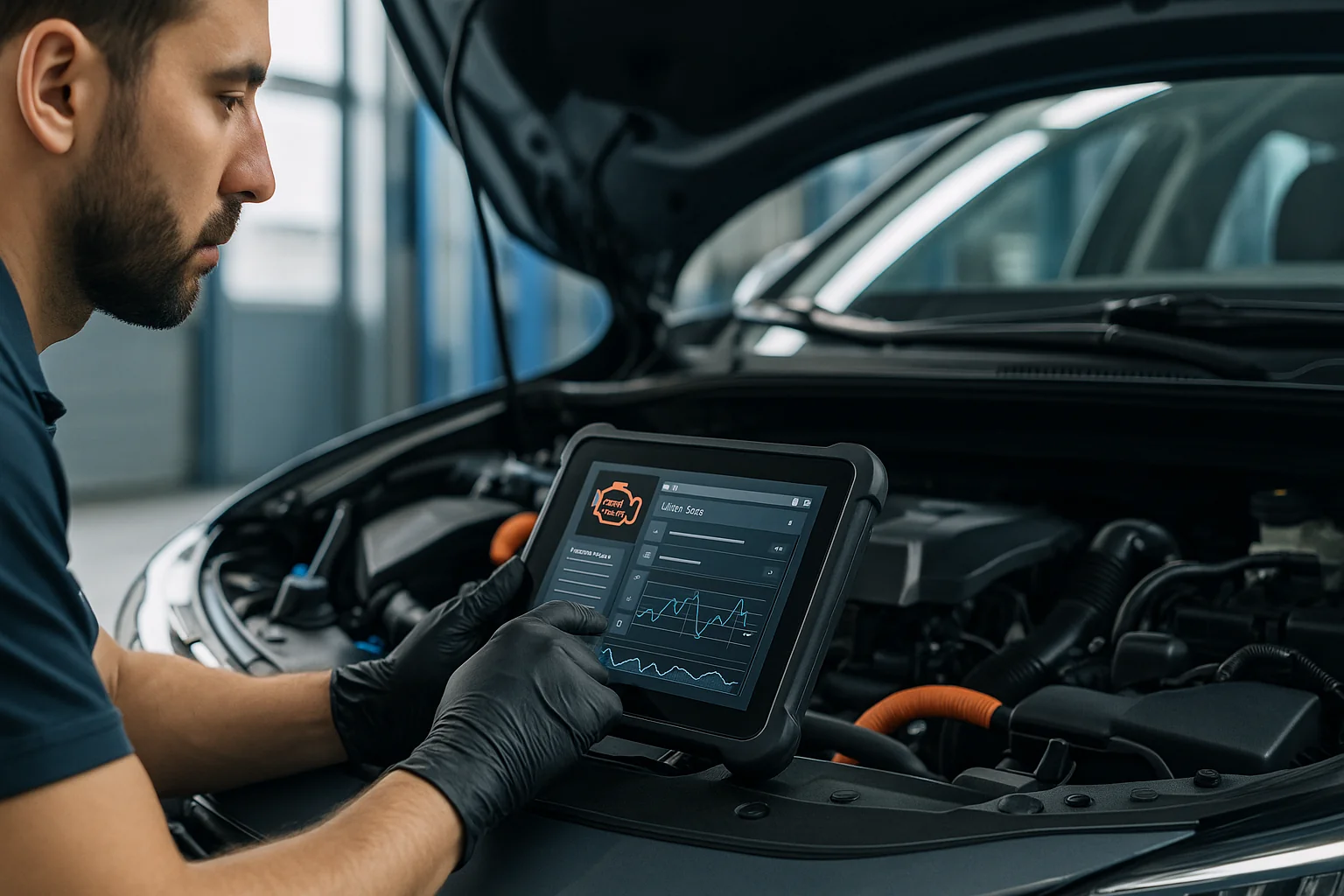

The modern auto mechanic plugs in a laptop before picking up a wrench. A new car is a rolling network of computer modules, and the person who fixes it is running software diagnostics, reading live sensor data, and calibrating camera systems — then, yes, occasionally turning a bolt the old-fashioned way.
The demand side of this trade is unusually well documented. The BLS Occupational Outlook Handbook puts the May 2024 median wage at $49,670, with about 70,000 openings per year projected through 2034. And the TechForce Foundation’s 2026 Technician Supply & Demand Report — the industry’s standard reference on the shortage — found that across ten technician sectors the country needs 241,842 new technicians a year while schools graduate about 101,743, a gap it values at $7.42 billion in lost economic output annually. The industry is not subtle about wanting you.
This guide walks the whole path: how the entry ladder actually works, what training costs at each type of school, the ASE certification structure from your first test to Master Technician, the tool bill nobody mentions at orientation, and how flat-rate pay really works.
What the Job Actually Is in 2026
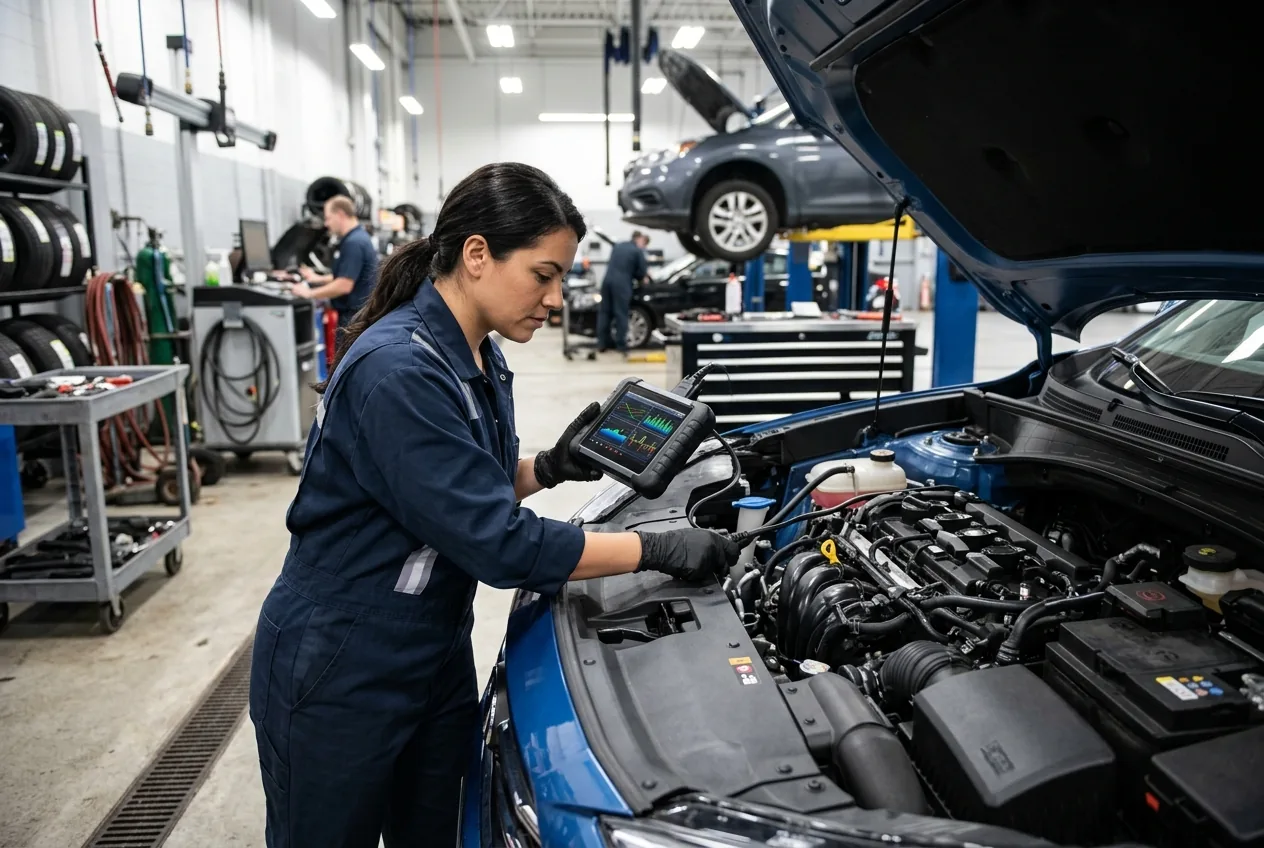
Forget the greasy-rag stereotype. Today’s automotive technician is a diagnostician first:
- Scan-tool diagnostics — connecting to the vehicle’s OBD-II port and manufacturer software to read fault codes and live data from engine, transmission, brake, and body control modules
- Electrical and electronic repair — wiring, sensors, infotainment, and the growing pile of driver-assistance (ADAS) cameras and radar that need recalibration after even a windshield replacement
- Software updates and module programming — many “repairs” now end with reflashing a control unit
- Mechanical repair — brakes, suspension, engines, transmissions; still the foundation, now guided by data instead of guesswork
Per BLS, employment is projected to grow 4% from 2024 to 2034 — about average — but the openings number is the real story: roughly 70,000 a year, mostly from retirements and career changes. The cars will keep breaking either way; that’s one job perk no economic cycle has managed to cancel.
For a broader look at where the field is heading, see our companion piece on automotive technology career opportunities.
Step 1: Start Turning Wrenches — the Lube-Tech Ladder
You don’t need any credential to get your first automotive job. The classic entry ladder:
- High school auto shop (if available) — worth taking seriously; some programs are accredited by the ASE Education Foundation and can count toward your future certification experience requirement
- Lube tech / quick-lube — oil changes, tire rotations, fluid checks at a quick-lube chain, tire shop, or dealership express lane
- General service technician — brakes, batteries, belts, basic diagnostics under supervision
- Line technician — full diagnosis and repair, your own bay, your own jobs
The lube-tech stage is genuinely entry-level: employers expect a high school diploma or GED, a driver’s license, and the ability to show up on time. The pay reflects that — BLS reports the lowest 10% of the occupation earned under $33,660 — but you’re being paid to build the two years of hands-on experience that ASE certification requires. Think of it as an audition that happens to come with a paycheck.
The trap to avoid: staying a lube tech for years without training toward the next rung. The ladder only works if you climb it, which is where school comes in.
Step 2: Pick a Training Program (and Do the Cost Math)
Formal training isn’t legally required, but it accelerates everything — it shortens the ASE experience requirement, and shops increasingly won’t hand a diagnostic-heavy bay to someone with no schooling. You have three realistic options, and the price spread between them is enormous.
Community College Automotive Programs
The value pick. Certificate programs run months to a year; an Associate of Applied Science takes about two years. Per the Imagine America Foundation, associate programs in automotive technology generally cost $10,000–$25,000 total — and in-district students at big systems pay far less. Dallas College, for example, estimates about $5,940 in tuition for the full two-year program for in-county residents. Look for ASE Education Foundation accreditation — it’s what lets your schooling substitute for certification experience later.
You can browse and compare programs in our automotive technology program directory, or start with our ranked list of the best trade colleges for auto mechanics.
Manufacturer-Sponsored Programs: T-TEN, ASEP, ASSET
The industry’s best-kept semi-secret. Toyota’s T-TEN program (Technician Training and Education Network) partners with community colleges to train technicians specifically for Toyota and Lexus dealerships — and its equivalents, GM ASEP and Ford ASSET, work the same way. At partner schools like the Community College of Philadelphia, T-TEN is a roughly two-year associate degree that alternates classroom instruction with paid work at a sponsoring dealership, and graduates leave with an AAS, factory certifications, and a foot already in the door of a network of 1,400+ Toyota and Lexus dealers.
You pay community college tuition, earn dealership wages during the work terms, and graduate essentially pre-hired. The catch is commitment: you’re training deeply on one manufacturer’s vehicles, and you need a sponsoring dealership. If you know you want dealership work, this is the strongest value in automotive education.
Private Technical Schools (UTI and Similar)
Private schools like Universal Technical Institute compress training into about a year and offer brand-specific advanced programs. They also cost several times what a community college does: IPEDS-reported 2025 tuition for UTI’s automotive program was $43,550 at its Illinois campus and $49,950 in Pennsylvania, with costs varying by campus.
To be fair to the model: the schedule is fast, the equipment is current, and manufacturer partnerships are real. But run the numbers honestly against the outcome. A UTI graduate and a community college graduate sit for the exact same ASE tests, and the certificates don’t list tuition paid. If speed matters more to you than cost, fine — just decide that on purpose, with a calculator, not in an admissions office.
Step 3: Climb the ASE Ladder — A1 Through Master Technician
ASE (the National Institute for Automotive Service Excellence) is the industry’s credentialing body, and its certifications are how employers sort technicians. This is the part of the path worth understanding precisely.
The A-Series Tests
The automobile series covers nine specialty areas:
| Test | Area |
|---|---|
| A1 | Engine Repair |
| A2 | Automatic Transmission/Transaxle |
| A3 | Manual Drive Train & Axles |
| A4 | Suspension & Steering |
| A5 | Brakes |
| A6 | Electrical/Electronic Systems |
| A7 | Heating & Air Conditioning |
| A8 | Engine Performance |
| A9 | Light Vehicle Diesel Engines |
Master Automobile Technician status requires passing A1 through A8 (A9 is a bonus specialty, not a Master requirement). Most techs test one or two areas at a time over several years, usually starting with A4, A5, and A6 — the bread-and-butter repair areas.
The Experience Requirement
Passing the test alone doesn’t certify you. Per ASE’s work experience requirements, you also need relevant hands-on work experience — two years for the automobile repair tests — or a combination of formal training and experience. Formal training can substitute for up to half of it: completing a program at an ASE Education Foundation–accredited school typically counts for one of the two years. This is the concrete payoff of choosing an accredited program — it cuts a year off your certification timeline.
Cost and Renewal
Per ASE’s current fee schedule, registration is $34 per order plus $62 per test (advanced L-series tests are $124). Certifications are valid for five years, after which you take a shorter recertification test. Many employers reimburse test fees and pay per-certification bonuses, so ask before you pay your own way.
The Realistic Timeline
- Years 0–2: Entry-level work + accredited schooling
- Years 2–4: First ASE certifications (A4/A5/A6 commonly), moving to full line-tech work
- Years 4–8: Remaining A-series tests, Master Technician status, and possibly L1 (Advanced Engine Performance) or manufacturer specialist credentials
The Tools Bill Nobody Warns You About
Here is the trade’s most under-discussed fact: professional technicians buy their own hand tools. Shops provide lifts, tire machines, and big diagnostic equipment; the rolling toolbox next to your bay — and everything in it — is yours.
The numbers are not small. In WrenchWay’s technician survey data, 57% of technicians estimate a career tool spend of $60,000 or more, and 33% name the tool investment as the single biggest challenge facing new technicians — ahead of pay and hours. Entry-level techs typically start with a modest starter set and add tools weekly from the tool trucks (Snap-on, Matco, Mac) that visit shops on payment plans.
Practical advice: start with a mid-tier starter set, buy premium only for the tools you use daily, and treat the tool truck like the running tab it is. For a full breakdown of what you actually need in year one versus what can wait, see our guide to essential tools for automotive technicians. Your toolbox will eventually be worth more than your first car — most techs can tell you the exact day that crossover happened.
Flat Rate vs Hourly: How Mechanics Actually Get Paid
This is the part of the job that surprises people most, so here it is straight.
Hourly pay is what it sounds like: a wage for hours present. Common for lube techs, fleet shops, and some independents.
Flat rate (the dominant dealership model) pays you per job, based on “book time” — a published estimate of how long each repair should take. If the book says a brake job pays 2.0 hours, you’re paid 2.0 hours whether it takes you 1.2 or 3.5.
The honest ledger:
- Upside: Fast, experienced techs “beat book” consistently — flagging more paid hours than they spend in the building. Flat rate is a big part of how senior dealership techs reach the top of the occupation’s wage range.
- Downside: Slow weeks — few customers, warranty-heavy work (warranty book times are tighter), or a diagnosis that eats a day — mean thin paychecks for the same 40 hours in the building. New techs are slower than book almost by definition, which is why the first flat-rate year is the hardest.
The industry knows the model is contentious: in WrenchWay’s surveys, about four in ten technicians say changing compensation models is the most important fix for the technician shortage, and some shops now offer hybrid or guaranteed-minimum flat-rate plans. When you interview, ask exactly how pay is calculated, what the guarantee is, and how warranty time is handled. A shop that answers those questions clearly is telling you something; so is a shop that doesn’t.
What You’ll Earn, From First Bay to Master Tech
Anchored to BLS May 2024 data: the occupation’s median is $49,670, the bottom 10% earn under $33,660, and the top 10% earn over $80,850.
Mapped onto the career ladder, that spread looks like this:
- Lube tech / entry (years 0–2): bottom of the range — near the sub-$33,660 decile
- Certified line tech (years 3–5): converging on the median as certifications and speed accumulate
- Master Tech / dealership specialist (years 6+): the top decile above $80,850 is populated largely by Master Techs on flat rate, manufacturer-certified specialists (diesel, diagnostics, EV), shop foremen, and techs who moved into service management or opened their own shops
Geography, employer type, and flat-rate proficiency move these numbers substantially — explore the state-by-state wage data on our automotive service technician career page.
The EV Shift: What It Means for Your Plan
Electric and hybrid vehicles are changing the trade’s skill mix. EVs eliminate oil changes, exhaust work, and much of the traditional powertrain — and add high-voltage battery systems, power electronics, and even more software. BLS still projects steady overall demand because the vehicle fleet keeps growing and aging, but the fastest-growing specialty inside the trade is unambiguously electrified.
ASE has responded with dedicated xEV High-Voltage Electrical Safety certifications: Level 1 (safety awareness for anyone working around electrified vehicles) and Level 2 (for technicians trained to work on high-voltage systems), each valid for five years. High-voltage systems carry lethal current, and no technician should touch them without proper training and personal protective equipment — this is formal-training territory, not learn-on-the-job territory.
For a new entrant, the strategic read is simple: conventional skills remain the volume business for the next decade, and EV competency is the differentiator that will separate wage tiers within it. Pick a program that includes hybrid/EV coursework now. Our guides to EV technician career opportunities and Michigan’s EV trade careers cover the specialty in depth.
Dealership vs Independent vs Fleet
Where you work shapes the job as much as what you fix:
- Dealership — one manufacturer, factory training pipeline, best equipment, flat-rate pay, warranty work. The fastest route to specialist credentials; the most exposure to flat-rate volatility.
- Independent shop — every make and model, broader diagnostic variety, often hourly or hybrid pay, closer customer relationships. Skills stay general; factory training is on you.
- Fleet / municipal — maintaining a company’s or city’s vehicles. Usually hourly with benefits and predictable schedules; less variety, more stability. The quiet favorite of techs with young kids, for reasons any parent can reconstruct.
None is “best” — they optimize for different things: earning ceiling (dealership), skill breadth (independent), or stability (fleet). Plenty of careers touch all three.
Where to Start This Week
The path, compressed: get hired at an entry-level bay, enroll in an ASE Education Foundation–accredited program (community college or manufacturer-sponsored if a dealership career appeals), start your two-year experience clock, test for your first ASE certifications as soon as you qualify, and keep stacking credentials toward Master Tech while the tool truck slowly takes its share.
Start with the research that costs nothing but time: compare ranked automotive programs near you, browse the program directory, and check the wage data for your state. The industry is short tens of thousands of technicians a year and says so in public, with dollar figures attached. Rarely does a career path leave the porch light on for you this deliberately.
Sources
- U.S. Bureau of Labor Statistics — Occupational Outlook Handbook: Automotive Service Technicians and Mechanics — May 2024 wage data, 2024–34 projections — https://www.bls.gov/ooh/installation-maintenance-and-repair/automotive-service-technicians-and-mechanics.htm
- TechForce Foundation — Technician Supply & Demand Report (9th annual) — May 2026 — https://techforce.org/supplydemand/
- ASE (National Institute for Automotive Service Excellence) — Work Experience Requirements — accessed July 2026 — https://www.ase.com/work-experience
- ASE — Dates, Fees & Test Times — accessed July 2026 — https://www.ase.com/dates-fees-test-times
- ASE — xEV Safety Certifications: Level 1 & 2 — accessed July 2026 — https://www.ase.com/ev/
- Toyota Motor North America — T-TEN: Technician Training and Education Network — accessed July 2026 — https://www.t-ten.com/
- Community College of Philadelphia — Toyota T-TEN Associate in Applied Science — accessed July 2026 — https://www.ccp.edu/college-catalog/degree-programs/associate-applied-science-aas/toyota-t-ten
- WrenchWay — Technician & Mechanic Statistics & Infographic — updated February 2025 — https://wrenchway.com/blog/technician-mechanic-statistics-infographic-recruiting-training-job-satisfaction-more/
- Imagine America Foundation — How Much Does Automotive School Cost? — accessed July 2026 — https://imagine-america.org/blog/much-automotive-school-cost
- College Evaluator (IPEDS data) — Universal Technical Institute Tuition & Fees (Illinois / Pennsylvania campuses) — 2025 — https://www.collegeevaluator.com/institute/universal-technical-institute-of-illinois-inc/tuition/