
Search “underwater welder salary” and the first three results promise $300,000, life expectancy of 35, and a 15% chance of dying on the job. Search the same phrase on the American Welding Society career library and you get Lightcast 2025 numbers: $62,000 at entry, $68,000 national median, $100,000+ for experienced divers. Both sets of numbers are presented as truth about the same job.
One set is closer to right than the other. The headline pay is real on the high end, but only for narrow specialty work most divers never qualify for. The headline fatality rate is misattributed — the original 15% figure traces to a small 1970s study and bears almost no resemblance to what the Bureau of Labor Statistics and NIOSH have been reporting for the last decade. The honest version of this career is less dramatic than the YouTube version and more interesting than the corporate-recruiter version.
This guide is for working welders considering the specialty, prospective welders trying to decide whether the headlines are real, and parents whose kid just announced they want to do this for a living. If you’re not yet on the welding-school side of the decision, start with our how to become a welder guide. Underwater welding is a welding career first; the diving credentials are stacked on top.
TL;DR
- Pay (per AWS / Lightcast 2025): entry-level $62,000, national median $68,000, experienced $100,000+, with saturation-diving welders at the top. Source: AWS Underwater Welder career profile.
- Pay context (BLS OEWS): the broader commercial diver occupation (SOC 49-9092) has a mean annual wage of roughly $75,000. The viral $300K figure is not consistent with what either BLS or AWS publishes for the occupation.
- Training cost and time: an ACDE-accredited commercial diving program at Divers Institute of Technology (Seattle) lists a total program cost of $48,800 over 28 weeks, with a 91% on-time graduation rate. Other accredited schools (CDA Technical Institute, Santa Barbara CC, Southern Louisiana CC) run a similar 6–8 month timeline.
- Required credentials: ACDE-accredited commercial dive school + AWS welding certifications (D1.1 structural is the workhorse; D3.6M is the AWS specification for underwater welding). Plus an ADCI dive card, a DOT/dive physical, and on-the-job sea time.
- The fatality picture, honestly: per NIOSH citing BLS data, 39 fatal occupational injuries and 460 nonfatal injuries were recorded among commercial divers during the 2011–2017 period, against a workforce of roughly 3,380 commercial divers as of 2017. That’s a serious occupational fatality rate (well above all-industry average) — but it is not the “15% lifetime” rate the viral posts cite.
- Two career types: wet welding (open water, wet metal, fillet repair work — inland and inspection) and dry hyperbaric welding (sealed pressurized habitat at depth, the highest-quality and highest-paid work — offshore and saturation). Different schools, different pay scales, different risk profiles.
- Honest bottom line: real career with real money for a narrow population of physically fit, mobile, mentally resilient welders. Not the get-rich-quick career the algorithm sells.
Where the “15% Fatality Rate” Myth Comes From
The single most cited statistic about underwater welding online is some version of “one in six underwater welders dies on the job.” That figure traces back to a 1970s academic estimate built from a tiny sample of North Sea offshore divers in an era when surface-supplied diving, saturation procedures, and OSHA’s commercial-diving standard (29 CFR 1910 Subpart T) were less mature than they are today. It has been recycled into hundreds of clickbait articles, but it is not what current federal data shows.
The current federal data:
- NIOSH (the CDC’s occupational-safety institute) reports that the Bureau of Labor Statistics documented 39 fatal occupational injuries and 460 nonfatal occupational injuries and illnesses among commercial divers during 2011–2017.
- As of 2017, the U.S. workforce was approximately 3,380 commercial divers (NIOSH, citing BLS).
- That translates to roughly 5–6 commercial diver deaths per year across the entire U.S. occupation, including all dive work (inspection, salvage, construction, welding).
5–6 deaths per year out of 3,380 active workers is a fatality rate in the range of roughly 150–180 per 100,000 — far higher than all-industry averages (the U.S. all-occupations fatality rate is roughly 3.5 per 100,000), and substantially higher than even high-risk occupations like roofing or logging. It is a dangerous job. It is not the “15% lifetime death rate” the algorithm-friendly headlines repeat.
The other inflated number that follows the 15% one — “underwater welders die at age 35” — is similarly unsupported by federal data. NIOSH does not publish a life-expectancy figure for commercial divers. Real risks are decompression sickness, chronic joint damage from repeated saturation cycles, and hearing loss from helmet noise; those are documented and serious. Dying in your thirties is not the typical outcome of the career.
That doesn’t make underwater welding safe. It just means the risk picture deserves a serious treatment, not a viral one.
What Underwater Welding Actually Is
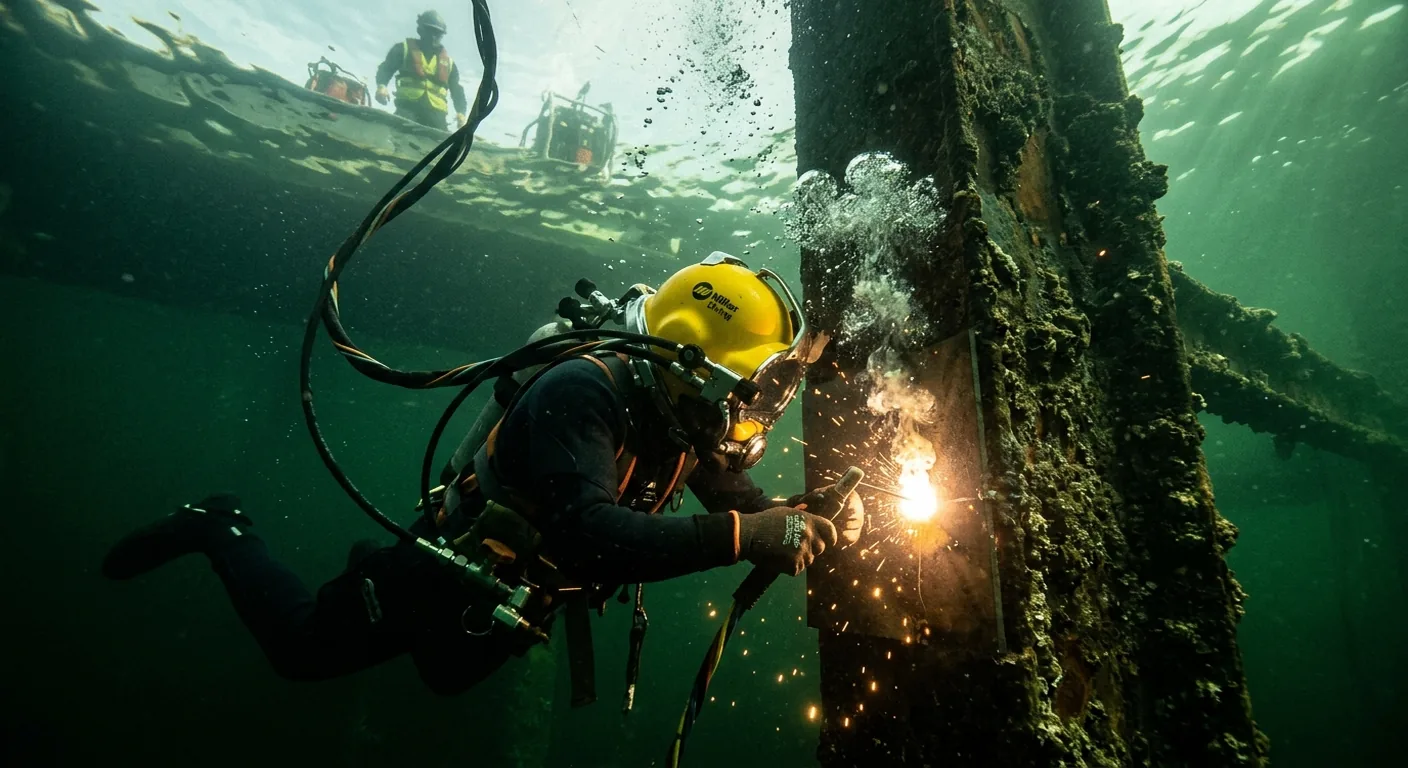
Underwater welding is a welding specialty performed by a commercial diver. The diving credential comes first because you cannot weld anywhere underwater without first being a certified, employable commercial diver under OSHA’s commercial diving operations standard. The welding is the value-add on top of the diving career.
Two distinct work types make up the field:
Wet Welding (Open Water)
The welder is in the water, breathing surface-supplied air through an umbilical, holding a stinger with a waterproofed electrode. The arc is shielded by a gas bubble formed at the electrode tip from the decomposing flux coating. Wet welds typically use shielded metal arc welding (SMAW / stick) with specially designed underwater electrodes.
Wet welding is the workhorse for inland diving (dams, intake structures, locks, bridge piers) and most inspection-and-repair work on submerged steel. It is faster to set up than dry welding, doesn’t require specialized habitat equipment, and is the kind of work an entry-level dive welder will see most often.
The downside is metallurgy. Wet welds quench rapidly in the surrounding water, which produces harder weld microstructure and higher cracking risk than the same weld made in dry air. AWS D3.6M defines weld classes and acceptance criteria specifically for underwater work, and most production wet welding sits in the mid-tier class intended for general structural service rather than the top class that approximates surface-air weld quality.
Dry Hyperbaric Welding (Habitat Welding)
A sealed steel chamber is built around the work area, the water is displaced with a breathing gas mixture, and the welder works inside in dry conditions but at the pressure of the surrounding water depth. The welds are essentially surface-quality. Dry hyperbaric work is the standard for high-criticality offshore pipeline tie-ins, repair of pressure-containing structures, and any weld that must pass radiographic inspection.
Dry hyperbaric work is the highest-paid underwater welding because it requires saturation-diving qualifications, longer training, and a smaller pool of qualified divers willing to live in pressurized habitats for weeks at a time. The work is concentrated in offshore oil and gas, deep-water pipeline maintenance, and offshore wind construction — sectors where the consequence of a weld failure is large enough to justify the cost of a habitat-welding operation.
For background on the underlying welding processes you’ll be adapting to underwater conditions, see our MIG vs TIG vs Stick guide.
The Real Pay Picture
Two authoritative sources matter for the pay question: the American Welding Society career library (occupation-specific, Lightcast 2025 data) and the Bureau of Labor Statistics OEWS data for commercial divers.
AWS / Lightcast 2025 for underwater welders specifically:
- Entry-level: $62,000
- National median: $68,000
- Experienced: $100,000+
- Saturation-diving welders working at extreme depths: well above the experienced band
Source: AWS Underwater Welder career profile. The page also notes that pay is layered: “Hazard pay, per diem, and overtime” are common compensation components on top of base wages.
BLS OEWS 2025 for the Commercial Divers occupation (49-9092) — a broader category that includes inspection divers, salvage divers, and underwater welders — reports a mean annual wage of roughly $75,000 and a median around $61,000, with the top 10% above $100,000. Underwater welders sit toward the upper end of the commercial-diving distribution because the welding credential commands a premium over inspection-only work.
For comparison, the BLS Occupational Outlook Handbook for Welders, Cutters, Solderers, and Brazers puts the median wage for all welders at roughly $51,000 as of May 2024. Underwater welding’s pay premium over surface welding is real but it is not the 6x multiple the algorithm-friendly headlines suggest.
The $300,000-plus number that circulates online describes the top of the saturation diving sub-specialty during high-tempo offshore campaigns, including all hazard pay, per diem, day rates, and overtime accumulated during a fully-utilized year. It is real for a small number of divers working a high number of days in a high-demand season. It is not the typical career trajectory and it is not a number a first-year underwater welder will see.
A reasonable expectation for the career, based on the AWS and BLS numbers together:
- Year 1 (tender / new diver, not yet welding much): $35,000–$45,000
- Years 2–3 (working diver-welder, mostly wet welding): $55,000–$70,000
- Years 4–7 (experienced welder, inland or offshore): $75,000–$100,000+
- Specialty (saturation, offshore deep, dry hyperbaric): $100,000–$200,000+ in heavy seasons
The trajectory is wide because the work is project-based. A diver who works 220 days a year on a steady offshore contract earns substantially more than the same diver working 130 days on inland inspection work. The dispersion within the occupation is unusually large.
The Required Credentials
Underwater welding requires a credentials stack that most welding-only careers do not. The standard sequence:
1. Commercial Dive School (ACDE-Accredited)
You cannot self-teach to surface-supplied commercial diving. The industry-recognized accreditation is from the Association of Commercial Diving Educators (ACDE), and the Association of Diving Contractors International (ADCI) maintains a member-school list. The most commonly attended programs in the U.S.:
- Divers Institute of Technology (Seattle, WA) — 28-week program with surface-supplied air and mixed-gas training. See the cost page for the breakdown.
- CDA Technical Institute (Jacksonville, FL) — ACDE-accredited, air/mixed-gas commercial diver program.
- Santa Barbara City College Marine Diving Technology (CA) — community college program.
- Southern Louisiana Community College — the only state-funded, accredited commercial diving program in Louisiana.
The schools each take 6–8 months and cover diving physics, decompression theory, dive medicine, surface-supplied diving operations, underwater cutting, basic rigging, and underwater welding fundamentals.
2. AWS Welding Certifications
Diving school teaches you to weld underwater at an introductory level. To be hireable as an underwater welder, you also need surface AWS welding certifications appropriate to the work:
- AWS D1.1 Structural Welding — the workhorse certification for carbon steel structural work.
- AWS D3.6M — the AWS specification specifically for underwater welding, defining wet and dry welding procedures and acceptance criteria (Class A / B / O wet welds).
- Process-specific certifications (typically SMAW for wet welding; FCAW or SMAW for dry habitat work).
Most working underwater welders earn their D1.1 either before dive school or in the year after graduation while tending on dive boats. A practical path is to attend a welding program first, certify on D1.1, then enroll in dive school with the welding side already settled. For accredited welding schools in your region, see Best Welding Schools: AWS-Accredited Programs by Region.
3. ADCI Card and Dive Physical
To work on most U.S. commercial dive contracts, you need an ADCI (Association of Diving Contractors International) entry-level diver card and a current commercial dive physical from a physician trained in dive medicine. The physical includes pulmonary function, audiometry, and a treadmill test. Existing heart, lung, ear, or sinus issues can disqualify a candidate; this is the most common reason aspiring underwater welders never enter the field.
4. Sea Time and Tender Years
You do not graduate dive school and step onto a saturation rig. The first 12–24 months are spent as a tender on a dive boat, supporting more senior divers — operating the umbilical, maintaining gear, performing surface-side tasks, and gradually getting in the water on simpler dives. Pay is on the lower end ($35,000–$45,000) and the work is physical, dirty, and often long-hours. The tender period is where the actual hireable-diver competence is built.
What Dive School Actually Costs
Real numbers from publicly disclosed sources. From Divers Institute of Technology’s cost page:
| Item | Cost |
|---|---|
| Tuition (28 weeks, $32.22 per clock hour) | $29,000 |
| Gear and dive physical | $5,850 |
| Off-campus housing and food | $10,440 |
| Travel | $1,170 |
| Personal / miscellaneous | $2,340 |
| Total program cost | $48,800 |
DIT also reports a 91% on-time graduation rate and a 28-week intended completion time.
CDA Technical Institute publishes its own cost-of-attendance figures, which run in a similar range with on-campus housing included. Community college options (Santa Barbara City College, Southern Louisiana CC) are substantially cheaper for in-state students but typically take longer and have limited annual enrollment.
GI Bill coverage: active-duty and veteran students at most ACDE-accredited schools can use the Post-9/11 GI Bill. DIT advertises up to $29,920.95 in tuition coverage for eligible veterans. Many commercial divers entered the trade after Navy salvage / EOD / hull-tech experience, and the GI Bill route is well-trafficked.
Federal aid: ACDE-accredited schools typically participate in Title IV federal financial aid, so Pell Grants and Direct Loans are available for eligible students.
The Hazards OSHA Actually Names
OSHA’s commercial diving hazards-and-solutions page lists the real risks the federal regulator cares about. Quoted directly:
“respiratory and circulatory risks, hypothermia, low visibility, and physical injury from the operation of heavy equipment under water.”
OSHA explicitly calls out dysbarism — any adverse health effect caused by a difference between ambient pressure and total gas pressure in body tissues. This is the umbrella term that covers:
- Decompression sickness (“the bends”) — nitrogen bubbles forming in tissue and blood on ascent
- Arterial gas embolism — lung overexpansion injury that pushes gas into circulation
- Barotrauma — sinus, ear, and lung pressure injuries
- Nitrogen narcosis — cognitive impairment at depth from breathing high-pressure nitrogen
Underwater welding adds welding-specific risks on top of these:
- Electric shock — arc welding underwater carries open-circuit voltage hazards even with insulated equipment.
- Hydrogen and oxygen explosions — water electrolysis at the arc produces flammable gas mixtures that can ignite in trapped pockets near the weld.
- Burns and arc flash — even in water.
OSHA’s commercial diving standard (29 CFR 1910 Subpart T) requires specific minimum crew sizes, decompression-chamber availability for deeper work, dive-medical-physical certification, and detailed dive logs. The standard, adopted in the late 1970s and periodically updated, exists because the historical fatality rate before its adoption was substantially higher than it is now.
Wet vs Dry: Different Jobs, Different Careers
The wet-vs-dry split divides the career meaningfully.
| Dimension | Wet Welding | Dry Hyperbaric Welding |
|---|---|---|
| Where the work is | Inland (dams, locks, water intakes, bridge piers, hydroelectric), nearshore (port and harbor) | Offshore (oil and gas platforms, deep-water pipelines, offshore wind) |
| Typical depth | 0–150 ft | 200–1,000+ ft (saturation work) |
| Equipment | Surface-supplied air, waterproofed electrodes, stinger | Sealed habitat at ambient pressure, surface-supplied breathing gas mix |
| Weld quality | AWS D3.6M Class A / B / O — typically Class B | Approaching surface-air quality |
| Day rate | Modest premium over surface welding | Substantial premium; saturation pay layers |
| Training overlay | Standard ACDE commercial dive | ACDE plus saturation diving qualifications |
| Typical employer | Inland dive contractors (Brennan, Underwater Construction Corporation, regional outfits) | Offshore service majors (Subsea 7, TechnipFMC, Helix Energy Solutions) |
| Time away from home | Weeks to months on inland project | Months on offshore campaigns |
Most divers spend several years inland before getting offshore opportunities. A small minority go directly offshore after dive school via specific recruiter pipelines (most commonly Gulf of Mexico work for the major service contractors). Saturation diving is a credential earned by experienced divers, not a starting role.
Career Arc: What the First Decade Looks Like
A representative path for a diver-welder who enters dive school in their early 20s with a welding background:
- Year 1 — Tender / new diver. Working on a dive boat. Diving only on simple jobs. Income $35K–$45K. Most of the year is unloading gear, maintaining umbilicals, and watching senior divers work.
- Year 2 — Break-in diver. Doing your own dives. Inspection and basic repair. Some wet welding under supervision. Income $50K–$65K.
- Year 3–4 — Working diver-welder. You can be hired as a welder on an inland contract. Income $65K–$85K with overtime and per diem.
- Year 5–7 — Experienced. You travel for the work. AWS D3.6M certification. Hired on offshore projects. Income $85K–$120K+ in good years.
- Year 8+ — Specialty or transition. Either you move into saturation diving and chase $150K+ years offshore, or you transition out of the water (most divers do): dive supervisor, dive medical technician, ROV pilot, marine inspector, project management. The body has a limit.
The transition out is normal and expected. Joint compression, hearing damage, and the cumulative effect of decompression cycles mean that most commercial divers leave saturation work by their mid-40s. The career has a built-in pivot to topside roles, and the divers who plan for that pivot fare better than the ones who don’t.
Who Should Consider This (and Who Shouldn’t)
Underwater welding is a real career for a narrow profile. Pursue it if:
- You’re physically fit and pass a commercial dive physical without conditions to manage.
- You’re comfortable in confined spaces, in cold water, and at depth in low visibility. Some people learn this in dive school; many discover they aren’t.
- You’re willing to travel and live away from home for weeks or months at a time, especially in the offshore lane.
- You can absorb $30,000–$50,000 in training cost and 6–8 months of zero income before earning a paycheck — or you have GI Bill / federal aid / family support to bridge it.
- You’re patient enough to spend 1–2 years as a tender before you’re actually welding underwater regularly.
- You have a welding background already (AWS D1.1 certification, ideally a year or more of surface welding experience). Coming in with welding-only or diving-only halves your career options.
Do not pursue if:
- You’re chasing the $300K-per-year headline as a financial fix. The number exists but it’s a specialty outcome for experienced divers in heavy offshore seasons, not a starting wage.
- You cannot pass a commercial dive physical for a non-correctable reason (uncontrolled cardiovascular condition, certain ear/sinus problems, certain pulmonary conditions). Roughly one in ten dive-school applicants washes out medically before they ever certify.
- You’re claustrophobic and have not tested this. A surface-supplied helmet at 60 feet in zero visibility is a hard place to discover this.
- You’re not comfortable with the work cycle and life pattern — months on the road, missed family events, irregular off-season income.
For welders who want pay in the $100K+ range without the diving-credentials overhead and the offshore travel pattern, pipeline welding is a closer comparable. The travel is similar; the credentials are different; the death rate is meaningfully lower.
Bottom Line
Underwater welding pays well, is far less deadly than the viral headlines claim, costs roughly $50,000 and 6–8 months to enter, and offers a real path to $100K+ for divers who survive the first two tender years and earn the right credential stack. It is not the get-rich-quick career the algorithm sells. It is a niche skilled trade with serious physical demands, real hazards documented by OSHA and NIOSH, and a built-in career-pivot expectation by the mid-40s.
If you’re already a welder considering the move, attend an ACDE-accredited dive school (DIT, CDA, Santa Barbara, Southern Louisiana CC), earn AWS D1.1 if you haven’t, and plan to tender for 12–24 months before you start welding professionally. If you’re starting from zero, weld first — pass D1.1 — then add the diving credentials. The welding side gets harder underwater; the welding-school side is where the underlying skill is built.
For the full pay-and-demand picture of welding broadly, see our welding career opportunities guide. For training programs, see the welding program directory.
Sources
- American Welding Society — Underwater Welder Career Profile — Lightcast 2025 pay data — https://www.aws.org/career-resources/career-paths-in-welding/underwater-welder/
- NIOSH (CDC) — Commercial Diving — Maritime Safety and Health Studies, citing BLS 2011–2017 fatal/nonfatal injury counts and 2017 workforce size — https://www.cdc.gov/niosh/maritime/about/commercial-diving.html
- OSHA — Commercial Diving: Hazards and Solutions — dysbarism, drowning, electric shock, low visibility — https://www.osha.gov/commercial-diving/hazards-solutions
- OSHA — Commercial Diving Overview — 29 CFR 1910 Subpart T standard — https://www.osha.gov/commercial-diving
- U.S. Bureau of Labor Statistics — Occupational Employment and Wage Statistics: Commercial Divers (49-9092) — May 2025 wage data — https://www.bls.gov/oes/current/oes499092.htm
- U.S. Bureau of Labor Statistics — Occupational Outlook Handbook: Welders, Cutters, Solderers, and Brazers — May 2024 median wage — https://www.bls.gov/ooh/production/welders-cutters-solderers-and-brazers.htm
- Divers Institute of Technology — Program Cost — $48,800 total / 28 weeks / 91% on-time graduation — https://diversinstitute.edu/student-guide/cost/
- CDA Technical Institute — Commercial Diver Program — ACDE-accredited air/mixed gas training — https://www.commercialdivingacademy.com/
- Association of Diving Contractors International — ADCI Member Schools List — accredited commercial diving programs — https://www.adc-int.org/files/ADCI%20MEMBER%20SCHOOLS.pdf