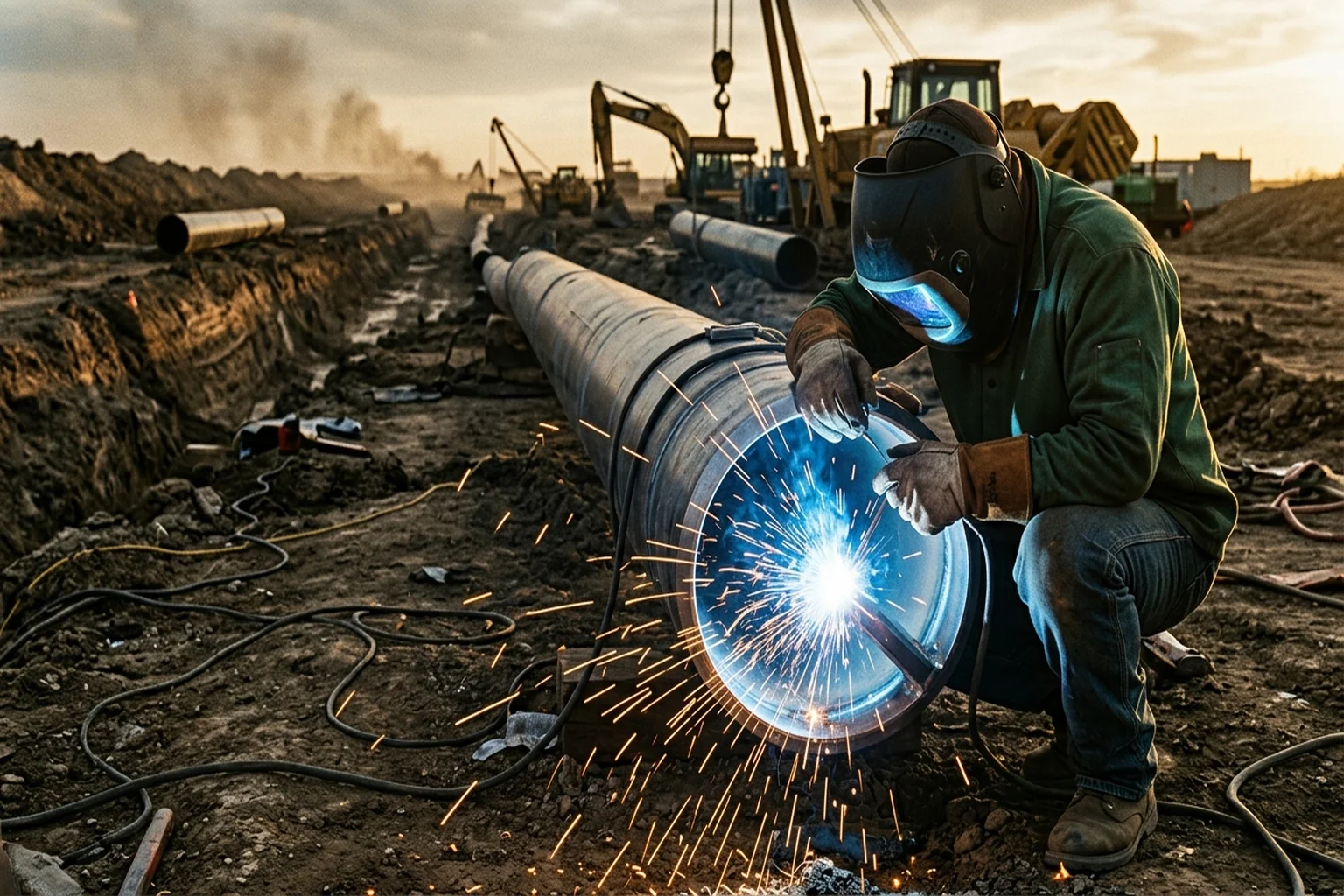
A journeyman pipeline welder under the National Pipeline Labor Agreement makes between $52.07 and $53.00 per hour in straight wages this year, plus a $165-per-day per diem, plus truck pay if he runs his own rig — and he earns it standing in a Bakken-winter ditch trying to lay down an X-ray-quality root pass on a 36-inch fixed-position joint while the temperature reads minus eleven. That’s the deal. The pay is real, and so is everything that comes with it.
Pipeline welding is not the hardest welding job on Earth — underwater hyperbaric work probably owns that title — but it is the one with the cleanest income-to-credential ratio. The barrier to entry is high: a 6G performance qualification on schedule 80 pipe is a test most working welders fail on their first attempt. The reward is a wage profile that reaches well into six figures even in moderate-cost states, and a job that has not been automated, offshored, or commoditized.
This article is for welders evaluating the specialty, prospective welders who want to know if the headlines are real, and parents trying to figure out whether their kid’s welding-school flier is selling a fantasy or a roadmap.
TL;DR
- Pay range: The general welder, cutter, solderer, and brazer median is $51,000/year (May 2024) per BLS; pipeline welders sit far above that. Working pipeline welders under the Local 798 NPLA scale earn $52.07–$53.00/hr base wages on covered projects, plus $165/day per diem — a fully-utilized year compounds into six figures. Specialty work (X-ray service, offshore, nuclear) clears further above that.
- The 798 scale: The 2025–2026 Pipeliners Local 798 wage rates set Journeyman High Scale at $52.07–$53.00/hr depending on state, with a Journeyman 90% rate of $46.28–$47.11, plus $165/day per diem for welders ($105 for non-welder helpers).
- The two gatekeepers: A 6G performance qualification (45° fixed pipe in all positions) and a procedure qualification under API 1104 — the American Petroleum Institute standard for welding pipelines. Without these, you are not pipelining.
- The honest part: You go where the work is. Permian Basin, Bakken, Marcellus, the Gulf Coast — multi-month travel away from home is normal. The work cycle tracks oil and gas capital spending plus federal infrastructure programs. The career is mobile by design.
Why Pipeline Welding Pays So Much
Most of welding does not pay $100K. The BLS Occupational Outlook Handbook puts the median welder, cutter, solderer, and brazer wage at $51,000 as of May 2024. Pipeline welders sit far above that median. Four reasons:
- The failure cost is enormous. A defective weld on a high-pressure crude oil pipeline, a refinery hydrocracker line, or a natural gas transmission main can rupture, leak, ignite, or kill people. Every weld is X-rayed or ultrasonically tested. Every reject costs the contractor money. Welders who repeatedly produce X-ray-clean welds command premium rates because their throughput is the contractor’s profit margin.
- The skill ceiling is high. A 6G performance qualification — welding a fixed pipe inclined at 45 degrees, where the welder must execute every position (flat, vertical, overhead, and everything in between) on a single joint — is one of the hardest tests in the trade. According to GoWelding.org and welding-school programs, beginners typically need 12 to 18 months of dedicated pipe practice to be ready for the test, and most fail their first sit. For a deeper look at the underlying processes you’ll be combining, see our MIG vs TIG vs Stick guide.
- You travel for the work. Pipelines are not built where people live. They run from production basins to refineries and ports, often across remote, weather-exposed terrain. Per diem and travel pay exist because nobody would do this from home.
- Demand outlasts the cycle. Even in oil and gas downturns, there is repair, replacement, and integrity-management work — the BLS Oil and Gas Workers OOH projects roughly 10,600 openings per year in oil and gas occupations through 2034. Federal infrastructure programs and the LNG export buildout add structural demand on top of replacement cycles.
A general-purpose welder’s median wage is $51,000 because most welding is shop work — repeatable, supervised, and not weather-exposed. Pipeline welding inverts every variable: harder test, harder conditions, higher consequence, longer travel. The pay differential exists because the labor pool that actually qualifies is small.
Decoding the Pay Structure
The $115K headline number is real, but it doesn’t show up as a salary. Pipeline welder compensation is layered, and understanding the structure matters before you evaluate any job offer.
The Local 798 NPLA scale
Pipeliners Local 798 is the United Association local that represents most union pipeline welders and helpers in the United States. The National Pipeline Labor Agreement (NPLA) sets the wage scale that travels with welders across state lines for covered projects.
For the 2025–2026 contract year (wage scale PDF):
- Journeyman High Scale: $52.07/hr in Alabama, Arkansas, and Colorado; $53.00/hr in Arizona; with state-by-state variation in between
- Journeyman 90%: $46.28–$47.11/hr (the rate paid to journeymen who haven’t yet earned the High Scale designation)
- Per diem: $165/day for welders, $105/day for non-welder classifications
- Helper rates: Lower base, with progression toward journeyman classification
A journeyman welder on a six-month covered project typically clears these line items: ~2,000 working hours at scale, ~180 days of per diem, plus overtime when the schedule supports it. The math compounds quickly: $52 × 2,000 = $104,000 base, plus ~$30,000 in per diem, plus overtime — $140K+ is achievable for a fully-utilized year.
The rig welder model
Outside of strict day-rate situations, many pipeline welders run their own welding rigs — pickup trucks fitted with engine-driven welding machines, gas cylinders, and tooling. The compensation in this model splits into:
- Arm pay — the welder’s labor rate, typically $36–$52/hr depending on contract and region
- Truck pay — a separate payment for the use of the welder’s rig, typically $15–$25/hr on top of arm pay
- Per diem — daily living expense allowance, $100–$165/day depending on contract
A welder owning his rig is essentially leasing equipment to the contractor in addition to selling labor. The model has tax advantages but also requires substantial upfront capital — a complete pipeline rig (truck, welder, miscellaneous gear) commonly runs $80,000–$120,000 before the first job.
X-ray welder day rates
Welders who consistently produce X-ray-quality welds on critical-service pipe (high-pressure transmission, sour service, nuclear-adjacent process) command the top of the market. On non-union projects, these welders are often paid on a day-rate basis rather than hourly. Day rates are not published in any official wage source, but the rate reflects production-quality output, not just hours on the clock — contractors pay a premium because every X-ray-rejected weld is a direct hit to their schedule and margin.
The bottom-line takeaway: any single pay number is misleading without the full structure. Always evaluate offers as base + truck + per diem + overtime + benefits, not as an hourly rate alone.
The Certifications You Actually Need
Pipeline welding is a credential-gated specialty. The credentials matter in a specific order:
1. Performance qualifications — 6G is the gateway
A welder performance qualification (WPQ) certifies that you can produce a sound weld on a specific configuration. Common positions, ranked roughly by difficulty:
- 1G–4G (groove welds in plate, flat through overhead) — covered in basic welding programs
- 2G, 5G, 6G (groove welds in pipe, horizontal through inclined-fixed) — pipe-specific tests
- 6G — pipe at 45° fixed inclination, requiring the welder to execute every position on a single joint without rotating the pipe
Per GoWelding.org and pipe welding programs, the 6G test is the single most important performance qualification for pipeline work. A 6G in SMAW (stick) plus GTAW (TIG) root, on schedule 80 carbon steel, is the typical baseline test rig. Pipeline contractors test welders on the rig before hiring. A single rejected weld during the test ends the interview.
2. Procedure qualification — API 1104 is the standard
API 1104, Welding of Pipelines and Related Facilities, is the American Petroleum Institute standard governing welds on pipelines transporting crude oil, petroleum products, fuel gases, CO₂, and nitrogen. It sets the welding procedure specifications (WPS) and inspection criteria for pipeline welding and is referenced in U.S. Department of Transportation pipeline safety regulations.
Welders don’t typically write procedures themselves — that’s the job of a Certified Welding Inspector (CWI) or welding engineer — but they must be qualified to a procedure that complies with API 1104. Inspectors and senior welders pursue the AWS API 1104 Endorsement, a 60-question, two-hour exam requiring 72% to pass. The endorsement is a career-progression credential for welders moving toward inspection or supervision.
3. Adjacent codes for plant and process work
Refinery, petrochemical, and power plant pipe work runs under different codes:
- ASME B31.3 — process piping (refineries, chemical plants)
- ASME B31.1 — power piping (boilers, steam systems, turbine plants)
- ASME Section IX — the qualification standard underlying B31 procedures
- AWS D1.1 — structural steel (relevant for pipe-rack and pipeline support structures)
Many career pipeline welders cross-qualify into B31.3 and B31.1 to take refinery and power plant turnaround work between pipeline projects. This is one of the smartest career moves in the specialty — it turns a seasonal pipeline calendar into year-round work.
For the foundational welding curriculum that gets you to the starting line, see our How to Become a Welder guide.
The Training Path
There is no two-week shortcut to pipeline welding. The realistic sequence:
Step 1 — General welding foundation (6–18 months)
Most pipeline welders start with a community college, technical school, or trade school welding program. AWS-accredited programs that teach SMAW, GTAW, GMAW, and FCAW with substantial pipe content are the right starting point. See our Best Welding Schools by Region article for accredited program criteria.
Step 2 — Pipe-specific training (3–18 months)
After basic certification, welders move into pipe-focused programs. Most pipe welding programs include around 120 hours of hands-on instruction plus practice time, and are built around the 3G/4G plate combo first, then 2G/5G/6G pipe progression. The 6G test typically takes 12 to 18 months of cumulative experience for a beginner to be ready.
Step 3 — Helper or apprentice on a pipeline crew
Welders who join Local 798 typically start as welder helpers — a paid classification under the NPLA — and accumulate hours and seniority while studying for the welder qualification. Non-union welders break in by passing a contractor’s test rig and getting hired directly. Either way, the first year on an actual pipeline is heavy on grunt work, fitting, and bevel preparation while you continue practicing the welding itself.
Step 4 — Test the rig
The defining moment in a pipeline welder’s career is passing a contractor’s test rig — a real pipeline joint welded under inspection conditions, then X-rayed. Welders test repeatedly across their careers because each new project, contract, or contractor often requires a fresh qualification. As tradeable.org and welding-career sources note, failure on the first attempt is common — many welders take two or three attempts to pass on their first major test.
The career-arc context — what welding looks like long-term, why the industry is short workers, where the demand is going — is covered in our Welding Career Opportunities article.
Local 798 vs Non-Union Pipelining
Like most trades, pipeline welding has a union side and a merit-shop side. The split:
Local 798 (union)
- Largest pipeline welder local in the U.S., based in Tulsa, Oklahoma
- Members work under the National Pipeline Labor Agreement (NPLA) on covered projects nationally
- Compensation: scale wages, $165/day per diem, defined-benefit pension, employer-paid healthcare, annuity
- Trade-off: dispatching is typically out of the union hall, work assignment depends on book position and seniority, and side work for non-union pipeline contractors is restricted
Non-union (open-shop) pipeline contractors
- Compensation set by the contractor, often on a day-rate or hourly + per diem structure
- Geographic strength in regions with weak union density (parts of the South, Gulf Coast, Mountain West)
- Faster start (no waiting list) and more direct contractor-to-welder relationships
- Trade-off: no portable pension across employers, healthcare varies, wage continuity depends on contractor performance and project pipeline
A meaningful share of pipeline welders work both sides over a career — union for major covered projects, non-union for repair, integrity, and smaller-diameter work. The skills and credentials transfer cleanly.
The Honest Reality
The Instagram version of pipeline welding shows the truck, the paycheck, and the welcome dinners. The full reality:
- You travel. Multi-month projects in the Permian, the Bakken, the Marcellus, the Haynesville, the Gulf Coast, or wherever the next contract lands. Welders who can’t be away from home for 60–120 days at a stretch should pick a different specialty.
- The cycle matters. Pipeline construction tracks oil and gas capital expenditure, LNG export buildout, federal infrastructure spending, and natural gas transmission expansion. In capex downturns, hours dry up. The classic welder mitigation is to cross-qualify into refinery/power plant turnaround work to bridge the cycle.
- The weather is not optional. Bakken winter, Permian summer, Louisiana storm season — pipeline welders work through all of it. Weather delays cost money and don’t pay; finished joints under inspection schedule do.
- The physical wear is real. Knees, shoulders, lungs (welding fume), and hands take damage over decades. Welders who plan a 30-year career typically migrate toward inspection (CWI), supervision, or contractor ownership before their bodies force the issue.
- Test failure is normal. Failing a test rig is not a career-ending event. Most pipeline welders fail at least one rig somewhere in their career. The ones who succeed long-term treat each rejected test as data and re-test.
- The income is real. With travel and per diem stacked, six figures is the median for working pipeline welders, not the ceiling. The ceiling is higher than most welders ever bother to chase.
Adjacent Specialty Paths
Pipeline welding is the entry point to a broader high-pay welding ecosystem:
- Offshore pipe welding — Gulf of Mexico platforms, North Sea, West Africa. Higher pay, longer rotations, stricter qualifications.
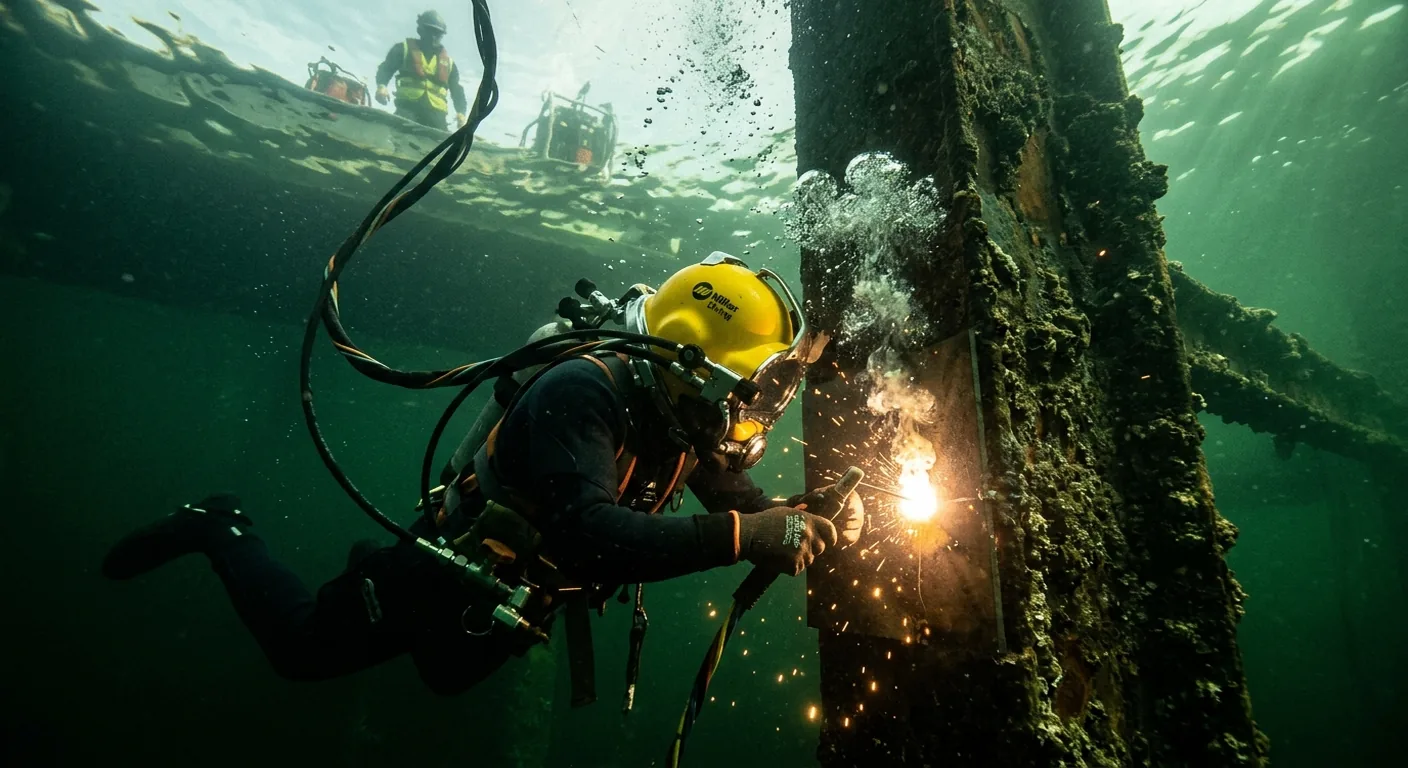
- Underwater (hyperbaric) welding — surface-supplied diving plus welding qualifications. The highest-paid, highest-risk niche in welding.
- Nuclear pipe welding — ASME Section III qualifications for nuclear plant pipe. High pay, intense documentation and inspection regime.
- Refinery turnaround welding — short-cycle, high-intensity work during scheduled plant shutdowns. Year-round opportunity for welders willing to travel.
- Inspection (CWI / SCWI / AWS endorsements) — the long-career exit ramp. Adds the AWS Certified Welding Inspector and API 1104 endorsements for a pivot from welding to inspecting.
The specialty is a platform, not a dead end.
What to Do Next
If you’re starting from zero and the pay structure makes sense to you:
- Enroll in an AWS-accredited welding program with strong pipe content
- Earn 6G certification in stick and TIG combo on schedule 80 pipe
- Get on a pipeline crew as a helper (Local 798 or a non-union pipeline contractor) to accumulate site experience while continuing to practice
- Test the contractor’s rig when you’re ready and tested clean repeatedly in practice
- Cross-qualify into B31.3 / B31.1 to bridge the seasonal cycle with refinery and power plant work
Patience is the part nobody markets. The credential takes 18–36 months from day one to first journeyman pipeline paycheck. The income that follows is worth the climb — for welders who fit the lifestyle the work demands.
Sources
- U.S. Bureau of Labor Statistics — Occupational Outlook Handbook — “Welders, Cutters, Solderers, and Brazers” — May 2024 data — https://www.bls.gov/ooh/production/welders-cutters-solderers-and-brazers.htm
- U.S. Bureau of Labor Statistics — Occupational Outlook Handbook — “Oil and Gas Workers” — accessed 2026 — https://www.bls.gov/ooh/construction-and-extraction/oil-and-gas-workers.htm
- Pipeliners Local 798 — “Journeyman High Scale Rates: June 2, 2025 – May 31, 2026 (NPLA wage scale)” — May 2025 — https://local798.org/wp-content/uploads/2025/05/2025-2026-npla-wage-rates_05272025.pdf
- American Petroleum Institute — “API Standard 1104, Welding of Pipelines and Related Facilities, 22nd Edition” — accessed 2026 — https://www.api.org/products-and-services/standards/important-standards-announcements/1104
- American Welding Society — “API 1104 Endorsement for CWI & SCWI” — accessed 2026 — https://www.aws.org/certification-and-education/professional-certification/cwi-and-scwi-endorsements/api-1104-endorsement/
- American Welding Society — “Pipeliner Career Profile” — accessed 2026 — https://www.aws.org/career-resources/career-paths-in-welding/pipeliner/
- GoWelding.org — “How to Pass a SMAW 6G Pipe Welding Certification” — accessed 2026 — https://gowelding.org/welding-certification/smaw-6g-pipe/