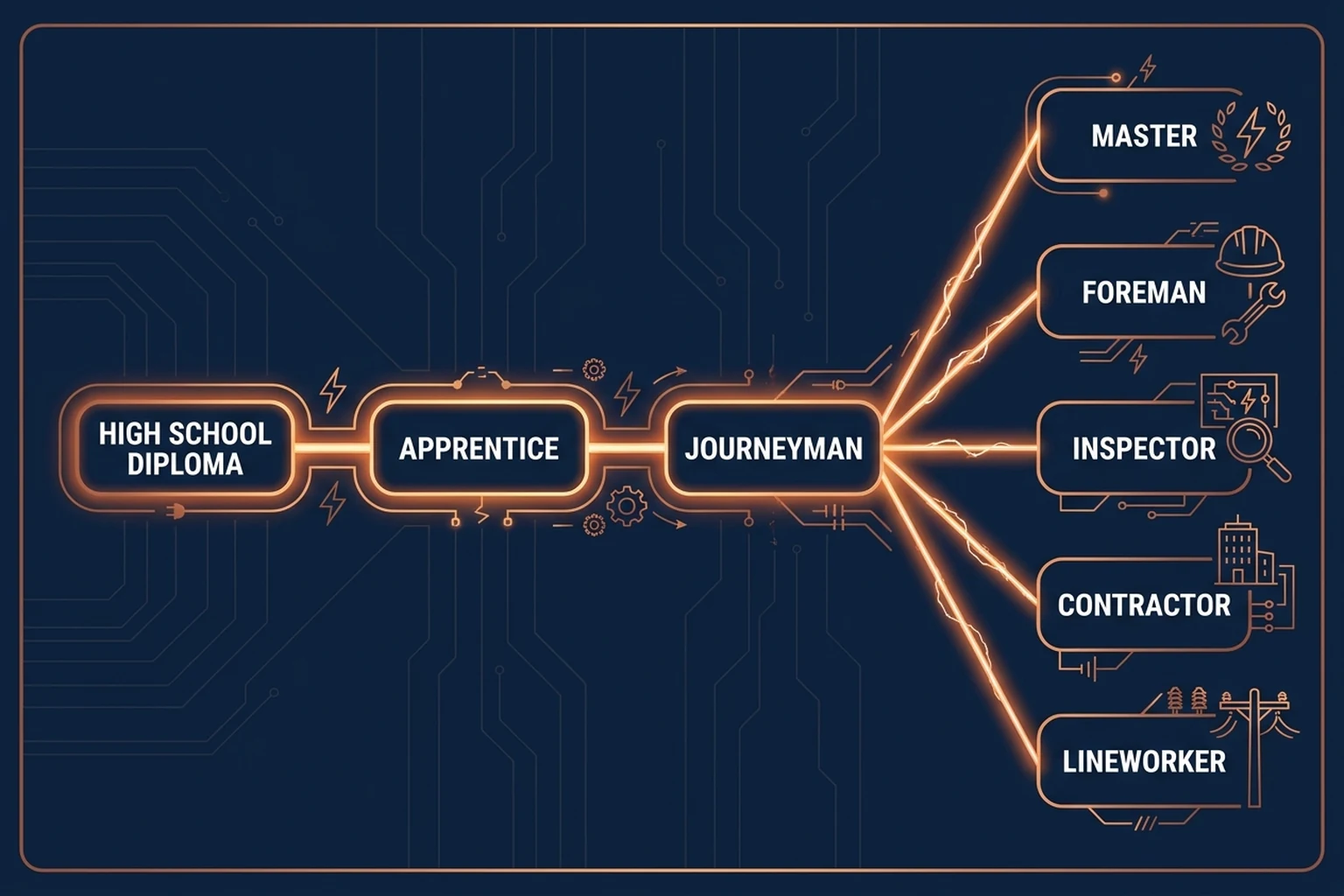

A journeyman electrician in Texas was earning $28 an hour — solid pay, but below the national median of $62,350 for electricians. He had just passed his master electrician exam and earned an additional specialty certification in industrial controls. When he asked his employer for a raise, he did not say “I feel like I deserve more.” He showed up with his new credentials, a printout of local wage data from the BLS, and two competing offers he had received without even applying — recruiters had contacted him. He walked out with a $9-per-hour raise and a vehicle allowance.
That is not a rare outcome in this market. The construction industry needs 349,000 net new workers in 2026 according to Associated Builders and Contractors, and that figure is actually down from the 439,000 gap in 2025. Employers are competing hard for qualified tradespeople. But having leverage and using it effectively are two different things. This guide covers how to do the second part.
TL;DR
- The market is on your side. Construction and extraction occupations pay a median of $58,360 — 18% above the national median for all occupations — and the labor shortage is pushing wages higher.
- Know your number before you ask. Use BLS data, regional wage surveys, and job postings to establish what your trade, experience level, and certifications are worth in your area.
- Union and non-union negotiations are fundamentally different. Union wages are set by collective bargaining agreements; non-union pay is individually negotiated.
- Certifications are your strongest card. Additional credentials can boost earnings by 15–50%, and they give you concrete proof of value.
- Timing matters. Ask after completing a major project, earning a new credential, or when your employer is struggling to fill positions.
- Going independent changes the math entirely. Self-employed tradespeople set their own rates, but they also cover their own taxes, insurance, and benefits.
Why Trade Workers Have More Leverage Than They Think
The skilled trades are in a structural labor shortage, and that shortage translates directly into bargaining power. About 20% of the construction workforce is over age 55, and retirements are outpacing new entrants. The Bureau of Labor Statistics projects that construction and extraction employment will grow faster than average through 2034, driven by infrastructure spending, housing demand, and the clean energy buildout.
What does that mean for you? It means your employer almost certainly finds it harder and more expensive to replace you than it was five years ago. A 2026 analysis from Randstad found that demand for skilled trades workers is growing three times faster than demand for professional roles, and workers in high-demand specialties like data center construction are seeing 25–30% pay increases as employers compete for a limited pool.
This is not a temporary blip. The skilled trades shortage is driven by demographics and decades of underinvestment in trade education. It will take years to close the gap, which means the leverage workers have today is likely to persist.
But leverage alone does not get you a raise. You still have to make the ask — and make it well.
Step 1: Know What You’re Worth
The single biggest mistake people make when negotiating pay is guessing what they should earn based on what friends say or what feels right. Do the research instead.
Where to find real wage data
- Bureau of Labor Statistics (BLS): The Occupational Employment and Wage Statistics program publishes annual wage data by occupation, state, and metro area. This is the most reliable baseline for what your trade pays nationally and locally. You can see 10th, 25th, 50th, 75th, and 90th percentile wages — which tells you not just the average, but where the top earners land.
- Job postings: Many states now have salary transparency laws requiring employers to post pay ranges. Browse current openings in your trade and region. Even if you are not job hunting, these postings tell you what the market is paying right now.
- Union wage scales: If you are in a union or considering one, the local’s collective bargaining agreement spells out exact hourly rates by classification. The IBEW and UA both publish general information, and your local hall can provide your specific CBA.
- Industry salary guides: Firms like Randstad publish annual compensation guides specific to skilled trades, broken down by role, experience level, and region.
What to look for
You want three numbers:
- Your market rate — the median pay for your trade, experience level, and location.
- The ceiling — the 75th or 90th percentile for your trade. This shows what top earners make and gives you a target.
- Your current gap — the difference between what you earn now and what the data says you could earn.
For context, here is what May 2024 BLS data shows for some of the major trades at the national level:
| Trade | Median Annual Wage | 90th Percentile |
|---|---|---|
| Electricians | $62,350 | $104,180 |
| Plumbers, Pipefitters | $62,820 | $102,950 |
| HVAC Mechanics | $57,300 | $86,710 |
| Construction Equipment Operators | $55,280 | $92,250 |
| Welders | $48,600 | $71,380 |
The gap between median and 90th percentile is your negotiation runway. An electrician earning $50,000 is leaving real money on the table — the data says top earners in the same trade make twice that. For a deeper dive on how earnings grow with experience, see our guide on salary progression in the trades.
Step 2: Build Your Case Before You Ask
Pay negotiations are not about feelings or fairness. They are about value — specifically, the value you bring that your employer would have to pay someone else to replace.
The strongest cards you can play
Certifications and licenses. This is the most concrete, verifiable proof of value you can bring to a negotiation. A trade certification like NATE for HVAC, a master electrician license, or an AWS welding certification signals a level of competence that reduces your employer’s risk and broadens the scope of work you can handle. Workers with professional certifications earn roughly 35% more than those without them, according to BLS data.
Specialization. Niche skills command premium pay. Industrial electricians, refinery-certified plumbers, and welders with exotic alloy certifications earn significantly more than generalists because there are fewer people who can do what they do. If you can position yourself in a high-demand specialty, you become harder to replace — and harder to replace means better leverage.
Reliability and safety record. This one gets overlooked. Employers in the trades lose significant money to turnover, absenteeism, and workplace accidents. If you consistently show up on time, pass drug tests, maintain a clean safety record, and do not generate callbacks, that has direct financial value. Quantify it if you can: “I had zero safety incidents in three years and a callback rate under 2%.”
Revenue generation. If you can tie your work to specific outcomes — completed projects, revenue generated, customer retention — do it. “I completed 47 service calls last month with a 98% satisfaction rating” is far more persuasive than “I work hard.”
Step 3: Understand How Union and Non-Union Negotiations Differ
The mechanics of negotiating pay depend heavily on whether you work in a union or open-shop environment. For a comprehensive comparison, see our union vs. non-union trades breakdown.
Union negotiations
If you work under a collective bargaining agreement (CBA), your base wage is not individually negotiated. It is set by the CBA for your classification — apprentice, journeyman, foreman, and so on. According to BLS data, union construction workers earn an average of $33.86 per hour in base wages, with total compensation including benefits reaching about $56.12 per hour. Nonunion construction workers average $25.16 per hour in base wages — a gap of roughly 35%.
That does not mean union members have no ability to influence their earnings. Here is where union workers still have room to negotiate or advance:
- Classification upgrades. Moving from journeyman to foreman or general foreman carries a built-in raise. Demonstrating leadership and project management skills accelerates that path.
- Overtime and premium work. Certain jobs — night shifts, hazmat, confined space, high-altitude — carry premium rates under most CBAs. Volunteering for this work increases your earnings without changing your base classification.
- Supplemental skills. Some CBAs provide additional pay for bilingual workers, workers with multiple trade certifications, or workers who can operate specialized equipment.
- Running for leadership. Union officers and stewards often receive stipends or paid time for union business, and the experience opens doors to higher-paying roles in training, safety, and management.
The BLS Employment Cost Index for December 2025 showed that union worker compensation costs rose 4.0% over the prior year, compared to 3.3% for non-union workers — meaning the union wage advantage is not just maintained, it is growing.
Non-union negotiations
In an open-shop environment, your pay is between you and your employer. This means more risk but also more opportunity. There is no guaranteed floor, but there is also no ceiling set by a contract.
The negotiation itself follows standard principles, with some trade-specific nuances:
Do it in person. This is not an email conversation. Request a sit-down with your direct supervisor or the business owner. Trades culture values directness.
Lead with your value, not your needs. “I completed my journeyman certification and I’d like to discuss adjusting my pay to reflect that” is stronger than “I need more money because my rent went up.”
Name a specific number. Based on your research, state the wage you are targeting and why. “The BLS median for electricians in this metro area is $32 an hour. I’m currently at $27 with five years of experience and a journeyman card. I’d like to move to $33.” Vague requests get vague responses.
Have a fallback. If a raise is not possible right now, negotiate other forms of compensation: a tool allowance, a company vehicle, paid training for an additional certification, more overtime opportunities, or a defined path to the number you want within six months.
Be prepared to walk. This is the nuclear option, and you should only use it if you genuinely have other offers or are willing to job-hop. But in a market where employers need 349,000 new construction workers in 2026, the threat of losing a proven worker carries real weight.
Step 4: Pick the Right Moment
Timing a pay conversation well can matter as much as the content of the conversation itself. Some moments are significantly better than others.
Good timing
- After earning a new certification or license. You just increased your market value in a quantifiable way. This is the strongest natural trigger for a pay discussion.
- After completing a major project successfully. Your contribution is fresh in everyone’s mind.
- During a labor crunch. If your employer is struggling to hire or just lost experienced workers, your retention value spikes.
- At annual review time. If your company does formal reviews, use the structure. Come prepared with data, not just a hope that the boss remembers your contributions.
- When you receive an outside offer. Use this carefully — presenting a competing offer as a negotiation tool works, but only if you are genuinely willing to take it. Bluffing erodes trust.
Bad timing
- During a company crisis. If the firm just lost a major contract or is going through layoffs, asking for a raise signals poor situational awareness.
- On a Monday morning or Friday afternoon. The former catches people off guard; the latter risks getting brushed off until “next week,” which becomes never.
- When you are angry about something else. Pay conversations should be strategic, not emotional.
Step 5: Think Beyond Hourly Rate
Base pay is only part of your total compensation, and in the trades, the other components can add up to a significant share of your real earnings.
Benefits to negotiate
- Health insurance. In construction, 96% of union workers have health coverage compared to 69% of non-union workers. If your employer does not offer coverage, that gap costs you thousands per year out of pocket — and should be factored into any wage comparison.
- Retirement contributions. A 401(k) match or pension contribution is free money. A 4% match on a $65,000 salary is worth $2,600 per year.
- Tool and vehicle allowances. Trades professionals spend thousands annually on tools and transportation to job sites. A company truck or a $200/month tool allowance has real financial value.
- Paid training and certification. An employer who pays for your continuing education and certifications is investing in your earning power. An HVAC company that covers your NATE exam and study materials is giving you a credential that travels with you.
- Per diem and travel pay. If your work takes you to remote sites, per diem rates and travel bonuses can add $50–$150 per day to your effective compensation.
- Overtime structure. In the trades, overtime is often where the real money is. Understanding your company’s overtime policy — and whether you can negotiate priority access to OT hours — directly impacts your annual earnings.
When comparing two offers or evaluating your current position, calculate total compensation, not just the hourly rate. An employer paying $30/hour with full benefits, a truck, and regular overtime might be worth more than one offering $35/hour with nothing else.
The Independent Contractor Option
If you have been in the trades long enough to have a client base, a reputation, and the right licenses, going independent changes the negotiation entirely. You are no longer asking someone else for a raise — you are setting your own rates.
The general rule of thumb is that independent contractor rates should be 50–70% higher than equivalent employee wages to account for self-employment tax (15.3% for Social Security and Medicare), your own health insurance, retirement savings, and periods without work. A journeyman electrician earning $35/hour as an employee would need to charge roughly $53–$60/hour as an independent to maintain equivalent total compensation.
The upside is significant: self-employed tradespeople set their own rates, choose their clients, and capture the full profit margin on their work. The SBA reports that there are 3.66 million small construction businesses in the U.S., and roughly 23% of construction workers are self-employed.
The downside is equally real: inconsistent income, no employer-sponsored benefits, the administrative burden of running a business, and a first-year failure rate of 36.8% for construction businesses. Our guide on how to start your own trade business covers the full picture — licensing, insurance, financing, and what self-employed tradespeople actually earn.
Common Mistakes to Avoid
Comparing yourself to coworkers. “Mike makes more than me” is not a negotiation strategy. It creates resentment and puts your employer in an awkward position. Focus on your own value and market data.
Accepting the first no. A “no” often means “not right now” or “not at that number.” Ask what it would take to get to that number and when. Get a specific timeline and revisit it.
Negotiating only when you are desperate. The best time to negotiate is when things are going well — when you are performing, when the company is busy, when you have options. Desperation is a weak position.
Ignoring the total package. An employer who cannot give you $5/hour more might be able to cover a $3,000 certification course, add a truck allowance, or guarantee 50 hours a week instead of 40. Be creative.
Burning bridges. The trades are a small world in most markets. Every contractor knows other contractors. Leaving a job professionally — with notice, with the work wrapped up, with relationships intact — matters more than in most industries. Even if a negotiation fails, handle it with respect.
What to Do Right Now
If you have read this far, here is a concrete action plan:
- Look up your trade’s BLS wage data at bls.gov/ooh for your specific metro area. Write down the 50th and 75th percentile wages.
- Compare that number to your current pay. If you are below the 50th percentile for your experience level, you have a strong case to make.
- Identify one certification or license you could earn in the next six months. This gives you both a concrete skill improvement and a natural trigger for a pay conversation. Our certifications guide can help you pick the right one.
- Check the job market in your area. Browse postings for your trade on Indeed, ZipRecruiter, or your local union hall. Know what employers are offering new hires — because if they are offering new people more than you make, that is data you can use.
- Set a date for the conversation. Not “sometime soon.” A specific date within the next 30 days. Preparation without action is just research.
The skilled trades pay well and the market has rarely been more favorable for workers. But favorable markets do not automatically translate to higher paychecks — you have to ask for them. The data is on your side. Use it.
Sources
- Bureau of Labor Statistics — Construction and Extraction Occupations, Occupational Outlook Handbook
- Bureau of Labor Statistics — Occupational Employment and Wage Statistics, May 2024
- Bureau of Labor Statistics — Weekly Earnings of Union vs. Nonunion Workers, 2024
- Bureau of Labor Statistics — Employment Cost Index, December 2025
- Associated Builders and Contractors — Construction Industry Must Attract 349,000 Workers in 2026
- Randstad USA — 2026 Skilled Trades Salary Guide
- BLS Monthly Labor Review — Professional Certifications and Occupational Licenses
- Fearless Salary Negotiation — Contractor vs. Full-Time Employee Salary