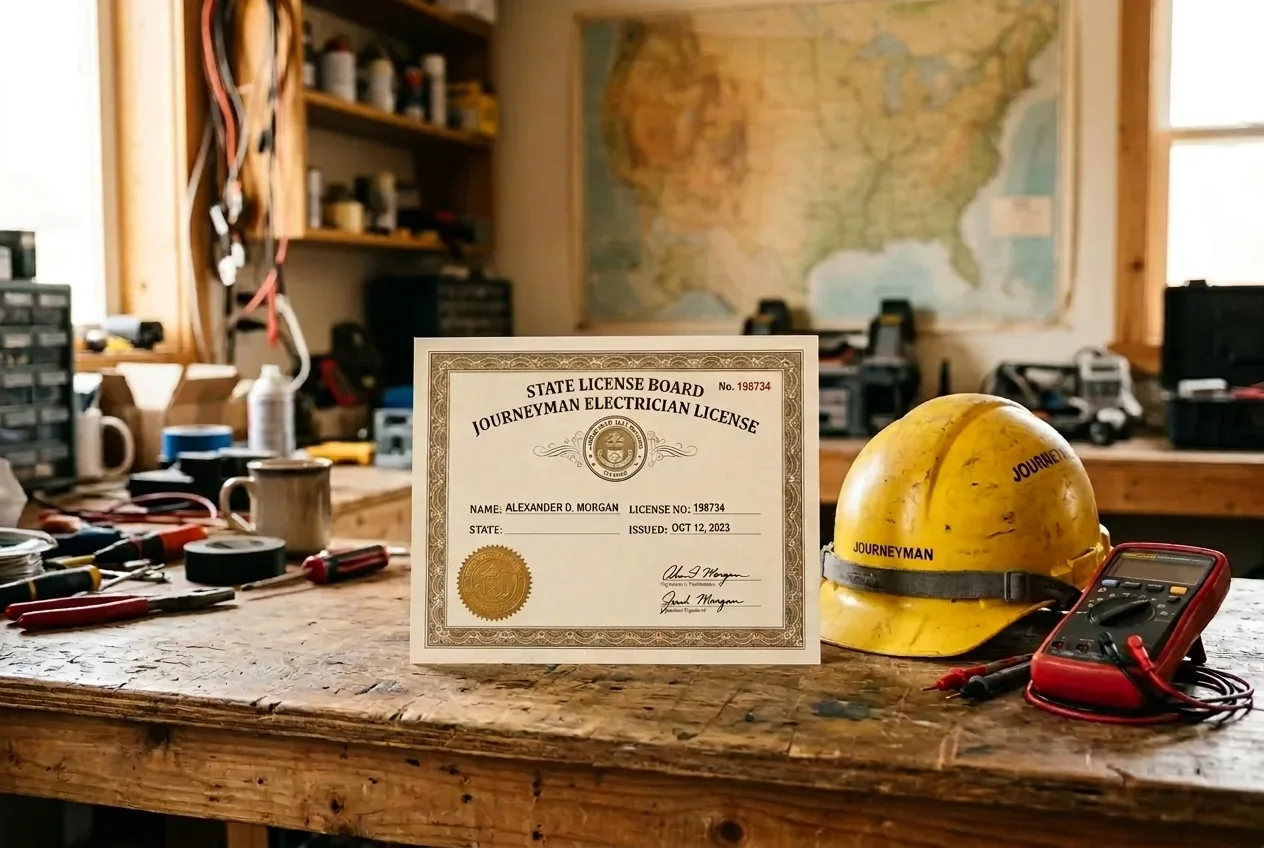
You can’t legally wire a building on your own in most of the United States until a state board says so. Forty-three states license electricians statewide — almost always through the same three-step ladder of apprentice → journeyman → master — while a handful, most famously New York and Illinois, leave licensing to cities and counties. The ladder is the reason electrical work pays a median of $62,350 nationally (and over $95,000 in Oregon, Washington, and Illinois): the license is a legal barrier that protects the wage.
This guide puts every state’s requirements in one table — key license types, exam rules, median pay, and 10-year job growth — then explains how the ladder works, what to do in local-licensing states, and how to get licensed without paying for school.
TL;DR
- 43 states issue statewide electrician licenses in the U.S. Department of Labor’s licensing database; the rest regulate at the contractor, county, or city level. New York, Illinois, and Kansas are the best-known local-licensing states.
- The ladder is nearly universal: ~4 years / 8,000 hours of supervised experience for a journeyman license, then 1–2 more years for master. Most states test you on the National Electrical Code (NEC).
- Pay tracks licensing strictness. Median electrician pay (BLS, May 2024) tops out in Oregon ($97,320), Washington ($96,530), and Illinois ($96,360); the national 90th percentile is $106,030.
- You don’t have to pay for training. There are 4,533 registered apprenticeship sponsors for electricians in the DOL system — see how to get into an IBEW apprenticeship.
- Requirements change — always verify with the issuing agency linked in your state’s row before enrolling anywhere.
How Electrician Licensing Works
Every statewide system is a variation on the same three licenses:
Apprentice (or trainee) registration
Most states require you to register before your first day of paid electrical work. Registration is cheap ($15–$50/year) and mostly exists so the state can verify your supervised hours later. You work under a journeyman or master, and your hours are the currency of the whole system.
Journeyman electrician
The first “real” license — you can work unsupervised, though usually not pull permits or run your own shop. Typical requirements:
- ~8,000 hours (about four years) of supervised experience, sometimes reduced by classroom hours from a trade school program
- A written exam, heavily based on the National Electrical Code, plus state amendments
- Application fee, typically $30–$150
Master electrician / electrical contractor
Two different things that often get conflated: a master license certifies advanced competence (usually 1–2 years as a journeyman plus a harder exam); a contractor license lets a business sell electrical work to the public and usually adds insurance and bonding requirements. In many states you need a master electrician on staff to hold a contractor license.
If you’re comparing programs, our guides to how to become an electrician and the best electrician schools and IBEW/NECA apprenticeships cover the training side in detail.
Electrician License Requirements by State
How to read this table: Key licenses are the license types tied to the electrician occupation in the U.S. Department of Labor’s CareerOneStop database (top three per state). Exam condenses the exam rules across those licenses. Median pay is BLS May 2024 for electricians (SOC 47-2111). 10-yr growth is your state workforce agency’s 2022–2032 projection. States marked as having no statewide license may still regulate electricians at the contractor, county, or city level — check locally before assuming anything.
| State | Key licenses | Exam | Median pay (2024) | 10-yr growth |
|---|---|---|---|---|
| Alabama | Licensed Electrical Contractor, Licensed Journeyman Electrician, Licensed Provisional Electrical Contractor | State exam | $52,420 | +11.1% |
| Alaska | Electrical Worker, Electrical Administrator, Engineer- Chemical, Civil, Electrical, Mechanical, Mining and Petroleum | — | $81,860 | +12.8% |
| Arizona | No statewide license in this dataset — check local/contractor rules | — | $59,480 | +18.7% |
| Arkansas | Master Electrician, Electrical Apprentice, Electrical Contractor | No exam / State exam | $49,420 | +10.4% |
| California | Electrical Engineer, Electrical Contractor, Low Voltage Systems Contractor | — | $76,540 | +13.3% |
| Colorado | Master Electrician, Residential Wireman, Electrical Contractor | Third-party exam | $62,090 | +17.0% |
| Connecticut | Electrical Limited Contractor, Electrical Unlimited Contractor, Electrical Limited Journeyperson | State exam | $76,790 | +13.5% |
| Delaware | Master Electrician, Limited Electrician, Residential Electrician | State exam | $62,970 | +12.9% |
| Florida | Electrical Contractor, Standard Electrical Inspector, Provisional Electrical Inspector | No exam | $53,100 | +17.4% |
| Georgia | No statewide license in this dataset — check local/contractor rules | — | $58,860 | +17.0% |
| Hawaii | Electrician | State exam | — | — |
| Idaho | Master Electrician, Electrical Apprentice, Electrical Contractor | State exam | $60,670 | +28.8% |
| Illinois | Electrical Hoisting Engineer, Coal Mine Electrician Surface, Coal Mine Electrician Renewal | No exam | $96,360 | +7.1% |
| Indiana | Backflow Prevention and Cross Connection Control Inspector/tester | State exam | $65,480 | +7.4% |
| Iowa | Electrician and Electrical Contractor Licenses | State exam | $62,880 | +14.3% |
| Kansas | No statewide license in this dataset — check local/contractor rules | — | $61,830 | +8.9% |
| Kentucky | Electrician, Master Electrician, Electrical Contractor | State exam | $59,490 | +6.7% |
| Louisiana | No statewide license in this dataset — check local/contractor rules | — | $59,590 | +11.7% |
| Maine | Electrician, Helper, Electrician, Master, Electrician, Limited | No exam / State exam | $67,820 | +0.5% |
| Maryland | Qualified Agent, Master Electrician, Inactive Master Inspector | — | $65,650 | +10.8% |
| Massachusetts | Electrician, Master, Electrician, Journeyman | State + third-party exams / State exam | $82,120 | +11.3% |
| Michigan | Sign Specialist, Electrician, Master, Inspector, Electrical | State exam | $72,680 | +4.9% |
| Minnesota | Class B Installer, Electrical Contractors, Maintenance Electrician | — | $81,430 | +9.9% |
| Mississippi | No statewide license in this dataset — check local/contractor rules | — | $57,300 | +23.1% |
| Missouri | Electrical Contractor | Choice of state or third-party exam | $70,950 | +8.1% |
| Montana | Electrician - Contractor, Electrician - Master Electrician, Electrician - Journeyman Electrician | Third-party exam | $68,980 | +26.7% |
| Nebraska | Electrician, Electrology Instructor, Electrical & Computer Engineer | — | $60,020 | +14.0% |
| Nevada | Photovoltaic Installers, Electrical Contractor (c2) | State exam | $64,950 | +14.2% |
| New Hampshire | Electrician, Master, Electrician, Apprentice, Electrician, Journeyman | No exam / Third-party exam | $61,990 | +13.7% |
| New Jersey | Electrical Inspector, Electrical Contractor | No exam | $73,090 | +9.9% |
| New Mexico | No statewide license in this dataset — check local/contractor rules | — | $56,890 | +17.1% |
| New York | No statewide license in this dataset — check local/contractor rules | — | $77,460 | +4.6% |
| North Carolina | Electric Merchant Plant, Electronic Countermeasures, Utility Generating Facility | No exam | $54,070 | +13.2% |
| North Dakota | Electricians (master), Electricians (class B), Electricians (journeyman) | State exam | $65,820 | +15.5% |
| Ohio | Electrical Contractor | State exam | $63,560 | +5.4% |
| Oklahoma | Electrical Inspector, Electrical Contractor (limited), Electrical Contractor (unlimited) | State exam | $60,050 | +9.0% |
| Oregon | Electrician, Signmaker Apprentice, Electrician, Limited Maintenance Apprentice, Electrician, Limited Residential Apprentice | — | $97,320 | +20.0% |
| Pennsylvania | Electrical Inspector (ucc), Electrical Plans Examiner (ucc), Residential Electrical Inspector (ucc) | No exam | $65,400 | +7.0% |
| Rhode Island | Electrician, Electrical Sign Installer | State exam | $70,160 | +15.3% |
| South Carolina | Electrical, Electrical Inspector, Provisional Electrical Inspector | — | $58,260 | +9.5% |
| South Dakota | Class B Electrician, Electrical Inspector, Electrical Contractor | — | $58,550 | +16.7% |
| Tennessee | Limited Licensed Electricians | No exam | $59,190 | +13.1% |
| Texas | Electrician | State exam | $56,920 | +18.1% |
| Utah | Electrician | — | $61,430 | +42.2% |
| Vermont | Electrician, Contractor, Residential, Emergency Generator Installer | No exam / State exam | $59,670 | +11.0% |
| Virginia | Electronic Security Sales Representative | No exam | $61,610 | +6.6% |
| Washington | Electrician, Electrical Engineer, Administrator (electrical) | State + third-party exams / State exam | $96,530 | +10.2% |
| West Virginia | Electrical Licensing, Apprentice Electrician, Electrical Certification | State exam | $63,850 | +0.5% |
| Wisconsin | Master Electrician, Beginner Electrician, Electrical Apprentice | State exam | $75,090 | +13.9% |
| Wyoming | Electrician | — | $73,450 | +23.0% |
The States Where Licensing Is Local
A few big states never built a statewide electrician license:
- New York — licensing happens at the city and county level. New York City’s Department of Buildings licenses master and special electricians; Buffalo, Yonkers, and most counties run their own boards. If you move between NY cities, your license may not move with you.
- Illinois — no statewide electrician license (the state-level records in the federal database are mining-specific). Chicago and most municipalities license electrical contractors locally. Note that Illinois still has some of the highest electrician pay in the country at a median of $96,360 — local licensing plus strong union density does the same wage-protection work.
- Kansas — county- and city-level licensing; Johnson and Sedgwick counties run the biggest boards.
- Arizona, Georgia, Louisiana, Mississippi, New Mexico — the federal database ties licensing in these states to the contractor level rather than to individual electricians (or, in New Mexico’s case, the state’s journeyman system is filed under different occupational codes). Practically: individual certification requirements still exist; they’re just enforced through the business license or local rules.
In local-licensing states your apprenticeship hours still count — union and registered apprenticeship programs are structured to satisfy the strictest local boards in their area.
Moving Between States: Reciprocity
Electrician reciprocity is patchier than in nursing or trucking, but better than most trades. A few practical rules:
- Journeyman reciprocity clusters exist. Groups of states (much of the Mountain West and Upper Midwest, for example) honor each other’s journeyman exams if you got your license by examination and have a year or more of experience.
- Master and contractor licenses rarely transfer. Expect to re-test on the receiving state’s code amendments and business law.
- Hours always count. Even with zero reciprocity, documented supervised hours from any state feed the new state’s experience requirement. Keep your pay stubs and apprenticeship records forever.
The No-Tuition Path: Registered Apprenticeships
Electrical work has one of the deepest apprenticeship benches of any trade: 4,533 registered sponsors nationwide in the DOL system, including IBEW/NECA joint programs in every state. Apprentices earn from day one (typically starting at 40–50% of journeyman scale) and graduate with the exact hours their state board wants to see — no tuition debt.
Start with our IBEW apprenticeship application guide, and if you want to compare school-based routes in your city, the hubs for Houston, Phoenix, and Jacksonville list every local program with tuition data.
FAQ
How long does it take to get an electrician license?
About four years to journeyman in nearly every state — that’s the 8,000-hour experience requirement running at full-time pace. Trade school can shorten the field-hours requirement in some states (often crediting ~1,000 hours), but nothing eliminates the experience requirement entirely.
Can I work as an electrician without a license?
As a registered apprentice under supervision, yes — that’s the intended entry point. Unsupervised unlicensed work is illegal in every statewide-licensing state and in local-licensing jurisdictions, and fines land on both you and whoever hired you.
Which state is easiest to get licensed in?
There’s no shortcut state — the ~4-year experience requirement is close to universal because it feeds insurance and code-safety standards. The real variable is exam difficulty and how much credit a state gives for classroom hours. Pick your state for the job market, not the licensing speed: compare pay and growth in the table above.
Sources
- License types, exam and experience requirements, and issuing agencies: CareerOneStop License Finder, sponsored by the U.S. Department of Labor (occupational licenses dataset, 2024 edition).
- Wages: BLS Occupational Employment and Wage Statistics, May 2024, SOC 47-2111.
- Job growth: state workforce agency 2022–2032 projections via Projections Central.
- Apprenticeship sponsor counts: apprenticeship.gov Partner Finder, U.S. Department of Labor.
License requirements change. Always confirm current rules with your state’s issuing agency before enrolling in a program or scheduling an exam.