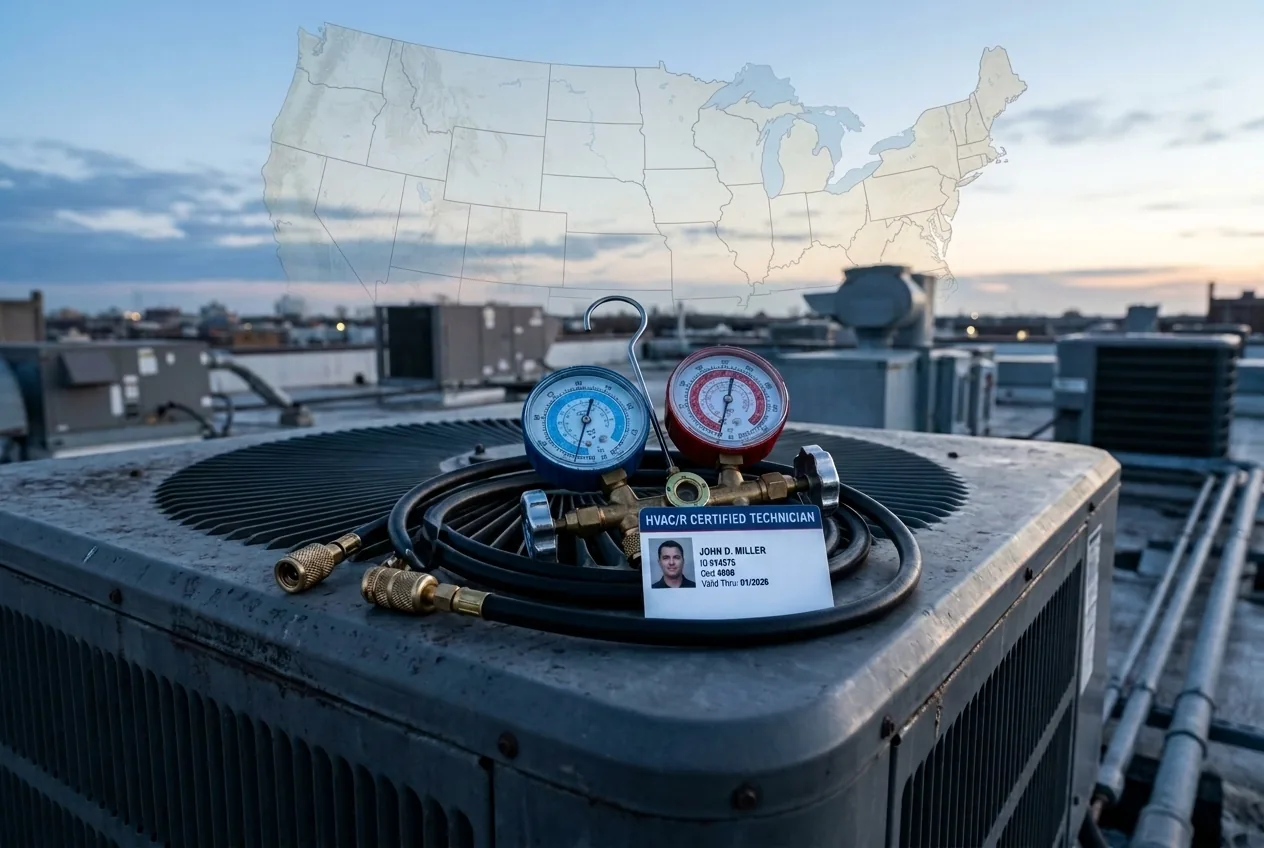

HVAC licensing confuses people because it’s really two systems stacked on top of each other. The federal rule is simple and universal: if you open a refrigerant circuit anywhere in the United States, you must hold EPA Section 608 certification — no state can waive it. The state rules are all over the map: most states license HVAC work in some form, some license only contractors, and a group of 11 — including New York, Pennsylvania, and Illinois — has no statewide HVAC license at all.
This guide sorts it out state by state: what license (if any) your state requires, what exam stands in the way, what HVAC techs earn there, and how fast the field is growing.
TL;DR
- EPA 608 is the only requirement that applies everywhere. It’s federal, it never expires, and every refrigerant-touching tech needs it — see our EPA 608 certification guide for the four types.
- 37 states plus DC issue a statewide HVAC license of some kind — a technician, journeyman, or contractor credential. 11 states leave it entirely to cities and counties, and Minnesota and Wyoming regulate only narrow slices (a contractor bond; equipment wiring).
- Median HVAC pay (BLS, May 2025) is $61,010 nationally, with a 90th percentile of $95,210. Top states: Alaska ($77,430), Illinois ($77,410), Massachusetts ($77,300) — and the District of Columbia tops them all at $84,390.
- 2,106 registered apprenticeship sponsors offer earn-while-you-learn HVAC training nationwide.
- Certification (EPA 608, NATE) is not the same thing as a license — the first proves competence, the second grants legal permission to work. Some states require both.
Certification vs. License: The Distinction That Runs the Trade
EPA Section 608 is a certification, required by the federal Clean Air Act for anyone who maintains, services, repairs, or disposes of equipment containing regulated refrigerants. There are four types (I: small appliances; II: high-pressure; III: low-pressure; Universal: all three). Trade schools build it into their programs; you can also test independently. Without it you cannot legally do the core work of the trade, in any state, licensed or not.
A state HVAC license is legal permission to practice or contract in that state — usually requiring documented experience (2–5 years), a trade exam, and sometimes a business/law exam for contractor tiers. This is what the table below maps.
NATE and other industry certifications are voluntary résumé-builders employers pay premiums for — our NATE certification roadmap covers when they’re worth it.
If you’re starting from zero, how to become an HVAC technician walks the full path, and our best HVAC schools guide compares programs.
HVAC License Requirements by State
How to read this table: HVAC license(s) are the state-issued credentials for HVAC work, checked against each state licensing board’s own documents on StateLicensed.org, our sister site for licensing requirements — follow a row’s details link for experience requirements, fees, exam vendors, renewal, and reciprocity. Exam is what an applicant sits: a trade exam alone, or a trade exam plus a business & law exam (typical for contractor tiers). Median pay is BLS May 2025 (no Arkansas figure available for this release). 10-yr growth is the state workforce agency’s 2022–2032 projection. EPA 608 applies in every state regardless, and states without a statewide license still have city, county, or contractor-level rules — verify locally.
| State | HVAC license(s) | Exam | Median pay (May 2025) | 10-yr growth |
|---|---|---|---|---|
| Alabama | Heating & Air Conditioning Contractor; Refrigeration Contractor (details) | Trade exam | $48,370 | +9.8% |
| Alaska | Mechanical Administrator (Residential HVAC or Unlimited HVAC/Sheet Metal) (details) | Trade exam | $77,430 | +10.0% |
| Arizona | C-39 / CR-39 Air Conditioning & Refrigeration Contractor (details) | Trade + statutes & rules | $59,400 | +18.3% |
| Arkansas | Class C (Service Only) HVACR License (details) | Trade exam | — | +9.5% |
| California | C-20 Warm-Air Heating, Ventilating & Air-Conditioning Contractor (details) | Trade + business & law | $72,560 | +11.2% |
| Colorado | No statewide license — set by cities/counties (details) | — | $65,200 | +15.6% |
| Connecticut | S-2 Heating, Piping & Cooling Journeyperson; S-1 Contractor (details) | Trade exam | $76,610 | +8.0% |
| Delaware | Master HVACR; Master HVACR Restricted (details) | Trade exam | $62,320 | +12.3% |
| District of Columbia | Journeyman or Master Refrigeration & Air-Conditioning Mechanic (details) | Trade exam | $84,390 | +8.6% |
| Florida | Certified Class A or Class B Air Conditioning Contractor; Registered AC Contractor (local) (details) | Trade + business & finance | $56,670 | +16.9% |
| Georgia | Conditioned Air Contractor (Class 1 Restricted or Class 2 Non-Restricted) (details) | Trade exam | $56,390 | +17.6% |
| Hawaii | C-52 Ventilating & Air Conditioning Contractor (details) | Trade + business & law | $65,450 | — |
| Idaho | HVAC Journeyman (details) | Trade exam | $56,240 | +26.9% |
| Illinois | No statewide license — set by cities/counties (details) | — | $77,410 | +6.0% |
| Indiana | No statewide license — set by cities/counties (details) | — | $60,430 | +7.8% |
| Iowa | HVAC/Refrigeration Journeyperson (details) | Trade exam | $60,680 | +13.3% |
| Kansas | No statewide license — set by cities/counties (details) | — | $60,460 | +8.1% |
| Kentucky | Journeyman HVAC Mechanic (details) | Trade exam | $58,620 | +5.3% |
| Louisiana | Mechanical Contractor (HVAC, duct & refrigeration sub-classification) (details) | Trade + business & law | $58,650 | +9.2% |
| Maine | Journeyman Oil Burner / Solid Fuel Technician (details) | Trade exam | $63,170 | -1.4% |
| Maryland | HVACR Journeyman (details) | Trade exam | $70,020 | +9.7% |
| Massachusetts | Journeyman Refrigeration Technician (details) | Trade exam | $77,300 | +8.6% |
| Michigan | Mechanical Contractor (HVAC Equipment classification) (details) | Trade exam | $60,850 | +4.6% |
| Minnesota | No individual license — mechanical contractors file a state bond (details) | — | $76,350 | +8.0% |
| Mississippi | Residential HVAC (State Board of Contractors) (details) | Trade + business & law | $48,680 | +20.2% |
| Missouri | No statewide license — set by cities/counties (details) | — | $59,950 | +6.6% |
| Montana | No statewide license — set by cities/counties (details) | — | $60,850 | +26.1% |
| Nebraska | No statewide license — set by cities/counties (details) | — | $59,850 | +13.2% |
| Nevada | C-21 Refrigeration & Air-Conditioning Contractor (details) | Trade + business & law | $60,510 | +14.8% |
| New Hampshire | Fuel Gas Fitter (Installation Technician endorsement) (details) | Trade exam | $73,850 | +6.7% |
| New Jersey | Master HVACR Contractor (details) | Trade + business & law | $74,450 | +7.4% |
| New Mexico | Journeyman Refrigeration (JR); MM-3 HVAC Contractor (details) | Trade exam (+ business & law for MM-3) | $50,270 | +16.1% |
| New York | No statewide license — set by cities/counties (details) | — | $74,430 | +6.5% |
| North Carolina | Heating Group 3 – Class I Contractor (H3-I) (details) | Trade + business & law | $57,260 | +12.9% |
| North Dakota | No statewide license — set by cities/counties (details) | — | $74,490 | +12.6% |
| Ohio | HVAC Contractor (OCILB) (details) | Trade + business & law | $62,510 | +6.0% |
| Oklahoma | Mechanical Journeyman — HVAC/R Unlimited (details) | Trade exam | $57,560 | +7.7% |
| Oregon | CCB Specialty Contractor (heating/AC scope); Limited Maintenance Specialty Contractor HVAC/R (details) | Laws & business exam | $62,940 | +19.3% |
| Pennsylvania | No statewide license — set by cities/counties (details) | — | $62,400 | +5.6% |
| Rhode Island | Refrigeration Journeyperson (Class I Unlimited or Class II Limited); Refrigeration Master (details) | Trade exam | $67,370 | +13.6% |
| South Carolina | Residential HVAC Installer & Repairer; Mechanical Contractor (commercial jobs over $10,000) (details) | Trade + business & law | $56,610 | +7.7% |
| South Dakota | No statewide license — set by cities/counties (details) | — | $61,390 | +16.2% |
| Tennessee | CMC-C Mechanical Contractor (HVAC, Refrigeration & Gas Piping); Full Mechanical Contractor (details) | Trade + business & law | $55,490 | +9.8% |
| Texas | ACR Certified or Registered Technician; ACR Contractor (Class A or Class B) (details) | Trade exam | $57,760 | +17.4% |
| Utah | HVAC Contractor (H100) (details) | Trade + business & law | $58,730 | +34.3% |
| Vermont | Type-S Specialty Electrician — Gas/Oil Heating (A1) or Refrigeration & AC (C3) (details) | Trade exam | $62,150 | +7.2% |
| Virginia | Journeyman HVAC Tradesman (details) | Trade exam | $59,730 | +6.0% |
| Washington | 06A / 06B HVAC/Refrigeration Specialty Electrician (details) | Trade exam | $75,660 | +11.0% |
| West Virginia | HVAC Technician; Residential Technician; Technician-in-Training (details) | Trade exam | $48,850 | +6.2% |
| Wisconsin | HVAC Qualifier; HVAC Contractor Registration (details) | Trade exam | $61,710 | +12.9% |
| Wyoming | Limited Technician – HVAC (equipment wiring only); other HVAC work set locally (details) | Trade exam | $54,700 | +23.9% |
Florida note: Florida splits air conditioning contractors into two classes open to new applicants — Class A (unlimited) and Class B (capped at 25 tons of cooling and 500,000 Btu of heating in any one system). If you are choosing between them, PassContractorExam has a clear breakdown of the Class A vs. Class B decision, including what the 25-ton cap rules out.
The No-Statewide-License States
Eleven states issue no statewide HVAC license at all: Colorado, Illinois, Indiana, Kansas, Missouri, Montana, Nebraska, New York, North Dakota, Pennsylvania, and South Dakota. Minnesota and Wyoming come close — Minnesota requires only a mechanical-contractor bond, and Wyoming licenses only technicians who wire HVAC equipment. Three practical notes if you’re in one of them:
- EPA 608 still applies in full. No state can opt out of federal refrigerant rules — in unlicensed states it’s effectively the credential.
- Cities and counties fill the gap. New York City, Chicago, Philadelphia, Denver, and most large municipalities in these states run their own mechanical licensing or permit regimes. What matters is where the job site is, not just the state.
- Contractor rules still bite. Even where techs are unlicensed, running your own HVAC business can trigger bonding (Minnesota), local contractor registration, or permit-holder requirements — relevant the moment you want to run your own book of business.
Getting the Experience: School, Apprenticeship, or Both
Most state licenses want 2–5 years of documented field experience. Two ways to build it:
- Trade school first (6 months–2 years): fastest route to being hirable, and many states credit classroom hours toward the experience requirement. Compare local options on our city hubs — for example Phoenix, Dallas, or Tampa.
- Registered apprenticeship (3–5 years): earn from day one with 2,106 registered sponsors nationwide; the structured hours map directly onto state license requirements. See how apprenticeships work.
FAQ
Do I need a license to do HVAC work on my own house?
Homeowner exemptions exist in most states for your own residence — but EPA 608 still applies to refrigerant work, and unpermitted mechanical work can surface at sale time. Your state row’s details link names the licensing agency to ask.
Is EPA 608 hard to get?
It’s the most accessible credential in the trade: a proctored multiple-choice exam (open-book for Type I in some formats), commonly bundled into week one of trade-school programs. Universal certification is the version worth having — it covers all equipment classes.
Which HVAC license tier should I aim for?
Follow the money in your state’s structure: technician/journeyman tiers let you work; contractor tiers let you bid work and hire others, and that’s where HVAC’s high earnings live. The 90th percentile nationally is $95,210, and most of the people earning it hold a contractor-tier license.
Sources
- License types, exams, and issuing agencies: StateLicensed.org HVAC requirements (our sister site), compiled from each state licensing board’s official applications, rules, and exam bulletins (verified July 2026).
- Wages: BLS Occupational Employment and Wage Statistics, May 2025, SOC 49-9021.
- Job growth: state workforce agency 2022–2032 projections via Projections Central.
- Refrigerant certification rules: EPA Section 608 Technician Certification.
- Apprenticeship sponsor counts: apprenticeship.gov Partner Finder, U.S. Department of Labor.
License requirements change. Always confirm current rules with your state’s issuing agency before enrolling in a program or scheduling an exam.