
The full picture, before you sign anything.
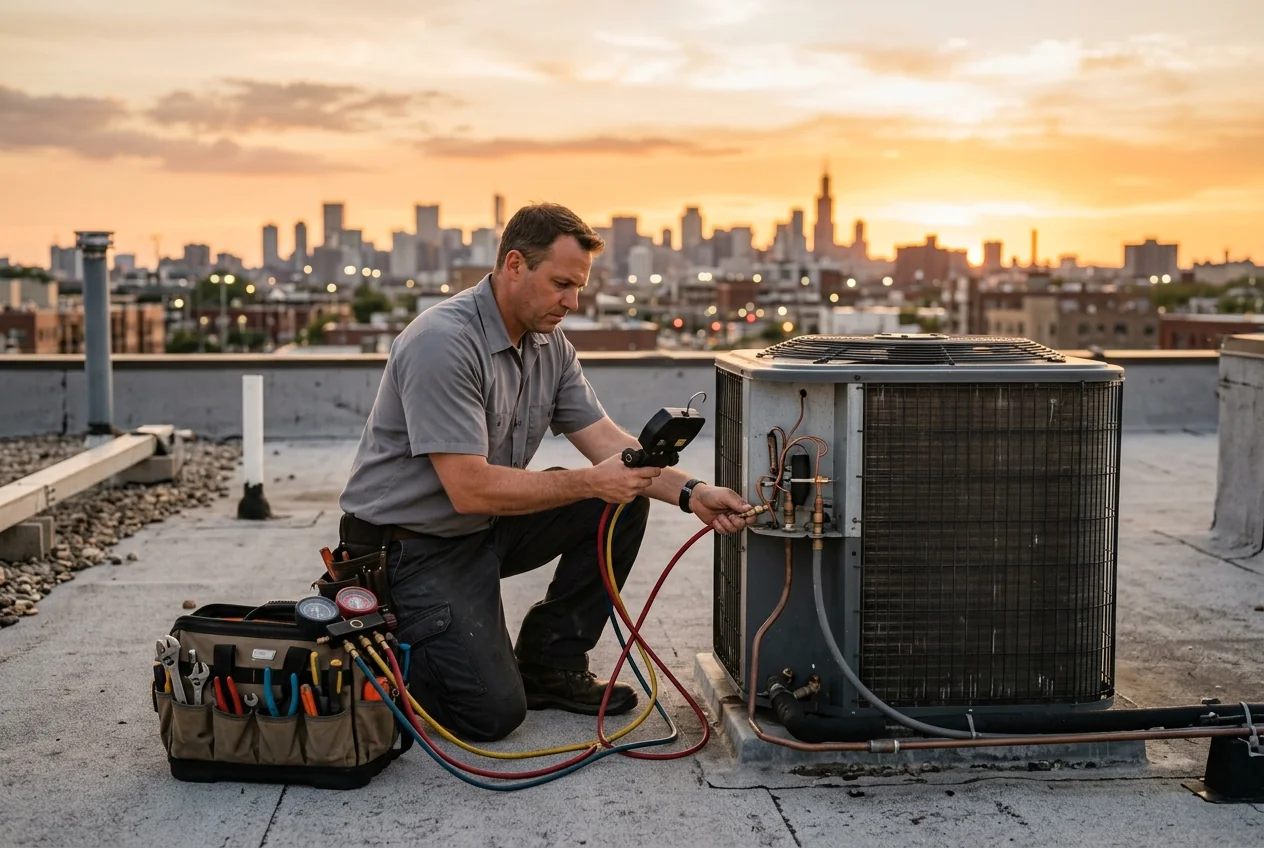
Picture the brochure photo: a technician in a clean polo smiling at a thermostat in a sunlit hallway. Now picture your third week on the job — on your knees in a July attic, threading a recovery hose past a rat’s nest of flex duct, polo soaked through. Both pictures are real. The brochure only prints one of them.
This is not an argument against HVAC school. The trade pays a livable wage, the demand is real, and a good program earns its tuition. But you’re about to hand somebody four or five figures, and the admissions office is not going to volunteer the fine print. So here it is: the whole bill, the honest paycheck math, the federal license nobody mentions until week one, and the paid route the brochure never compares itself against.
The tuition line is real. The bill isn’t done.
Schools publish their own numbers, so let’s use theirs. New England Institute of Technology’s cost guide puts HVAC certificate programs anywhere from $1,500 to $15,000, with associate degrees running higher. Delta Technical College lists its own training program at just under $15,000 in tuition and fees. Those figures are honest as far as they go.
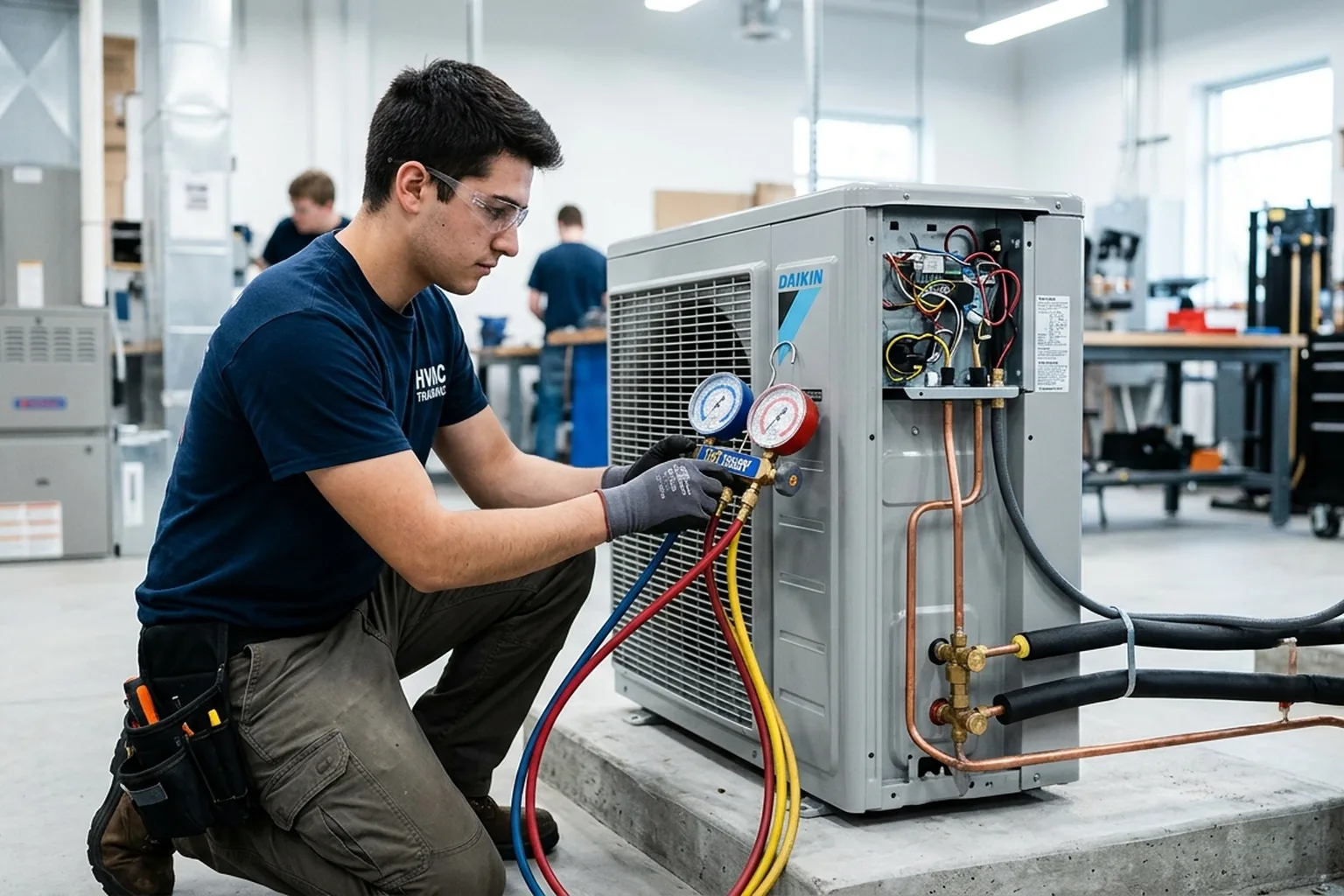
Here’s what they don’t include. Your hand tools: a manifold gauge set — the cluster of dials and hoses that reads system pressures — a multimeter you’d trust your fingers to, drivers, wrenches, a cordless drill, work boots that survive a rooftop. Then the exam fees for the certifications the program prepares you for, which are usually billed by the testing organization, not the school. Our tool guide for HVAC technicians walks through the full kit piece by piece.
Ask for the required tool list before you sign — in writing, with the estimated cost of each item. A school that won’t produce one is telling you something. And before you compare two brochures against each other, compare both against the full directory of HVAC training programs, where you can see completion data instead of marketing copy.
The verdict from the shop floor: budget the whole toolbag, not the tuition line.
The paycheck math the brochure does
Every HVAC brochure quotes the same number: the median. Per the Bureau of Labor Statistics Occupational Outlook Handbook, the median annual wage for HVAC mechanics and installers was $59,810 as of May 2024. That number is true. What the brochure skips is the word median — half the field earns less, and the half that earns less is where every rookie starts.
The same agency publishes the spread. In the May 2023 wage data for the occupation, the bottom 10 percent of HVAC techs earned around $37,270 a year, while the top 10 percent cleared $84,000. That gap isn’t unfairness — it’s the career arc printed in one row of numbers. The $37,270 end is the first-year helper carrying the ladder. The $84,000 end is the tech who’s been diagnosing commercial refrigeration for a decade.
Put a first-year check next to a fifth-year check and the story tells itself: this trade pays, but it pays on a climb, not a cliff edge. The demand behind the climb is solid — BLS projects 8 percent employment growth from 2024 to 2034, with about 40,100 openings a year as older techs retire out.
So when a program’s ad implies the median is your starting salary, read it the way a foreman reads a supplier’s delivery promise: possible, eventually, with conditions.
The license nobody mentions until week one
You cannot legally open a refrigerant circuit in the United States without a federal certification. Under EPA Section 608, anyone who maintains, services, repairs, or disposes of equipment that could release refrigerant must pass an EPA-approved exam. The certification comes in four flavors, and the difference matters:
- Type I — small appliances: window units, household refrigerators
- Type II — high-pressure systems, which covers most residential and light-commercial air conditioning
- Type III — low-pressure systems, mostly large chillers
- Universal — all of the above, and the one worth aiming for
Two details the brochure glosses over. First, the certification never expires — pass it once and it’s yours. Second, there’s a legitimate on-ramp: per EPA rules, an apprentice can work on refrigerant systems without certification as long as a certified technician is supervising. That’s the legal foundation of the earn-while-you-learn path we’ll get to in a minute.
Ask any program you’re considering: which 608 type do your graduates test for, and what’s the pass rate? Then remember the state layer on top — many states add their own licensing for HVAC work, and the requirements swing widely. Our state-by-state HVAC license guide maps that terrain.
School isn’t the only door
Here’s the comparison no HVAC school brochure prints: their program versus getting paid to learn the same trade.
A Registered Apprenticeship, validated by the U.S. Department of Labor, is a job — you earn a wage from day one, the wage steps up as your skills do, and you finish with a nationally recognized, portable credential. Structured on-the-job training under a journeyman, classroom instruction on the side, and per the EPA rule above, you can legally work on live systems under supervision while you rack up hours.
Now the honest trade-offs, both directions. Apprenticeships take years, not months, and the first-year wage sits at the bottom of the scale — you’re the one carrying the ladder. Slots are competitive, and in some regions you’ll wait for an opening. A school program, by contrast, gets you job-ready faster, gives you concentrated lab time, and enrolls you this semester instead of when a contractor has a seat. What it doesn’t do is pay you — you pay it.
There’s also a middle path worth asking about: some employers and apprenticeship sponsors will credit certificate-program hours toward an apprenticeship. Don’t assume it — ask the specific sponsor before you enroll anywhere.
If a school’s pitch never mentions that the paid route exists, that’s not an oversight. That’s marketing.
What “uncomfortable conditions” means at 2 p.m. in July
The Bureau of Labor Statistics describes the work environment with one dry phrase: technicians “may need to work in uncomfortable conditions”. Let a shop-floor translation fill that in.
It means attics in July hot enough to soften the candy bar in your pocket, and rooftops in January where the wind finds every gap in your jacket. Crawlspaces year-round. It means the busiest weeks of your year are the hottest and the coldest ones, because that’s exactly when systems quit — which is why peak-season on-call rotations exist, and why your phone may ring during the holiday you planned.
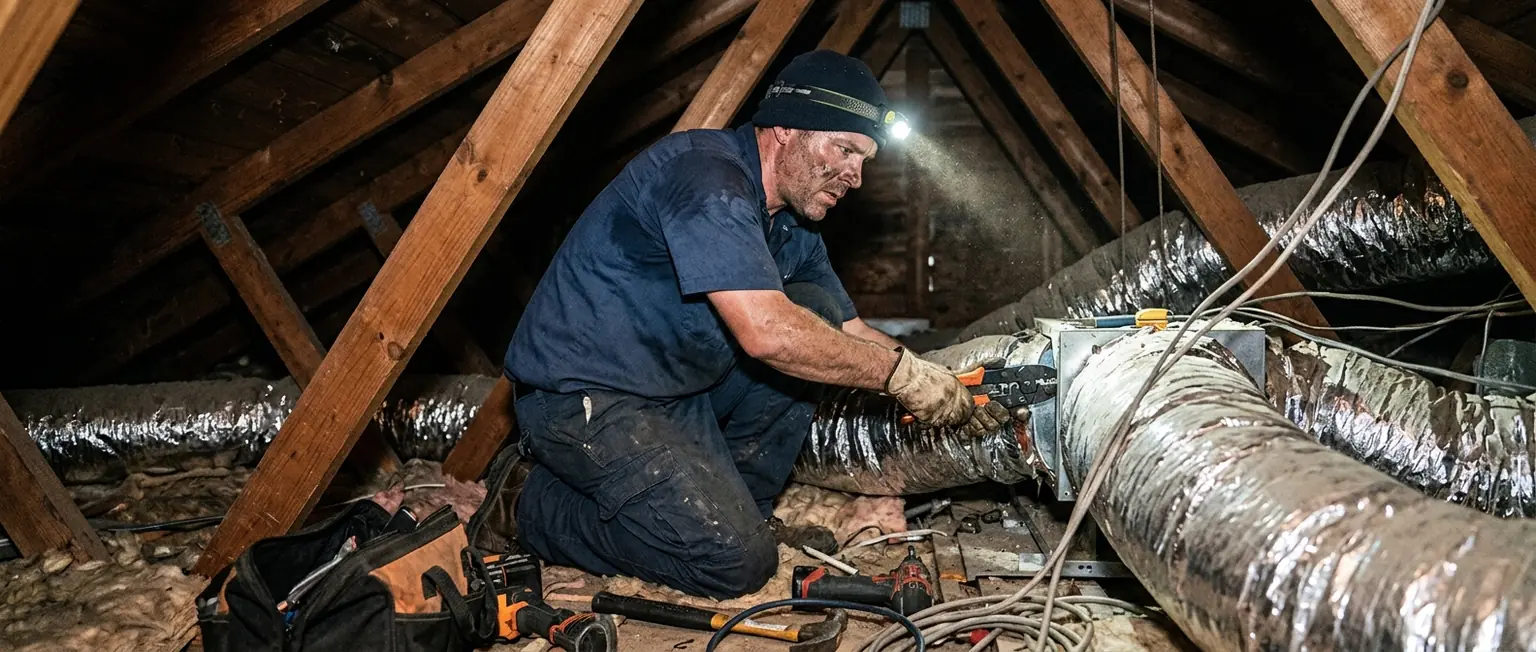
This is the page the brochure left out.
It also means your knees, shoulders, and back are tools, and like tools they wear. Recovery machines, coil sections, and compressors get carried up ladders. None of this is a reason to skip the trade — it is a reason to walk into it with open eyes, and to think early about where you want to land. Residential service and commercial work wear on you differently and pay differently; our breakdown of commercial versus residential HVAC pay and burnout is worth reading before you pick a lane.
The stock photo can’t show you August. Talk to a working tech before you enroll — most will give you ten honest minutes, and those minutes are worth more than the campus tour.
Vet the program like a foreman, not a customer
A foreman doesn’t accept a supplier’s word; they check the spec sheet. Do the same. Before signing with any program, get answers — in writing where possible — to these:
- Lab hours versus lecture hours. You learn brazing with a torch in your hand, not from a slideshow. Ask for the split.
- Which EPA 608 type graduates test for, and the pass rate. “We prepare you for certification” is not a number.
- The complete required tool list with estimated costs, before enrollment, not at orientation.
- Placement numbers, specifically. Which employers hire graduates, into what roles — installer’s helper and service technician are different jobs at different pay.
- Total cost of completion — tuition, fees, books, exam fees — as one figure.
- Whether local apprenticeship sponsors credit the program’s hours. The answer tells you how the trade itself rates the school.
A good program answers all six without flinching — the good ones are proud of these numbers. For the general version of this diligence, our guide on how to evaluate a trade school applies to every trade, not just this one.
What the good ones tell every rookie
Ask veteran techs what separates the ones who make it, and the answers rhyme: show up early, ask why the senior tech checked the panel twice, treat the ugly jobs as paid lessons, and never stop adding certifications. Nobody successful in this trade credits the brochure. They credit the habits.
The trade is worth entering — the pay data says so, and the 40,100 annual openings say so louder. Just enter it with the whole picture: the full bill, the real first-year wage, the license, and both doors in.
Here’s your concrete step for this week: price two programs using the six questions above, and find one registered apprenticeship near you at apprenticeship.gov. Compare all three on paper. Then decide like a foreman.
Sources
- U.S. Bureau of Labor Statistics — Occupational Outlook Handbook — “Heating, Air Conditioning, and Refrigeration Mechanics and Installers” — May 2024 wage/outlook data, page updated August 2025 — https://www.bls.gov/ooh/installation-maintenance-and-repair/heating-air-conditioning-and-refrigeration-mechanics-and-installers.htm
- U.S. Bureau of Labor Statistics — Occupational Employment and Wage Statistics — “49-9021 Heating, Air Conditioning, and Refrigeration Mechanics and Installers” — May 2023 — https://www.bls.gov/oes/2023/may/oes499021.htm
- U.S. Environmental Protection Agency — “Section 608 Technician Certification Requirements” — page updated March 2026 — https://www.epa.gov/section608/section-608-technician-certification-requirements
- U.S. Department of Labor — Apprenticeship.gov — “Registered Apprenticeship Program” — https://www.apprenticeship.gov/employers/registered-apprenticeship-program
- New England Institute of Technology — “How Much Does HVAC School Cost?” — school-published cost guide — https://www.neit.edu/blog/how-much-does-hvac-school-cost
- Delta Technical College — “How Much Does HVAC School Cost?” — school-published cost guide — https://www.deltatechnicalcollege.com/resources/careers/how-much-does-hvac-school-cost/