
TL;DR: North American companies ordered 36,766 industrial robots in 2025, job postings for robotics technicians have more than doubled since 2022, and none of those machines can install, calibrate, or repair themselves. That work belongs to a trade you can enter with a certificate or a two-year degree — no engineering school required. Here is what the job actually involves, what it pays according to BLS data, and the three main routes in.
The machines showed up. The people who fix them didn’t.
For most of the last decade, “robots are coming for the trades” was a threat headline. In 2026 it reads more like a help-wanted ad.
The Association for Advancing Automation (A3) counted 36,766 robots ordered by North American companies in 2025 — $2.25 billion worth, up 6.6% in units over 2024. The more telling detail is who ordered them: general industry — food processing, warehouses, metal shops, life sciences — took the majority share of units, outpacing the automotive plants that long drove the market. Automation is spreading into ordinary mid-sized businesses, and those businesses don’t have in-house robotics engineers. They have to hire technicians.
And the labor market confirms this. Randstad USA analyzed more than 150 million U.S. job postings from 2022 to 2026 and found that robotics technician vacancies are up 113% — the fastest growth of any skilled-trade role they tracked, even ahead of HVAC engineers (+78%) and industrial automation technicians (+51%). O*NET, the Department of Labor’s occupation database, flags robotics technicians as an in-demand occupation.
Every robot on that order sheet needs someone to bolt it down, wire it in, teach it its positions, keep it calibrated, and figure out why it faulted at 2 a.m. on a Sunday. And that someone is a tradesperson.
What a robotics technician actually does
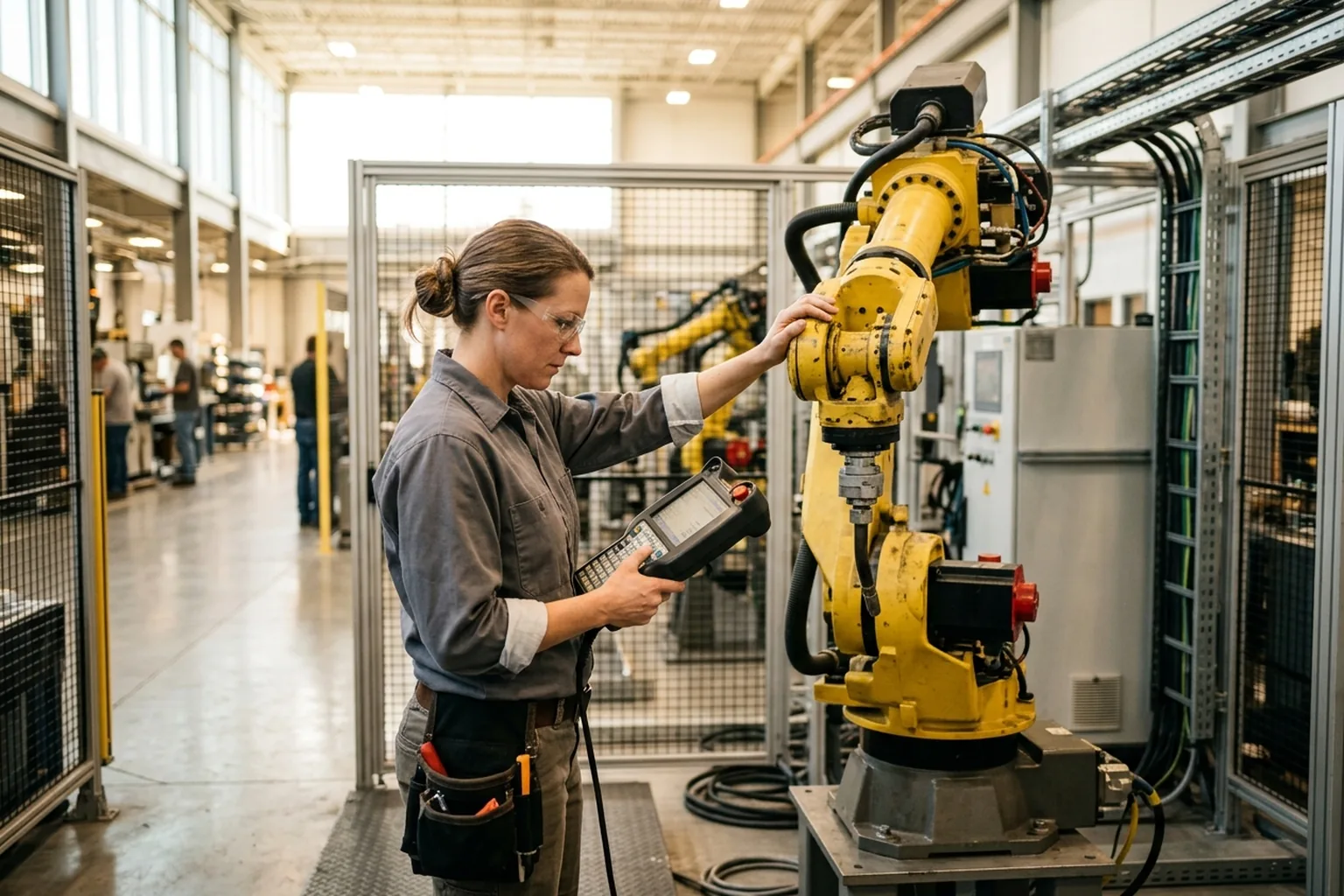
A robotics technician builds, installs, tests, maintains, and repairs robots and automated systems. In practice the week could look like this for them:
- Installation and integration. Anchoring a new robot cell, running power and network connections, mounting end-of-arm tooling, setting up safety fencing and light curtains.
- Programming at the pendant. Teaching positions and adjusting paths using the robot’s teach pendant. This is menu-driven, hands-on programming — closer to configuring a CNC machine than writing software.
- Preventive maintenance. Greasing axes, replacing batteries and cables, checking backlash, verifying calibration on a schedule.
- Troubleshooting. When a cell stops, reading the fault codes, tracing the problem across mechanical, electrical, pneumatic, and PLC systems, and getting the line running again with minimum downtime. Stopped lines are expensive, which is exactly why the person who can restart them asap gets paid.
It’s worth separating this from robotics engineering, which designs the robots and typically requires a bachelor’s degree. Technicians keep robots working. The Bureau of Labor Statistics classifies most of them under electro-mechanical and mechatronics technologists and technicians, which it says typically need an associate degree or a postsecondary certificate — not four years of college.
What it pays — and how to read the numbers honestly
Two BLS occupation codes cover most of this work, and they tell slightly different stories.
| BLS occupation | Median pay | Outlook |
|---|---|---|
| Electro-mechanical and mechatronics technologists and technicians | $73,900/yr (May 2025) | +3% projected, 2025–35 |
| Industrial machinery mechanics, machinery maintenance workers, and millwrights | $64,100/yr (May 2025) | +13% projected 2024–34, ~51,900 openings/yr |
The honest reading: the electro-mechanical code pays better at the median — the middle 50% earn roughly $59,800 to $88,500 — but it’s a small official category, about 15,700 jobs, with modest projected growth. That’s not because the work is scarce. It’s because employers title these jobs all kinds of things — automation technician, maintenance tech, controls technician, field service tech — and much of the work is counted under the much larger industrial machinery maintenance code, which BLS projects to grow 13% through 2034, much faster than average, with about 51,900 openings a year.
So don’t pick this trade off one occupation code; instead, pick it off the underlying fact both codes agree on: machines that make money are multiplying faster than the people qualified to keep them running smoothly.
One more data point on where this is heading: building robots is itself becoming factory work. Agility Robotics’ RoboFab plant in Salem, Oregon — built to produce more than 10,000 humanoid robots a year at full scale — is designed to employ around 500 people working alongside the robots it builds.
Three ways in
1. The certificate route (under a year). Community colleges and trade schools offer industrial automation and robotics certificates that cover electrical fundamentals, motor controls, PLCs, and robot operation. The best tactic is to pair one with a vendor credential — FANUC runs certification programs at more than 1,700 schools through its CERT program, including the entry-level FANUC Certified Robot Operator (FCR-O1) credential developed with NOCTI. Fastest to a paycheck; you’ll likely start as an operator or junior maintenance tech and learn upward.
2. The associate degree route (two years). A mechatronics or robotics/automation technology degree adds hydraulics, pneumatics, networking, and more PLC depth, plus general-education credits that transfer if you later want an engineering degree. This is the standard preparation BLS cites for electro-mechanical technicians, and it’s the route most mid-sized manufacturers recruit from directly. Browse trade colleges with automation and robotics programs to see what’s offered near you.
3. The apprenticeship route (earn while you learn). Millwrights and industrial maintenance mechanics learn through apprenticeships that run up to four years, per BLS — and get paid from day one, with robotics and automation increasingly folded into the curriculum because that’s what modern plants contain. This is slowest to the credential, but it comes with zero tuition debt, and the maintenance-first foundation is exactly what troubleshooting robots requires.
Already in a trade? You’re closer than you think
This career has an unusually wide side door. Electricians already know motor controls, conduit, and code — the industrial side of the electrician career path borders robotics work directly. Maintenance techs already do the mechanical half of the job. Welders who learn to run a welding cobot often become the cell programmer for their shop. If you’re weighing that move from inside a trade, our blog covers the jobsite side of this shift in Robots on the Jobsite in 2026.
How to pick a program
Ask these five questions before you decide to enroll (our guide to choosing a trade program covers the general version):
- Is there real robot hardware on site? You want hands-on hours on actual industrial arms — FANUC, ABB, Yaskawa, KUKA — rather than just simulators.
- Which certifications are baked in? Look for FANUC FCR-O/FCR-T, NIMS, or PMMI credentials you graduate with, not just a school certificate.
- Does the curriculum include PLCs? Robots don’t work alone; the programmable logic controllers around them cause half the service calls. Allen-Bradley or Siemens PLC coursework is a strong signal.
- Who hires the graduates? A program worth attending can name concrete local employers and exact placement numbers.
- Is there a co-op or internship? Paid plant hours before graduation routinely convert to job offers.
Not sure this is your trade at all? Our find-your-trade quiz matches interests to programs.
The honest trade-offs
- Robots run around the clock, so techs sometimes do too. This means night shifts, weekend call-outs, and holiday shutdown overhauls (maintenance’s busiest week) are actually part of the schedule, not the exception.
- Field service pays more but travels hard. Working for an integrator or robot OEM can mean weeks on the road commissioning cells.
- The learning never stops. Controllers, vision systems, and software change every few years. If you want a trade you master once and just capitalize on, this isn’t it.
- The jobs cluster. Manufacturing-heavy regions — the Midwest, the Southeast auto corridor, Texas — have deep demand; rural areas without industry obviously have little.
The bottom line
The robot boom didn’t shrink the trades — far from it. Instead, it added a rung to the ladder — one that pays a median north of $70,000 on the electro-mechanical code, is reachable in two years or less, and sits directly in the path of the 3x-faster demand growth hitting skilled trades overall. The machines are already ordered. The open challenge is who shows up trained to keep them running.
Sources
- Association for Advancing Automation (A3) — “Robot Orders Grow 6.6% in 2025 as General Industries Drive Broader Automation Adoption” — 2026 — https://www.automate.org/robotics/news/robot-orders-grow-6-6-in-2025-as-general-industries-drive-broader-automation-adoption
- Randstad USA — “U.S. Demand for Skilled Trades Grows 3x Faster than Professional Roles” — 2026 — https://www.randstadusa.com/about/press-room/press-releases/us-demand-skilled-trades-grows-3x-faster-professional-roles/
- U.S. Bureau of Labor Statistics — Occupational Outlook Handbook, “Electro-mechanical and Mechatronics Technologists and Technicians” — accessed August 2026 — https://www.bls.gov/ooh/architecture-and-engineering/electro-mechanical-technicians.htm
- U.S. Bureau of Labor Statistics — Occupational Outlook Handbook, “Industrial Machinery Mechanics, Machinery Maintenance Workers, and Millwrights” — accessed August 2026 — https://www.bls.gov/ooh/installation-maintenance-and-repair/industrial-machinery-mechanics-and-maintenance-workers-and-millwrights.htm
- FANUC America — CERT education program (1,700+ partner schools; FCR-O/FCR-T certifications) — https://www.fanucamerica.com/education
- Evan Ackerman — IEEE Spectrum — “Agility Robotics Opens First Humanoid Robot Factory” — September 19, 2023 — https://spectrum.ieee.org/agility-humanoid-robotics-factory
- O*NET OnLine — “Robotics Technicians (17-3024.01), In Demand” — https://www.onetonline.org/link/demand/17-3024.01