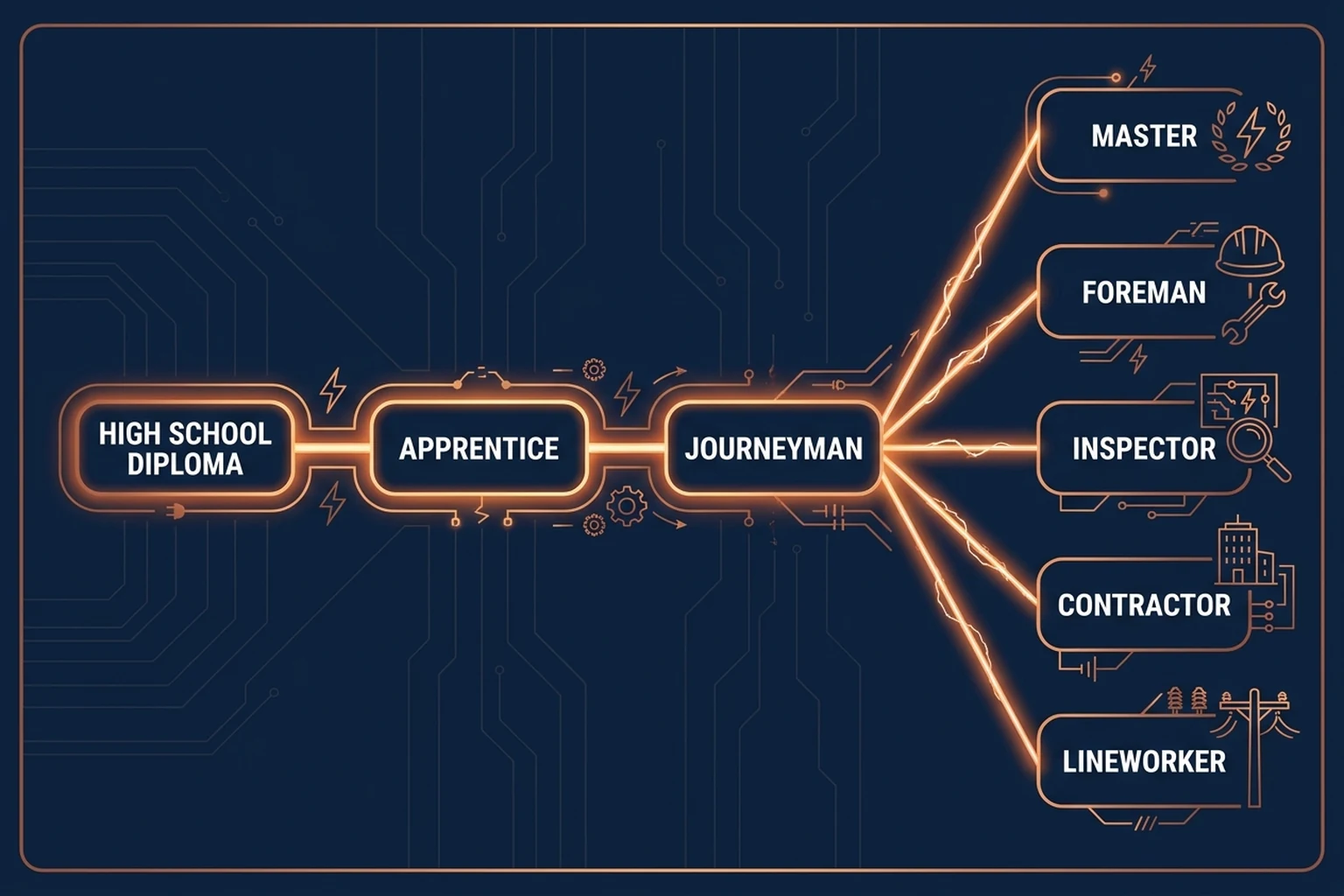

Most electrician guides end where the career actually starts getting interesting. They walk you through the apprenticeship, hand you a journeyman license, and stop — as if the next thirty years were a straight line.
They aren’t. Journeyman is a fork, not a finish line. From there the path splits at least five ways, and the branches differ by more than $40,000 a year in median pay. Some of them are growing fast. Two of the most commonly recommended ones are quietly shrinking.
This is the whole map: what it takes to get in, what the apprenticeship really is, and what each branch after journeyman pays, costs, and demands.
The Entry Gate Is Lower Than People Expect
The Bureau of Labor Statistics lists exactly one formal education requirement for electricians: a high school diploma or equivalent. No degree, no prerequisite certificate, no tuition bill required to start.
What the diploma doesn’t cover, the apprenticeship application does. Programs typically screen for:
- Age 18+ and a valid driver’s license — you’ll be driving to job sites daily
- Algebra — most programs test it, and conduit bending is geometry whether anyone calls it that
- Color vision — BLS lists it as a required quality, because you will identify wires by color for your entire career
- Physical capacity — moving components that weigh up to 50 pounds, long periods standing and kneeling
That’s the gate. Compare it to what’s on the other side: a median wage of $62,350 as of May 2024, against $49,500 for all U.S. occupations and $56,490 for construction trades workers generally. You clear the gate with a high school diploma and out-earn the national median.
If you want the step-by-step version of getting in — union versus non-union, aptitude tests, what to do the month before you apply — we’ve covered that separately in How to Become an Electrician. Browsing schools first? Start with electrician programs or the best colleges for electrician training.
Stage 1: Apprentice — Four Years of Getting Paid to Learn
An electrical apprenticeship runs four to five years, and each year is about 2,000 hours of paid on-the-job training plus classroom instruction, per BLS. That’s the structural difference between this trade and a degree path: you are an employee from month one, not a customer.
The classroom half covers electrical theory, blueprint reading, math, code requirements, and safety. The job half is where you learn what the classroom can’t teach — which is most of it.
Two shortcuts exist and both are underused. Technical school graduates “usually receive credit toward their apprenticeship,” and workers who gained electrical experience in the military or in construction may qualify for a shortened apprenticeship based on experience and testing. If either applies to you, ask before you sign — nobody volunteers time back.
Apprentice pay starts well below journeyman scale and steps up as you complete hours. That progression is the entire financial argument for the trade: you are never not earning.
Stage 2: Journeyman — Where the Map Actually Branches
Finish the hours, pass your state’s exam, and you’re a journey worker: licensed to work unsupervised, and portable across most of the country.
Here’s the number that matters more than the median. Among electricians, the lowest 10% earn under $39,430 and the highest 10% earn over $106,030. That’s a $66,000 spread inside one job title — and most of what explains it isn’t skill. It’s who signs your check:
| Employer type | Median annual wage (May 2024) |
|---|---|
| Government (excl. state/local education and hospitals) | $77,080 |
| Manufacturing | $71,820 |
| Electrical contractors and other wiring installation contractors | $61,290 |
| Employment services | $57,490 |
Sixty-five percent of electricians work for that third row. The two highest-paying rows employ a combined 9%. Simply knowing that the government and manufacturing lanes exist — and pay $10,000 to $16,000 more at the median — is worth more than a year of technique.
Sector matters too, and it’s a decision most apprentices make by accident. Our residential vs. commercial vs. industrial breakdown covers how those three tracks diverge in pay, hours, and ceiling.
Now the branches.
Branch A: Go Deeper on the Tools
The traditional next rung is the master electrician license — additional experience beyond journeyman plus a harder exam, administered by your state. BLS confirms the ladder (“journey workers may advance to become master electricians”) but publishes no separate wage for masters, so treat any specific “master electrician salary” you see online as an estimate, not a statistic.
What the data does support is where the ceiling sits: that $106,030 top-decile figure is what the upper end of on-the-tools electrical work looks like. Masters reach it more often because the license unlocks two things a journeyman card doesn’t — permit-pulling authority in most states, and in many places the legal prerequisite to hold a contractor’s license at all.
Specialization stacks on top. High-demand niches — controls and automation, low-voltage and data systems, EV charging infrastructure — let you charge for scarcity rather than hours. Licensing requirements vary sharply by state; check yours through the CareerOneStop license finder before you plan around it.
Trade-off: the pay ceiling is real but bounded, and your body is the asset. Every year on the tools is a year of ladders, crawlspaces, and standing.
Branch B: Lead the Crew
Foreman, general foreman, superintendent. You stay in the field, but your output becomes other people’s work. BLS lists supervision as a standard advancement route for electricians, and it’s the branch with the shortest distance from where you already are — no new license, no new school, just a different set of skills your journeyman card didn’t teach.
It’s also the most common on-ramp to Branch C, because scheduling, budgeting, and managing subcontractors are exactly what the off-tools roles screen for. You can compare the numbers on our first-line construction supervisors career profile.
Trade-off: the skills that make a great electrician — focus, precision, working alone — are not the skills that make a great foreman. Some of the best hands never make the transition, and there’s no shame in that.
Branch C: Off the Tools — and the Part Nobody Tells You
This is the branch every “electrician career” article recommends, usually with three options and no numbers attached. Here they are, and one of these is not like the others:
| Off-tools role | Median wage (May 2024) | Projected growth 2024–34 | Annual openings |
|---|---|---|---|
| Construction manager | $106,980 | +9% | 46,800 |
| Cost estimator | $77,070 | −4% | 16,900 |
| Construction / building inspector | $72,120 | −1% | 14,800 |
Read that middle column again. Estimating and inspection both pay more than the electrician median — and BLS projects both occupations to shrink over the next decade. Cost estimators are projected to lose about 9,300 jobs; inspectors decline roughly 1%. Openings still exist in both (retirements, mostly), but you’d be stepping onto a down escalator for a raise of $10,000–$15,000.
Construction management is the outlier: $106,980 median, 9% growth, 46,800 openings a year, and a top decile above $176,990. It’s the only off-tools branch that pays substantially more and is growing.
The catch is honest and specific. BLS lists a bachelor’s degree as the typical entry credential, and adds that firms “might hire as managers those who have a high school diploma and many years of experience in a construction trade; however, these people may be more likely to work as self-employed general contractors than to be hired as construction managers.” Translation: field experience alone rarely gets you hired into a CM seat at a large firm — it gets you into business for yourself. Which is Branch D.
Inspection has the cleanest entry requirement of the three: a high school diploma plus roughly five years of related work experience — a journeyman card and a few years of code-heavy work is precisely that profile.
Branch D: Own the Company
8% of electricians are self-employed. Among construction managers, that figure is 36% — the single largest employment category in the occupation, larger than specialty trade contractors, nonresidential building, and residential building combined.
That’s the honest shape of the trade’s high end. The path to six figures runs through ownership more often than through promotion. Most states require a master electrician license (or a qualifying master on staff) before issuing a contractor’s license, which makes Branch A a prerequisite rather than an alternative.
Trade-off: you stop being paid for hours and start being paid for risk. Estimating wrong, collecting slowly, or carrying payroll through a slow quarter will cost you more than any technical mistake ever did. Worth reading our guide on starting an electrical business before committing.
Branch E: The Adjacent Trades That Pay More
Some electrical-adjacent occupations out-earn electricians outright:
- Electrical power-line installers and repairers — $92,560 median, high school entry
- Elevator and escalator installers and repairers — $106,580 median, high school entry, 5% growth
- Solar photovoltaic installers — $51,860 median, but 42% projected growth through 2034, among the fastest of any U.S. occupation
Be clear-eyed about what a move here costs. Lineworker and elevator work are separate apprenticeships with their own hour requirements — the elevator trade runs its own four-year apprenticeship, and these are not promotions you get handed for holding an electrician card. Switching means restarting a clock, and BLS classifies lineman work under line installers, not electricians, for exactly that reason. The elevator trade is also small: about 2,000 openings a year nationally, against 81,000 for electricians.
Solar is the inverse trade: easy entry, enormous growth, low current pay. It’s a young person’s bet, or a specialization to bolt onto an existing license rather than a career to switch into.
The Five Branches, Side by Side
| Branch | Where it lands | Growth | Added time from journeyman | What you trade away |
|---|---|---|---|---|
| A. Master / specialist | Up to ~$106,030 (top decile) | +9% (trade overall) | 1–4 yrs + exam | Your body stays the asset |
| B. Foreman / supervisor | Above journeyman scale | — | 2–5 yrs on merit | Craft time for people time |
| C. Inspector / estimator | $72,120 / $77,070 | −1% / −4% | ~5 yrs experience | Growth, for stability and a desk |
| C. Construction manager | $106,980 | +9% | Degree or ownership route | Usually needs a bachelor’s to be hired |
| D. Contractor / owner | Uncapped | +9% (36% of CMs are self-employed) | Master license + capital | Steady pay, for risk |
| E. Adjacent trade | $92,560–$106,580 | Varies | New apprenticeship | Seniority — you restart |
What Years 1, 5, 10, and 15 Actually Look Like
- Year 1 — Apprentice. Earning, not paying. Decide early whether you’re aiming at residential, commercial, or industrial; the sector shapes everything downstream.
- Year 5 — Journeyman, licensed and portable. This is the moment to look hard at that employer table. Moving from a contractor to a government or manufacturing employer is the single largest pay lever available to you, and it requires no new credential.
- Year 10 — Master license, foreman stripes, or a specialization deep enough to price by scarcity. Most people who reach the top decile are here by now.
- Year 15 — The ownership question. By this point you have the license, the network, and the estimating instinct. Roughly one in twelve electricians answers yes.
None of this is a schedule. It’s the shape of the terrain — plenty of people spend thirty productive years at the journeyman stage by choice, and the pay data says that’s a perfectly defensible living.
Three Decisions That Set Your Ceiling
- Early: pick your sector deliberately. Residential, commercial, and industrial diverge in pay and ceiling, and drifting into one by accident is the most common unforced error in this trade.
- Mid: stack licenses before you need them. Master license, state reciprocity, specialization certs. Each one is a gate that takes months to open — open them before the opportunity arrives, not after.
- Late: decide whether you want to be billable or accountable. Branches A, B, and E keep you paid for your hours. C and D pay you for outcomes. That’s a temperament question at least as much as a money question — and the pay data shows both answers can work.
Want the full occupational data behind any of this? Our electrician career profile carries the wage, growth, and skills breakdown, and the electrical career opportunities guide covers where demand is concentrating.
Sources
- U.S. Bureau of Labor Statistics — Occupational Outlook Handbook — “Electricians” — modified August 28, 2025 — https://www.bls.gov/ooh/construction-and-extraction/electricians.htm
- U.S. Bureau of Labor Statistics — Occupational Outlook Handbook — “Construction Managers” — modified August 28, 2025 — https://www.bls.gov/ooh/management/construction-managers.htm
- U.S. Bureau of Labor Statistics — Occupational Outlook Handbook — “Construction and Building Inspectors” — modified August 28, 2025 — https://www.bls.gov/ooh/construction-and-extraction/construction-and-building-inspectors.htm
- U.S. Bureau of Labor Statistics — Occupational Outlook Handbook — “Cost Estimators” — modified August 28, 2025 — https://www.bls.gov/ooh/business-and-financial/cost-estimators.htm
- U.S. Bureau of Labor Statistics — Occupational Outlook Handbook — “Solar Photovoltaic Installers” — modified August 28, 2025 — https://www.bls.gov/ooh/construction-and-extraction/solar-photovoltaic-installers.htm
- U.S. Bureau of Labor Statistics — Occupational Outlook Handbook — “Line Installers and Repairers” — modified August 28, 2025 — https://www.bls.gov/ooh/installation-maintenance-and-repair/line-installers-and-repairers.htm
- U.S. Bureau of Labor Statistics — Occupational Outlook Handbook — “Elevator and Escalator Installers and Repairers” — modified August 28, 2025 — https://www.bls.gov/ooh/construction-and-extraction/elevator-installers-and-repairers.htm
- CareerOneStop (sponsored by the U.S. Department of Labor) — “Find Licenses” — https://www.careeronestop.org/Toolkit/Training/find-licenses.aspx
All wage figures are national medians from the BLS Occupational Employment and Wage Statistics survey, May 2024 — the most recent full-year data available. Employment projections cover 2024–34. Pay varies substantially by state, metro area, and employer.