
TL;DR: Robots stopped being just an eye-catching demo and started clocking in. Layout robots print floor plans at 40,000–70,000 sq ft per shift, a rebar robot has tied over 4 million intersections across 14 states, and welding cobots are one of the fastest-growing robot applications in a field that’s short 330,000 welders by 2028. None of these machines works without a tradesperson beside it. The workers who learn how to make them run reliably are setting themselves up for the better-paid role of every crew on the site.
What’s actually working on jobsites — not in demo videos
Filter out the concept 3D renders and pilot-program press releases, and a meaningful number of robots have crossed into everyday production work. A March 2026 field report from Bricks & Bytes tallied where each stands:
| Robot | Trade it touches | What it does | The verified numbers |
|---|---|---|---|
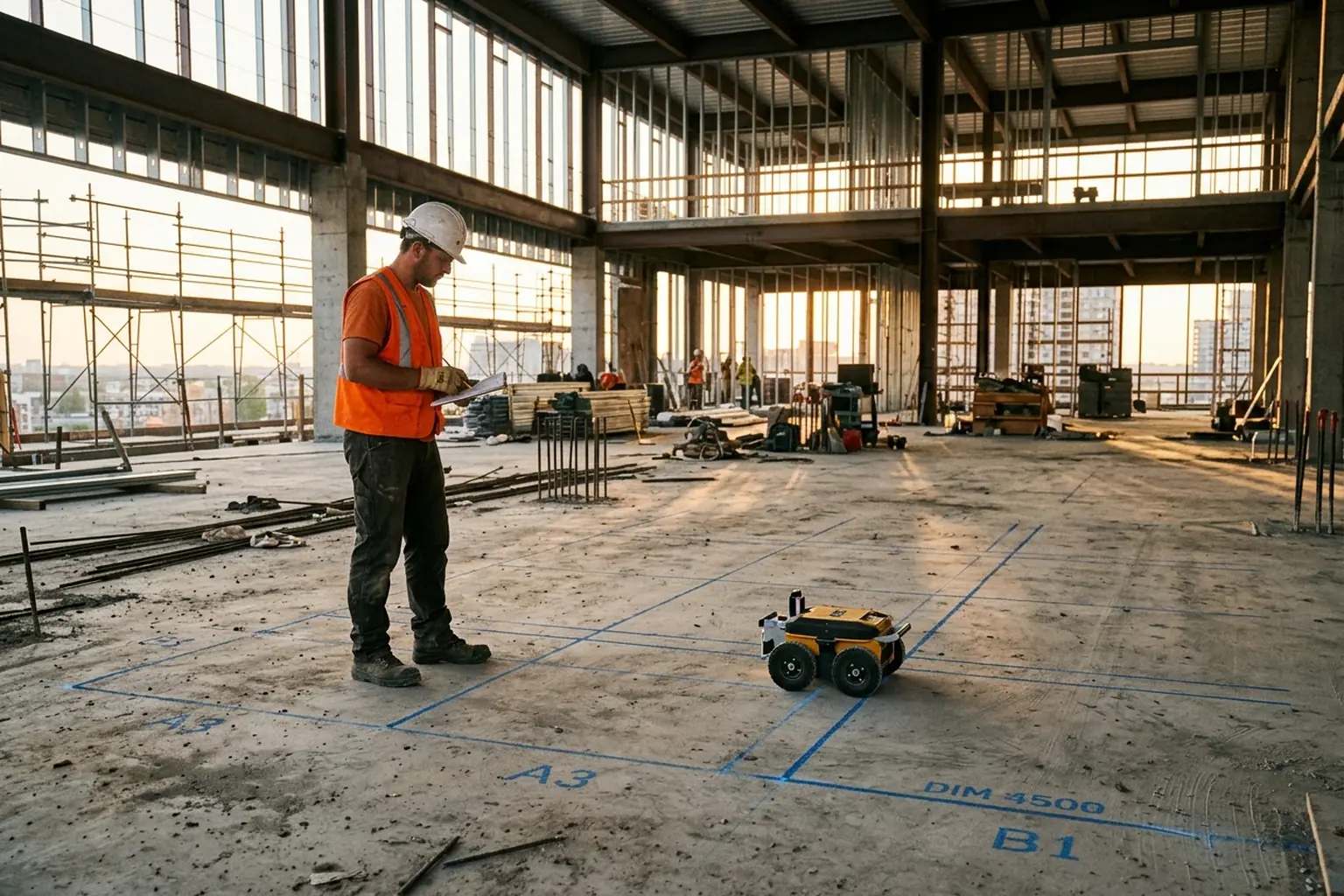
| Dusty Robotics FieldPrinter | Layout / carpentry | Prints the full BIM model onto the slab | 40,000–70,000 sq ft per shift vs. 8,000–15,000 for a manual crew, accuracy within ±1/8” |
| TyBot (Advanced Construction Robotics) | Ironwork | Ties rebar intersections on bridge decks | 1,100+ ties/hour vs. 150–250 by hand; 65+ deployments in 14 states; 4M+ ties |
| Weld cobots (FANUC and others) | Welding | Runs repetitive production welds in a shared cell | Cobots hit 7,212 units — 19.6% of all North American robot orders — in 2025, the first year A3 tracked them |
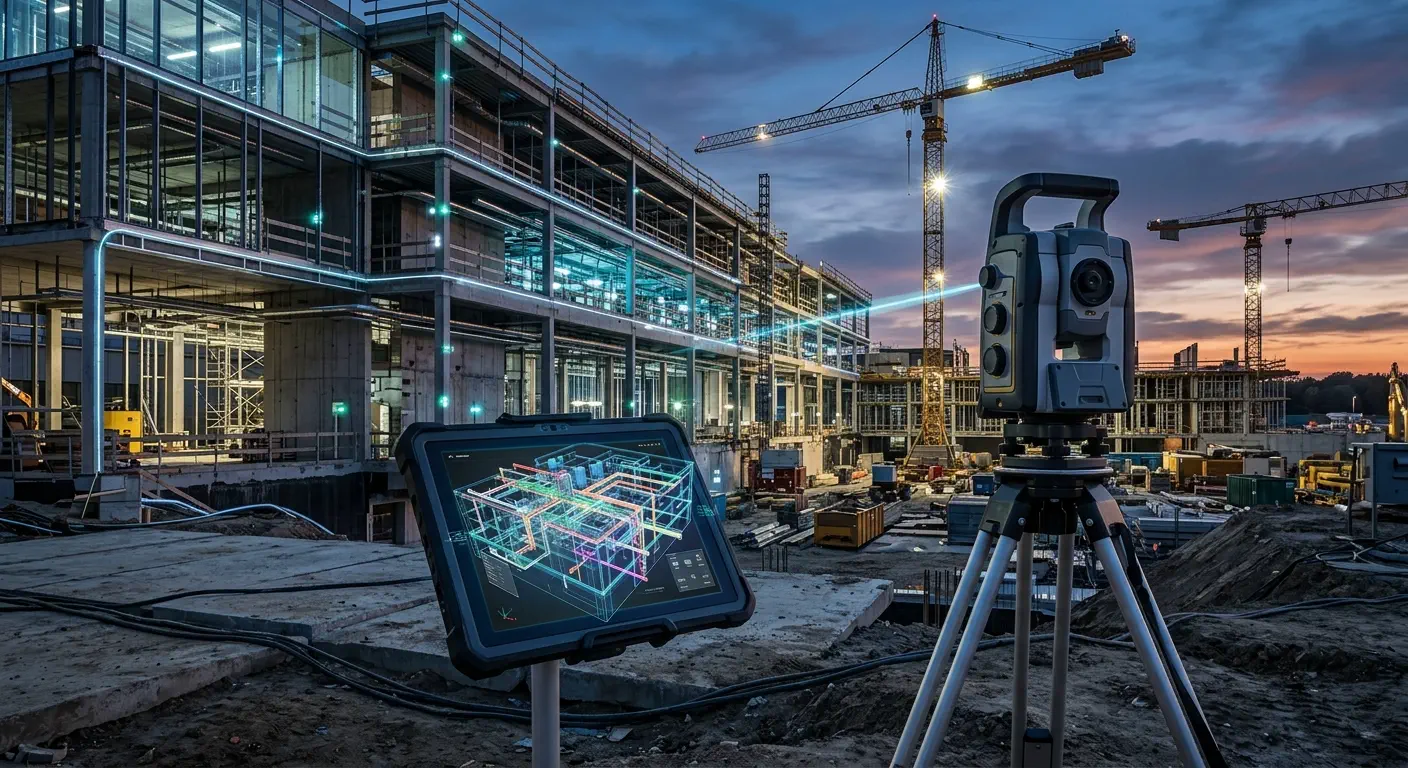
| Spot (Boston Dynamics) with laser scanners | Field engineering | Walks the site collecting point-cloud scans | ~$3,500–5,500/month on typical projects |
Beyond the jobsite, humanoids are entering factories and warehouses: Agility Robotics built its RoboFab plant in Salem, Oregon to eventually churn out more than 10,000 Digit robots a year — with about 500 humans employed to build them.
If your trade is on that list, this isn’t a future problem to monitor. It’s a present-moment change in how the work gets actually divided.
The pattern: robots take the middle of the job
Look at what each machine actually does. TyBot ties the thousands of identical intersections in the middle of a bridge deck — ironworkers still place and set the rebar, handle the edges and irregular details, and make sure the completed work looks good. The FieldPrinter prints the lines — carpenters still resolve conflicts in the model, verify control points, and build everything the lines describe. A weld cobot runs the two-hundredth identical fillet weld — a certified welder still sets the parameters, fixtures the part, handles anything custom, and owns final quality.
The repetitive middle of the task gets automated. The setup, important judgment calls, tricky edge cases, and the accountability stay purely human — and that human part is what employers are hiring for now. FANUC describes welders in automated shops advancing into robotics supervisor and weld-process roles: same trade expertise, applied through a machine that just multiplies it.
Here’s what that means for your paycheck: the robot doesn’t compete WITH your hands, it competes FOR your hands instead — every machine on the table above needs a trades worker running it, and that worker bills at a premium over the task the robot performed.
The shortage math says surf the trend, not resist it
The industries buying these robots aren’t choosing machines over available workers. The American Welding Society projects the U.S. needs 330,000 new welding professionals by 2028 — around 82,500 per year — against a workforce that is aging. Skilled-trades demand overall is growing three times faster than professional roles, per Randstad’s analysis of 150 million job postings. Shops are automating the welds they can’t hire for, and the same analysis shows what that entails: robotics technician postings up 113% since 2022.
In a labor-surplus market, automation displaces. In a labor-shortage market, it redistributes effort away from repetitive production tasks, toward setup, supervision, and maintenance. And the trades are firmly in the second market.
The five-move playbook
1. Raise your hand when the robot shows up. When your employer pilots a cobot or layout robot, volunteer to be the one trained on it. Early operators become effectively the site expert by default, and “I ran the automation” is the line on a trade resume that gets calls back.
2. Get the operator credential. Vendor certifications are short and cheap relative to what they say about you. FANUC’s Certified Robot Operator (FCR-O1) is taught at over 1,700 schools, including community colleges you can attend at night. Stack it onto your existing trade cert — see our guide to trade certifications and licenses.
3. Aim for the cell-tech role. The best-leveraged position isn’t operating the robot, it’s keeping it running smoothly. Industrial machinery maintenance — the BLS occupation family that covers most machine-upkeep work — is projected to grow 13% through 2034 with about 51,900 openings a year, per BLS. If you want the full career map for that route, we have a separate guide: Robotics Technician: The New Trade the Robot Boom Built.
4. Build your digital floor. Every robot on the table above relies on a digital model. Reading a BIM viewer, navigating a tablet-based plan set, and understanding basic controller logic are becoming the indispensable tools of this decade — assumed, not purely optional. Randstad’s analysis of trades postings describes digital fluency as a firm prerequisite now, from electricians through robot technicians.
5. Follow the training money. Employers buying six-figure robots budget for training on them — a Dusty subscription runs $8,000–12,000 a month and TyBot starts at $425,500, so nobody hands them blindly to the untrained. In job interviews, ask directly: what automation is on your sites, and who gets trained on it? The answer tells you whether the company is building operators or just renting them.
The trades robots can’t reach
Service work barely appears on the deployment list, and that’s not by accident. A robot thrives on repetition in a controlled space; a service call is quite the opposite — a different crawlspace, different work dynamics, different constraints every time, and failures begin to mount. ServiceTitan’s survey of 1,000+ contractors found 46% already using or experimenting with AI — for scheduling, marketing, and customer service, not fieldwork. Residential HVAC, service plumbing, and repair electrical remain about as automation-resistant as it can get. If you’re choosing a trade specifically to stay far from robots, those are among the best picks.
The honest caveats
- The economics gate the robots to big jobs. Layout robots only pay off above roughly 150,000 applicable square feet per month; TyBot’s price tag limits it to major decks. Small residential crews are not likely to see these machines for years.
- Operator roles concentrate where the robots do — large commercial, infrastructure, and manufacturing. If you work small residential jobs, the playbook above matters far less for now.
- Early tech breaks. Being the robot person also means being the person standing next to a faulted machine with a schedule slipping. The role rewards real troubleshooters, not mere button-pushers.
The bottom line
Previous new tool waves in the trades — nail guns, total stations, CNC — tended to end the same way: the tool got cheaper than the labor it saved, the crews that adopted it out-earned the crews that didn’t, and what looked like a threat became another piece of standard equipment. Robots are bigger and smarter tools, but the pattern is still holding, with a twist in your favor: this wave arrives while welding alone is short 330,000 workers through 2028 and trades demand is outrunning supply. The machines came here to fill empty seats, and they’re creating a better-paid seat beside them. Claim it before someone else does.
Sources
- Bricks & Bytes — “Construction Robotics in 2026: 4 Workflows Where Robots Are Actually Working on Construction Sites” — March 27, 2026 — https://bricks-bytes.com/technology/construction-robotics-in-2026/
- American Welding Society — Welding Digest, “Solving the Welding Shortage” — July 2023 — https://www.aws.org/magazines-and-media/welding-digest/wd-july-23-solving-the-welding-shortage/
- Association for Advancing Automation (A3) — “Robot Orders Grow 6.6% in 2025 as General Industries Drive Broader Automation Adoption” — 2026 — https://www.automate.org/robotics/news/robot-orders-grow-6-6-in-2025-as-general-industries-drive-broader-automation-adoption
- FANUC America — “Why Welding Robots and Cobots are Becoming Essential” — https://www.fanucamerica.com/articles/why-welding-robots-and-cobots-are-becoming-essential
- Randstad USA — “U.S. Demand for Skilled Trades Grows 3x Faster than Professional Roles” — 2026 — https://www.randstadusa.com/about/press-room/press-releases/us-demand-skilled-trades-grows-3x-faster-professional-roles/
- ServiceTitan — “AI in the Skilled Trades Report 2025” — https://www.servicetitan.com/press/ai-in-the-skilled-trades-report-2025
- U.S. Bureau of Labor Statistics — Occupational Outlook Handbook, “Industrial Machinery Mechanics, Machinery Maintenance Workers, and Millwrights” — accessed August 2026 — https://www.bls.gov/ooh/installation-maintenance-and-repair/industrial-machinery-mechanics-and-maintenance-workers-and-millwrights.htm
- Evan Ackerman — IEEE Spectrum — “Agility Robotics Opens First Humanoid Robot Factory” — September 19, 2023 — https://spectrum.ieee.org/agility-humanoid-robotics-factory