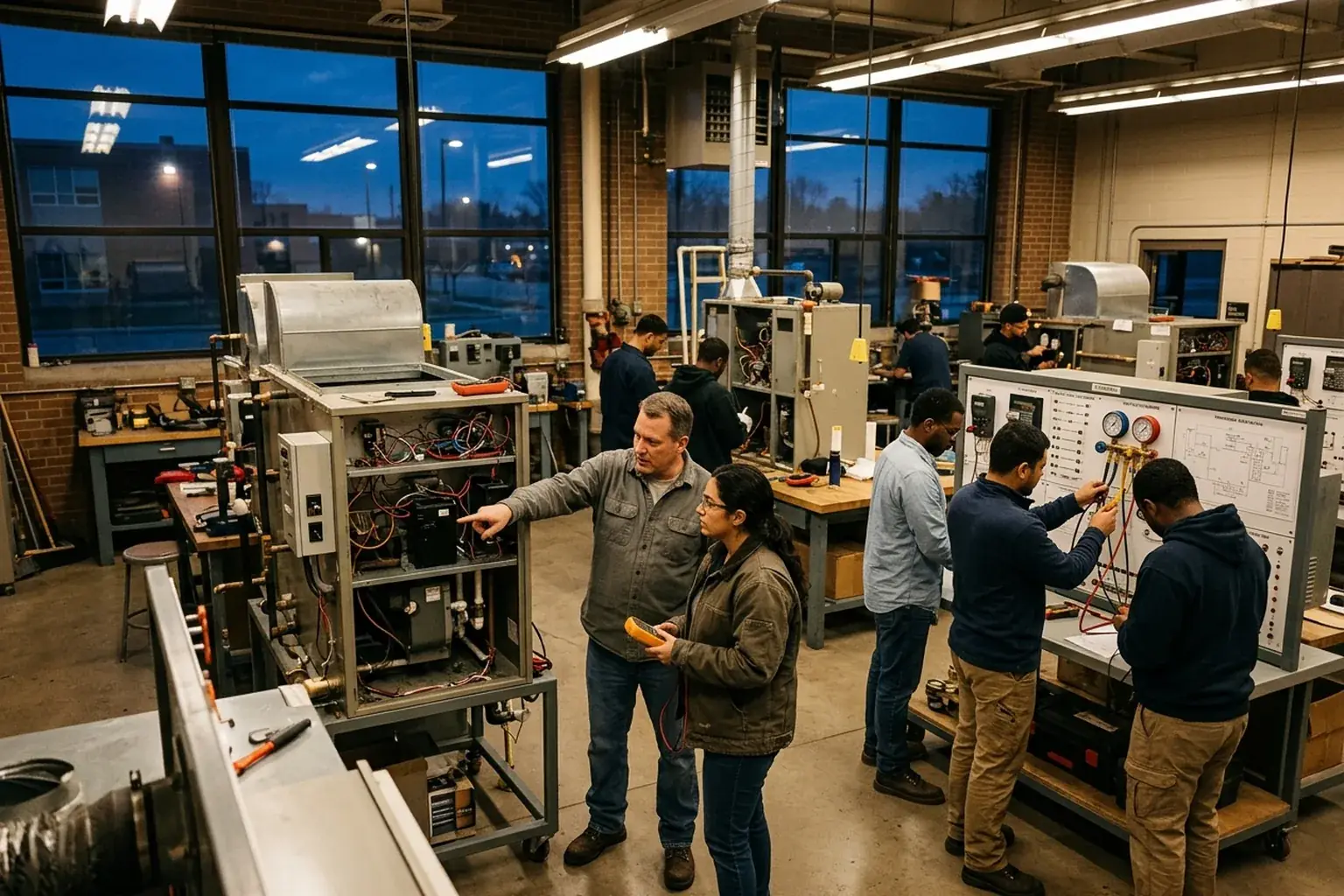

Re-entering the workforce after years of raising kids comes with a specific dread: the résumé gap. Office hiring processes are notoriously unkind to it — applicant tracking systems filter on recent experience, and interviews circle back to “so what have you been doing?”
The skilled trades run on a different operating system. A contractor hiring an HVAC apprentice or a dental office hiring a medical assistant cares about one thing: can you do the work, or can you learn it? Training programs and apprenticeships are designed for people starting fresh — that’s what “apprentice” means. Nobody asks an apprenticeship applicant why their last W-2 is from 2019.
And the timing is genuinely good. Women’s share of active registered apprentices rose from 8.7 percent in 2015 to 14.5 percent in 2024, per the Department of Labor Women’s Bureau, while total active apprentices grew from 360,000 to over 667,000. The infrastructure for nontraditional entrants — returning parents very much included — has never been bigger.
This guide covers why trades suit re-entry, which specific trades fit a school-hours family logistics problem, and the childcare barrier that deserves honest treatment rather than a pep talk.
TL;DR: Key Takeaways
- Trades hire on demonstrated skill, not résumé continuity. Training programs and apprenticeships assume you’re starting fresh — the career gap that sinks office applications barely registers.
- Apprenticeships pay you to train: GAO reports completers average about $80,000 in first-year wages. No tuition gamble with family savings.
- Women’s apprenticeship participation is climbing — 8.7% (2015) → 14.5% (2024) — and $5M in federal WANTO grants (July 2025) funds programs recruiting and retaining women in the trades.
- School-hours-compatible trades exist: medical assisting, medical billing and coding, cosmetology with booth control, HVAC/home-inspection daytime service work.
- Childcare is the named, documented barrier — DOL research lists it among the top reasons women leave apprenticeships. Solve it in your plan, not mid-program.
Why the Trades Fit Re-Entry Better Than Office Work
The gap doesn’t count against you. Trade hiring evaluates certifications, program completion, and hands-on aptitude. A 38-year-old completing an HVAC certificate this spring competes on that certificate — not on what she did in 2021.
Paid training removes the tuition gamble. A parent re-entering work usually can’t bet $30,000 of family savings on a degree with a distant payoff. Registered apprenticeships invert the bet: you earn from day one, wages step up on a published schedule, and GAO found completers averaged roughly $80,000 in annual wages their first year after finishing. Certificate routes are also short — most run 6–18 months, and our financing guide covers grants that don’t need repaying.
Demand is on your side. The trades face chronic worker shortages, which means employers increasingly compete for reliable adults — and hiring managers consistently describe parents managing a household as exactly that. Skills from running a family are real on a job site: scheduling, logistics, staying calm while three things go wrong at once.
Schedule variety actually exists. Unlike office work’s default 9-to-5-plus-commute, trades span early-start-early-end field work, self-scheduled appointment work, and remote administrative trade work. That variety is the raw material for solving the school-pickup problem.
Trades That Fit School Hours
The filter that matters for most returning parents isn’t wage — it’s whose schedule controls your afternoon. These trades score well.
Medical Assisting
Clinics run on daytime, weekday hours — the same hours your kids are in school. Medical assistants earn a median $44,200 (May 2024), and the field is projected to grow 12 percent through 2034 with about 112,300 openings a year — among the most reliable hiring markets in this guide. Certificate programs run 9–12 months, many with evening options while you prepare.
Medical Billing and Coding
The trade world’s genuine work-from-home option. Billing and coding is credential-gated (not gap-gated), remote-friendly, and training is fully doable online during naps and school hours. For a parent who needs maximum schedule control in the first years back, this is often the pragmatic first move — with the option to pivot into other healthcare trades later.
Cosmetology With Booth Rental
Cosmetology’s economics reward exactly what a returning parent needs: control. Booth renters set their own appointment windows — school-hours-only books are common. The BLS median is $16.95/hour (May 2024) with 5 percent projected growth and 84,200 annual openings, and established stylists with full books out-earn that median substantially. State-mandated program hours (typically 1,000–1,500) are the up-front cost.
Daytime Service Trades: HVAC and Home Inspection
Residential service calls happen when homeowners are home — overwhelmingly daytime work. HVAC service and home/building inspection both run on appointment schedules that end by late afternoon more often than construction-site trades do. Inspection in particular is analytical, low-lifting work we’ve profiled in our trades without heavy physical labor guide.
A trade to enter with open eyes: new-construction site work (framing, roofing, concrete) typically starts at 6–7 a.m. — brutal against a school-drop-off routine unless you have morning childcare solved. It’s not a no; it’s a “solve childcare first.”
The Childcare Barrier, Named Honestly
Here’s the part most “moms in trades!” content skips. Department of Labor research on women in registered apprenticeships identifies childcare as one of the top barriers to retention — alongside worksite culture. Early trade schedules and inflexible training calendars collide with daycare hours, and that collision, not aptitude, is what pushes many parents out.
The system is responding with real money, not just messaging. In July 2025, the DOL announced $5 million in Women in Apprenticeship and Nontraditional Occupations (WANTO) grants to seven organizations that recruit, mentor, and retain women in pre-apprenticeship and apprenticeship programs — several of which provide direct supportive services, childcare assistance among them. Pre-apprenticeship programs run by WANTO grantees and groups like local tradeswomen organizations are the highest-leverage first phone call a returning parent can make: they know which local programs have schedules and supports that work for parents.
Practical planning, before day one:
- Match the trade’s clock to your childcare reality — appointment-based and clinic trades before 6 a.m. site trades, unless morning care is solved
- Ask programs directly about evening/weekend theory options and attendance flexibility policies
- Budget childcare into training costs — a $4,000 certificate with $3,000 of childcare is a $7,000 program; plan it that way
The momentum data says it’s working: women in construction apprenticeships nearly tripled between 2015 and 2024 (3,789 to 10,834, per IWPR analysis), even though women remain just 5.4 percent of construction apprentices — a number that’s both progress and headroom.
Handling the Gap on Paper
You still need a résumé, and it should treat the gap as a line item, not a confession: one line (“2019–2026: full-time caregiver”), zero apology, followed immediately by the credential you’re earning. Trade employers read certificates first. Our trade worker résumé guide covers the format, and our portfolio guide shows how to document hands-on work — including the very real skills from managing a household renovation or fixing everything your family broke for a decade.
Your First Three Moves
- Pick the schedule model first (school-hours clinic, self-scheduled appointments, remote) — then the trade within it. Our Find Your Trade quiz helps shortlist.
- Call a pre-apprenticeship or tradeswomen organization in your state and ask which local programs support parents — they maintain exactly that list.
- Price the full plan — training plus childcare plus timeline — using our financing guide, and check whether Workforce Pell covers your program.
For the broader picture of women building trade careers — culture, gear, mentorship, pay data — our guides to trade careers for women and women in the trades go deeper. The short version of this one: the trades are one of the few corners of the labor market where starting over is the designed-for case, not the exception you have to explain.
Sources
- U.S. Department of Labor, Women’s Bureau — “Apprenticeships and Nontraditional Occupations” — accessed July 2026 — https://www.dol.gov/agencies/wb/topics/apprenticeships
- U.S. Department of Labor — “Women in Apprenticeships and Nontraditional Occupations in the United States” (WANTO knowledge report) — June 2023 — https://www.apprenticeship.gov/sites/default/files/WANTO-knowledge-report-508%206.15.23.pdf
- U.S. Department of Labor, Women’s Bureau — “WANTO Grant Program” ($5M, July 2025) — https://www.dol.gov/agencies/wb/grants/wanto
- Institute for Women’s Policy Research — “Women in Construction” Quick Figure #Q120 — August 2025 — https://iwpr.org/wp-content/uploads/2025/08/Women-in-Construction-QF_2025.pdf
- U.S. Government Accountability Office — “Apprenticeship: Earn-and-Learn Opportunities Can Benefit Workers and Employers” (GAO-25-107040) — 2025 — https://www.gao.gov/products/gao-25-107040
- U.S. Bureau of Labor Statistics — Occupational Outlook Handbook — “Medical Assistants” — accessed July 2026 — https://www.bls.gov/ooh/healthcare/medical-assistants.htm