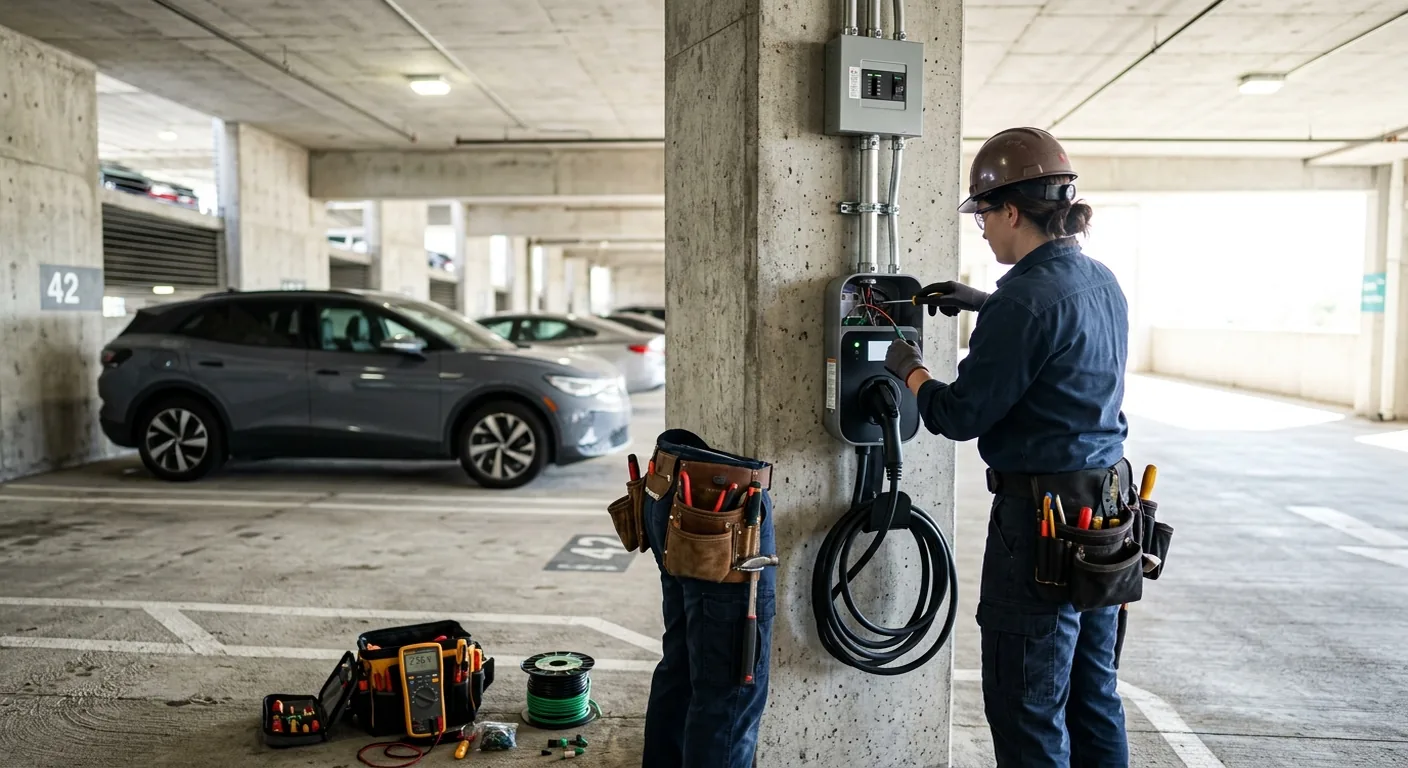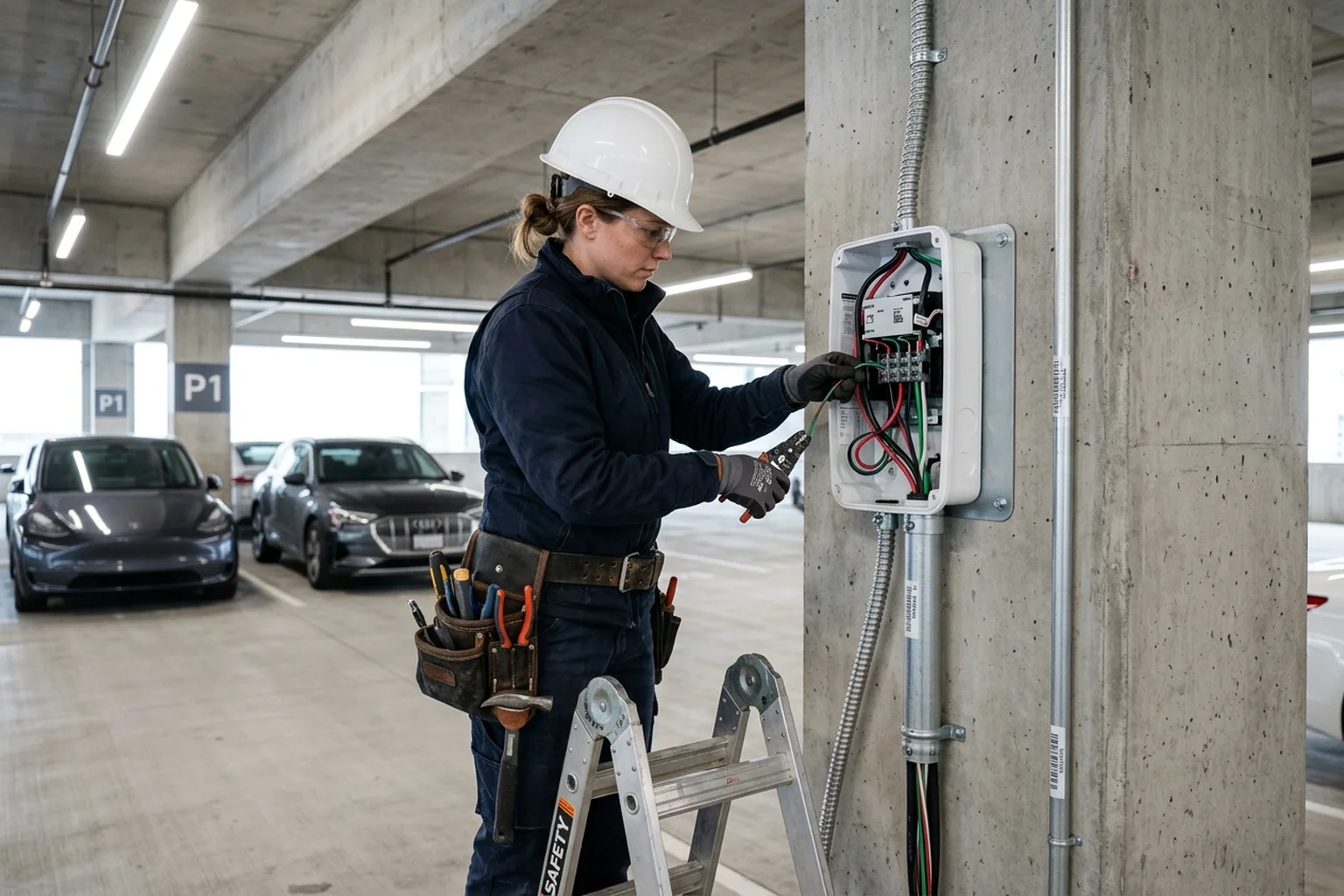

In January 2026, nine states simultaneously opened their next round of funding for new EV charging station installations — with twelve more expected to follow by the end of Q1. Behind every one of those charging stations is an electrician who had to mount the hardware, wire it into the grid, configure the network connection, and verify it met code. Those electricians are in short supply, and the federal government just committed $7.5 billion to make sure the stations get built anyway.
That creates a workforce problem — and a career opportunity. The U.S. currently has roughly 245,600 public EV charging ports. By 2030, PwC estimates the country will need 2.2 million public ports to serve a projected 33 million electric vehicles. Getting from here to there requires tens of thousands of trained installers who don’t yet exist.
This article is about the infrastructure side of the EV transition — the people who install, wire, and maintain charging stations, not the technicians who repair the vehicles themselves. (For that career path, see our guide to EV technician career opportunities.)
TL;DR
- The scale: U.S. needs to grow from ~245,000 public charging ports to 2.2 million by 2030
- The money: $7.5 billion in federal funding (NEVI + CFI programs) is flowing to states now
- The pay: Electricians earn a median of $62,350/year; EV-specialized installers report $70,000–$107,000+
- The entry point: Licensed electricians can add EVITP certification in ~20 hours for $275
- The growth: BLS projects 9% employment growth for electricians through 2034, with ~81,000 annual openings
- The career path: Residential Level 2 installs → commercial DCFC projects → infrastructure project management
Why EV Charging Installers Are in Demand
The math doesn’t work yet
The United States had 77,148 public EV charging station locations hosting more than 236,000 ports as of early 2026. The fast-charging segment is growing rapidly — Paren’s Q2 2025 industry report documented 59,694 DC fast-charging ports across 11,687 stations, with 4,242 new ports opening in that single quarter alone, a 23.3% increase over Q1.
But 2.2 million ports by 2030 means roughly quadrupling the current deployment rate — every year — for the next four years. That requires installers at a scale the industry has never operated at.
Federal dollars are creating the jobs
The Infrastructure Investment and Jobs Act (IIJA) allocated $7.5 billion specifically for EV charging deployment, split between two programs:
- NEVI (National Electric Vehicle Infrastructure) Formula Program: $5 billion distributed directly to states over five years (FY2022–2026) for charging along designated highway corridors
- CFI (Charging and Fueling Infrastructure) Grant Program: $2.5 billion for community-based charging in urban and rural areas
As of late 2025, states had awarded contracts for nearly 4,000 DC fast charger ports at 990 sites across the country. Projects are underway to deploy more than 24,000 federally funded chargers total. Each of those installations requires licensed electricians — and under NEVI rules, at least 25% of the crew must hold EVITP certification.
This isn’t speculative demand. The money is appropriated, the contracts are signed, and the work needs bodies.
The electrician shortage amplifies the opportunity
Even without EV charging, the electrician workforce is stretched thin. The Bureau of Labor Statistics projects 9% employment growth for electricians from 2024 to 2034 — much faster than the average for all occupations — with approximately 81,000 openings per year driven by retirements, infrastructure modernization, and renewable energy buildouts.
EV charging installation competes for the same labor pool as solar installations, data center construction, and grid upgrades. Electricians who specialize in EV infrastructure aren’t just entering a growing niche — they’re entering a niche within an already-tight labor market. For a broader look at how all these forces intersect, see our overview of clean energy trades careers.
What EV Charging Installers Actually Do
EV charging installation is electrical trade work with a specialized equipment focus. The job varies significantly depending on whether you’re installing a residential Level 2 charger in someone’s garage or a bank of DC fast chargers at a highway rest stop.
Residential Level 2 installations
The entry point for most installers. A typical residential job involves:
- Site assessment: Evaluating the home’s existing electrical panel capacity (most Level 2 chargers need a dedicated 240V, 40–50 amp circuit)
- Panel upgrades: Many older homes can’t support a 40-amp dedicated circuit without a panel upgrade — a common add-on that increases the scope and value of each job
- Wiring and mounting: Running conduit, pulling wire, mounting the EVSE unit, and connecting to the panel
- Permitting and inspection: Pulling the required electrical permits and coordinating with local inspectors
- Customer education: Walking homeowners through charger operation, smartphone app setup, and basic troubleshooting
A residential Level 2 install typically takes 2–4 hours for straightforward jobs, longer if panel work is needed. This is bread-and-butter work that builds skills and generates steady revenue.
Commercial Level 2 and DC fast charger installations
This is where the complexity — and the pay — scale up considerably. Commercial installations involve:
- Load calculations: DC fast chargers pull 400–1,000 volts and can draw significant power. Installers must calculate how the charging equipment impacts the facility’s existing electrical infrastructure and whether transformer or switchgear upgrades are needed
- Concrete and civil work coordination: Commercial charger pads, bollards, signage, and ADA-compliant layouts require coordination with civil contractors
- Networking and commissioning: Modern commercial chargers are networked devices — they connect to payment systems, load management platforms, and utility demand-response programs. Commissioning involves software configuration, not just electrical verification
- Utility coordination: Large DCFC installations often require new utility service connections, metering upgrades, or dedicated transformers — work that involves utility engineering review timelines
- Ongoing maintenance contracts: Commercial operators need preventive maintenance, firmware updates, and rapid response for outages. This creates recurring revenue for installers who build maintenance into their service model
How this differs from EV vehicle repair
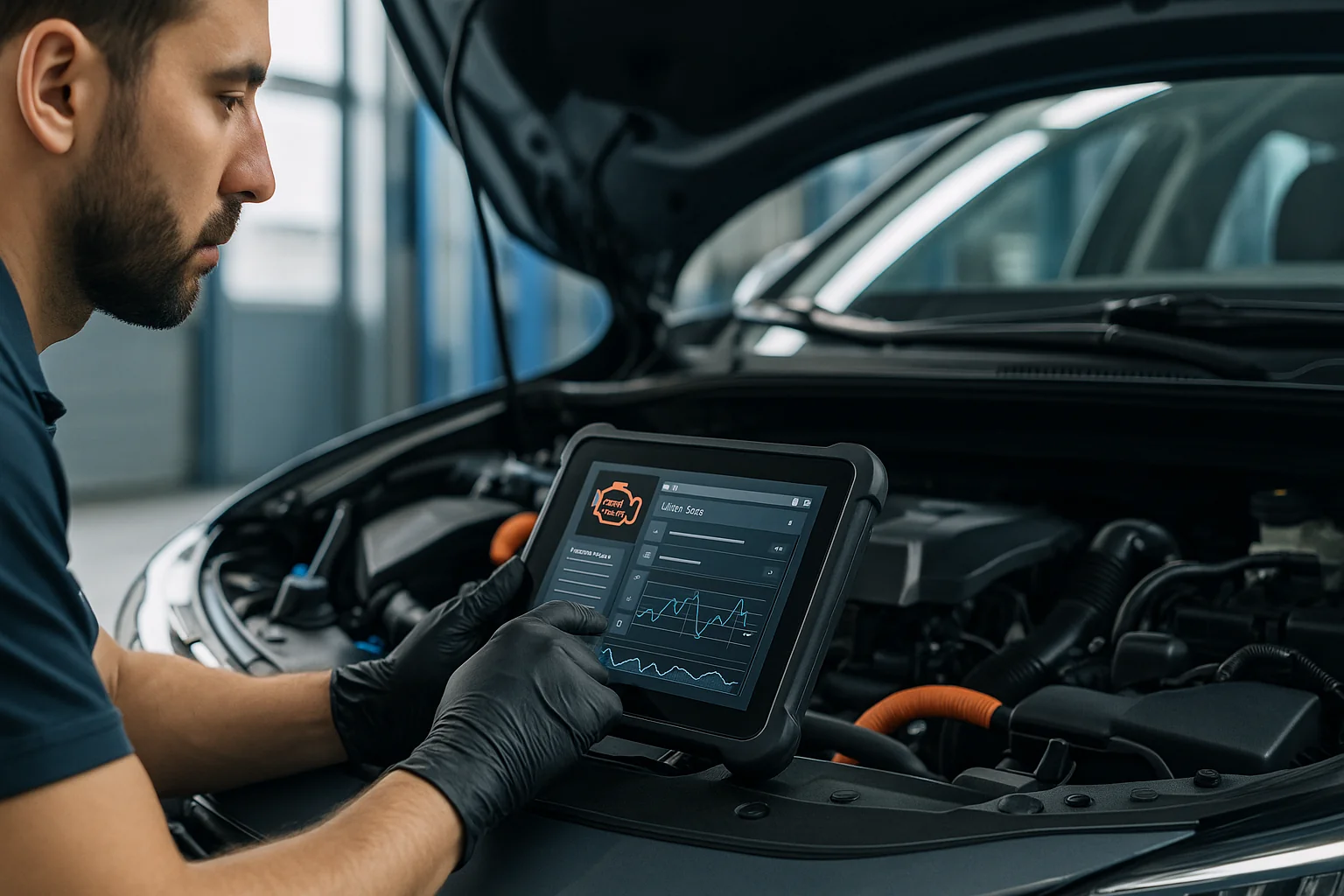
It’s worth being explicit about the distinction. EV technicians work on the vehicles — diagnosing battery systems, servicing high-voltage drivetrains, running software diagnostics. EV charging installers work on the infrastructure — the stations, the wiring, the grid connections. The skill sets overlap in electrical fundamentals but diverge in application. Think of it like the difference between an HVAC technician and the electrician who wires the building’s electrical system.
Salary and Career Outlook
What EV charging installers earn
Compensation for EV charging installers tracks closely with — and often exceeds — general electrician wages, reflecting the specialized knowledge required.
General electrician baseline: The BLS reports a median annual wage of $62,350 for electricians as of May 2024. The top 10% earned more than $106,030.
EV-specialized installers: Salary data from EV.Careers indicates that new EV infrastructure workers start around $82,000, with median pay reaching $95,000 and experienced installers earning $107,000+. ZipRecruiter data shows hourly rates ranging from $21 to $72 depending on role, experience, and location.
The premium over general electrical work reflects both the specialized certification requirements and the reality that demand currently outpaces supply. Markets with aggressive EV adoption — California, the Northeast corridor, and Pacific Northwest — tend to pay at the higher end.
Job growth trajectory
The BLS projects 9% growth for electricians overall from 2024 to 2034, but within that broader category, EV charging work is growing much faster. The charging network expanded at over 20% year-over-year in 2025, and that pace is expected to accelerate as NEVI-funded projects break ground across all 50 states.
For context, an estimated 19,500 new DC fast-charging ports are expected to come online in 2026 alone, pushing the national total toward 90,000 fast-charging ports. Each port requires installation labor.
How to Become an EV Charging Installer
There are two main entry points depending on where you’re starting from.
Path A: Start with electrical training
If you’re new to the trades, the foundational path is an electrical training program — either a trade school certificate, community college associate degree, or formal apprenticeship. The core requirement for EV charging installation work is being a licensed electrician.
A typical pathway looks like this:
- Complete an electrical program (1–2 years for a certificate/diploma, 2 years for an associate degree)
- Enter an apprenticeship or begin accumulating supervised work hours (most states require 4–5 years / 8,000+ hours for a journeyman license)
- Earn your journeyman electrician license
- Add EVITP certification (details below) to specialize in EV infrastructure
For a deep dive on the broader electrical career path — including apprenticeship structures, licensing requirements, and salary progression — see our electrical career opportunities guide. And if you’re weighing the apprenticeship route specifically, our apprenticeships explained guide covers how they work across the trades.
Path B: Upskill from an existing electrical career
If you’re already a licensed electrician, the pivot to EV charging work is straightforward. The EVITP certification — detailed below — takes about 20 hours and $275. Many contractors are actively seeking electricians willing to add this credential because it unlocks their eligibility for NEVI-funded projects.
The learning curve is real but manageable. EV charging installation builds directly on existing electrical skills — conduit work, panel connections, load calculations, and code compliance. The new knowledge centers on charger-specific standards, networking and commissioning protocols, and the NEC articles that apply specifically to EV supply equipment.
Certifications That Matter
EVITP: The industry standard
The Electric Vehicle Infrastructure Training Program (EVITP) is the primary credential for EV charging installers. Here’s what you need to know:
- Eligibility: Must be a state-licensed or certified electrician. In states without electrician licensing, you need documentation of at least 8,000 hours of hands-on electrical construction experience
- Training: Approximately 20 hours of online coursework covering charging station fundamentals, National Electrical Code standards, jobsite safety, and installation/maintenance best practices
- Cost: $275
- Exam: Proctored online examination after completing the training
- Validity: Certification is good for three years, then requires renewal
- Why it matters: NEVI-funded projects require at least 25% of electricians on each installation crew to hold EVITP certification for chargers rated at 25 kW or above
EVITP is not a replacement for an electrician’s license — it’s an add-on that signals specialized competency. Think of it as the EV charging equivalent of a specific NEC code specialization, not a standalone credential.
NFPA 70E and other safety credentials
Working around high-voltage electrical equipment carries real hazard. NFPA 70E (Standard for Electrical Safety in the Workplace) training is widely expected by employers, particularly for DC fast charger installations where voltages range from 400V to 1,000V. This isn’t a formal certification in most cases but rather required safety training that responsible contractors mandate for their crews.
Additional credentials that strengthen your profile
- OSHA 10 or OSHA 30: General construction safety training required on most commercial job sites
- Manufacturer-specific training: ChargePoint, Tesla, ABB, and other charger manufacturers offer training programs for their specific equipment. These aren’t universally portable but are valuable if you work with a contractor that installs a particular brand
- NEC Article 625 familiarity: Article 625 of the National Electrical Code covers Electric Vehicle Power Transfer System requirements specifically — it’s the code section that governs EV charging installations
For a broader overview of how certifications and licenses work across the trades, see our guide to trade certifications and licenses.
Career Paths and Advancement
Entry-level: Residential installations
Most EV charging installers start with residential Level 2 work, either as employees of electrical contractors or as part of a specialized EV installation company like Qmerit. Residential installs build foundational skills — site assessment, customer interaction, permitting — while generating consistent work volume as EV adoption grows in the consumer market.
Mid-career: Commercial and NEVI projects
With 3–5 years of experience and EVITP certification, installers move into commercial-scale work: multi-unit DCFC installations at highway stops, fleet charging depots for delivery and transit companies, and workplace charging projects. This work commands higher rates and involves project management skills — coordinating with general contractors, utilities, and equipment vendors.
Advanced: Specialization and management
- Infrastructure project management: Overseeing multiple installation sites, managing crews, and handling utility coordination across a portfolio of NEVI-funded or private-sector projects
- Consulting and design: Experienced installers who understand both the electrical and business sides can move into consulting — advising property owners, fleet operators, and municipalities on charging infrastructure strategy
- Maintenance and operations: Building a recurring-revenue business around preventive maintenance contracts for commercial charging networks
- Entrepreneurship: Starting an EV charging installation company. The barrier to entry is an electrician’s license, EVITP certification, and relationships with equipment distributors — lower than many trade business startups
The overlap with solar panel installation is worth noting. Many electrical contractors are bundling solar, battery storage, and EV charging as a combined clean energy offering. Installers who can work across all three categories are particularly valuable.
Realistic Trade-Offs to Consider
This is a strong career path, but it’s not without challenges:
- You need to be a licensed electrician first. EVITP is a specialization on top of a full electrical career — there’s no shortcut to skip the foundational training and apprenticeship. Budget 4–6 years from starting electrical school to being fully licensed and EVITP-certified
- The work is physical and outdoor. Commercial installations involve trenching, conduit runs, working in parking structures, and exposure to weather. It’s construction-adjacent work, not bench electronics
- Federal funding is time-limited. The NEVI program runs through FY2026. While private-sector investment will likely fill the gap, the current surge of federally funded projects won’t last indefinitely. Getting into the pipeline now positions you to ride the wave while it’s at its peak
- Technology changes. Charging standards, power levels, and networking protocols are still evolving. Megawatt-level charging for heavy trucks, vehicle-to-grid integration, and wireless charging are all on the horizon. Ongoing training is part of the job, not a one-time investment
- Market concentration varies. Demand is strongest in states with high EV adoption (California, Washington, New York, Colorado) and along NEVI-designated highway corridors. Rural markets may have fewer opportunities, though the CFI program specifically targets underserved areas
Getting Started
The most direct path into EV charging infrastructure work depends on where you are right now:
If you’re starting fresh: Enroll in an electrical installation program at a community college or trade school. Focus on building your core electrical skills and working toward a journeyman license. The EV specialization comes after the foundation.
If you’re already an electrician: Look into EVITP certification — 20 hours and $275 to open up a growing category of work. Talk to contractors in your area who are bidding on NEVI-funded projects; many are actively recruiting licensed electricians willing to add the credential.
If you’re in a related trade (solar, general construction, HVAC): Consider whether an electrical apprenticeship makes sense as a lateral move. The demand signals for electricians across clean energy, data centers, and infrastructure modernization are strong across the board.
The charging network the country needs isn’t going to build itself. The funding is allocated, the contracts are going out, and the installations need trained hands. Whether this becomes your career depends on whether you decide to pick up the tools.
Sources
- U.S. Bureau of Labor Statistics — Occupational Outlook Handbook: Electricians — May 2024 — bls.gov
- Joint Office of Energy and Transportation — Electric Vehicle Charging Infrastructure Growth — driveelectric.gov
- U.S. Department of Energy AFDC — National Electric Vehicle Infrastructure (NEVI) Formula Program — afdc.energy.gov
- Federal Highway Administration — NEVI Interim Final Program Guidance (August 2025) — fhwa.dot.gov
- Congressional Research Service — EV Charging Infrastructure: Frequently Asked Questions — congress.gov
- PwC — U.S. Electric Vehicle Charging Market Growth by 2030 — pwc.com
- Paren — US EV Fast Charging: Q2 2025 State of the Industry Report — paren.app
- EVITP — Electric Vehicle Infrastructure Training Program — evitp.org
- EV.Careers — EV Jobs USA Salary Guide 2025 — ev.careers
- ZipRecruiter — EV Charger Installer Salary Data — ziprecruiter.com
- Qmerit — How to Become an Electrician Specializing in EV Charger Installations — qmerit.com