
A plain-spoken guide for anyone thinking about building submarines in southeastern New England.
Picture your first week. You badge in before dawn and walk past a hull section bigger than most houses. Then you spend the shift on a welding booth practice plate, or hauling a hose up a ladder for someone who has done this for twenty years. Nobody hands you a submarine to build. They hand you a qualification test, a safety lecture, and a supervisor who will check your work twice.
That’s the job. It is also one of the largest trade hiring drives in the country right now.
TL;DR:
- Hiring: General Dynamics Electric Boat (EB) plans to hire 8,000 people in 2026, up from a 3,000-hire plan the year before (The Day, via CT Office of Military Affairs).
- The order book: In July, the Navy awarded EB $76.6 billion to build nine Virginia-class and five Columbia-class submarines (Rep. Joe Courtney).
- Starting pay: Entry-level skilled trades start at $24.28 an hour in Groton and $24 at Quonset Point (EB Careers). Experienced welders are posted at $32.46 to $41.64 an hour.
- The catch: Every job requires US citizenship and a security clearance, and most trade jobs require working any shift.
Why the yard is hiring this hard
The Navy wants one Columbia-class ballistic-missile submarine and two Virginia-class attack submarines a year. Industry partners estimate that pace takes about 70 million labor hours a year (NBC 10 WJAR). The yards are well short of it. A January 2026 Congressional Research Service report says Virginia-class production has run at about 1.1 to 1.2 boats a year since 2022 (CRS via USNI News). GAO told Congress the first ten Block V boats are running almost three years late on average, and named late materials and a shortage of experienced workers as causes (Breaking Defense).
The Columbia program is in better shape. The lead boat, the future District of Columbia, was about 65% complete in February. The Navy’s program executive called it one of only two Navy ships under construction that are on schedule (USNI News). A new floating dry dock built for Columbia-class work arrived in Groton in January (Naval News).
The money is now in place. The July contracts cover:
- $42.1 billion for nine Block VI Virginia-class boats
- $29.5 billion for five Columbia-class boats
- $5 billion for shipyard improvements
EB president Mark Rayha said the company was more than halfway to its 8,000-hire goal by late July and expects to hire about the same number in 2027 (NBC 10 WJAR). The company employed about 25,000 people in February. Courtney’s office expects that to reach 33,000 eventually (The Day).
The wider economy shows the same pull. Connecticut manufacturing added 6,500 jobs in the first nine months of 2026, more than any other industry (CT Department of Labor). Rhode Island manufacturing was up 1,300 jobs over the year. Its production workers averaged $27.02 an hour and 41.1-hour weeks (RI DLT).
Groton or Quonset Point?
EB builds in two places, and they are different jobs.
- Quonset Point, North Kingstown, RI is the module factory. Crews there build hull cylinders and large modules for both submarine classes, which then go to Groton for final assembly. Sen. Jack Reed’s office said Quonset would add 3,500 jobs in 2026, in metalwork, electronics, plumbing, painting, and engineering (Sen. Reed).
- Groton, CT is where modules become a finished submarine. Final assembly, outfitting, testing, and the waterfront are all there. The February plan called for about 2,500 trades hires in Groton, plus 1,000 engineers and designers and 1,000 other roles.
The exact split has moved during the year. A March breakdown from Rayha put Quonset at about 3,250 and Groton trades at about 2,250 (CBIA). Either way, the larger share of the hiring is now in Rhode Island.
EB is also turning the former Crystal Mall in Waterford into a training and engineering campus. The plans include 73 welding booths, three times the current weld school, and room for about 400 trainees a day across three shifts. EB said it hopes to start training there by the end of 2026 (Hartford Business Journal).
What it pays
EB is unusually open about pay. The rates below come from its careers site and from EB job postings viewed in October 2026. Annual figures assume 2,080 straight-time hours, with no overtime or shift premium.
| Role (Groton) | Hourly range | Annual equivalent |
|---|---|---|
| Paid trainee | from $20.00 | about $41,600 |
| Entry-level trades (shipfitter, painter, rigger, outside electrician, pipefitter) | $24.28 to $30.13 | $50,500 to $62,700 |
| Skilled pipefitter | $31.61 to $41.14 | $65,700 to $85,600 |
| Skilled welder (5+ years) | $32.46 to $41.64 | $67,500 to $86,600 |
| Skilled shipfitter, painter, rigger | $33.19 to $43.20 | $69,000 to $89,900 |
Sources: EB Careers; General Dynamics welder posting; BuildSubmarines.com EB listings.
For context, here is how the same trades pay across each state. The figures are from the BLS Occupational Employment and Wage Statistics survey, May 2025 (Connecticut; Rhode Island; national).
| Occupation | CT median | RI median | U.S. median |
|---|---|---|---|
| Sheet metal workers | $78,750 | $65,100 | $61,800 |
| Electricians | $77,540 | $74,090 | $63,190 |
| Plumbers, pipefitters, and steamfitters | $77,280 | $76,470 | $63,800 |
| Welders, cutters, solderers, and brazers | $64,880 | $50,580 | $53,750 |
| Machinists | $62,130 | $57,760 | $58,750 |
| Structural metal fabricators and fitters | $58,760 | — | $51,330 |
| Painting and coating machine operators | $52,900 | $49,850 | $48,250 |
| All occupations | $59,690 | $56,780 | $50,980 |
A few things to notice:
- The entry rate is a floor. A new hire at $24.28 starts below the Connecticut median for most of these trades. The jump to the skilled bands is where the money is, and it takes years. GAO puts the time for shipyard trades to reach proficiency at three to five years (19FortyFive).
- Overtime is real. Metal Trades Council members have been working more overtime and filling third-shift jobs (The Day). OEWS medians leave out overtime and shift pay (BLS OEWS FAQ).
- The shipyard county is a blank spot in the data. BLS reports no welder or structural-fitter wage for the Norwich–New London metro area, where Groton sits. In the metro, electricians earn a median of $72,240 and pipefitters $76,980 (BLS OEWS, Norwich–New London).
- The unions have been winning raises. In May 2025, the Marine Draftsmen’s Association ratified a five-year contract with a 30% wage increase for more than 2,400 Groton designers (UAW). The same month, a wage reopener covered more than 3,400 Metal Trades Council members and 350 carpenters (Rep. Courtney).
The trades the yard needs
EB’s posted openings cover welders, pipefitters, electricians, machinists, planners, designers, and inspectors, and many of these roles don’t require a four-year degree (19FortyFive). Here’s what each trade actually involves.
Welders
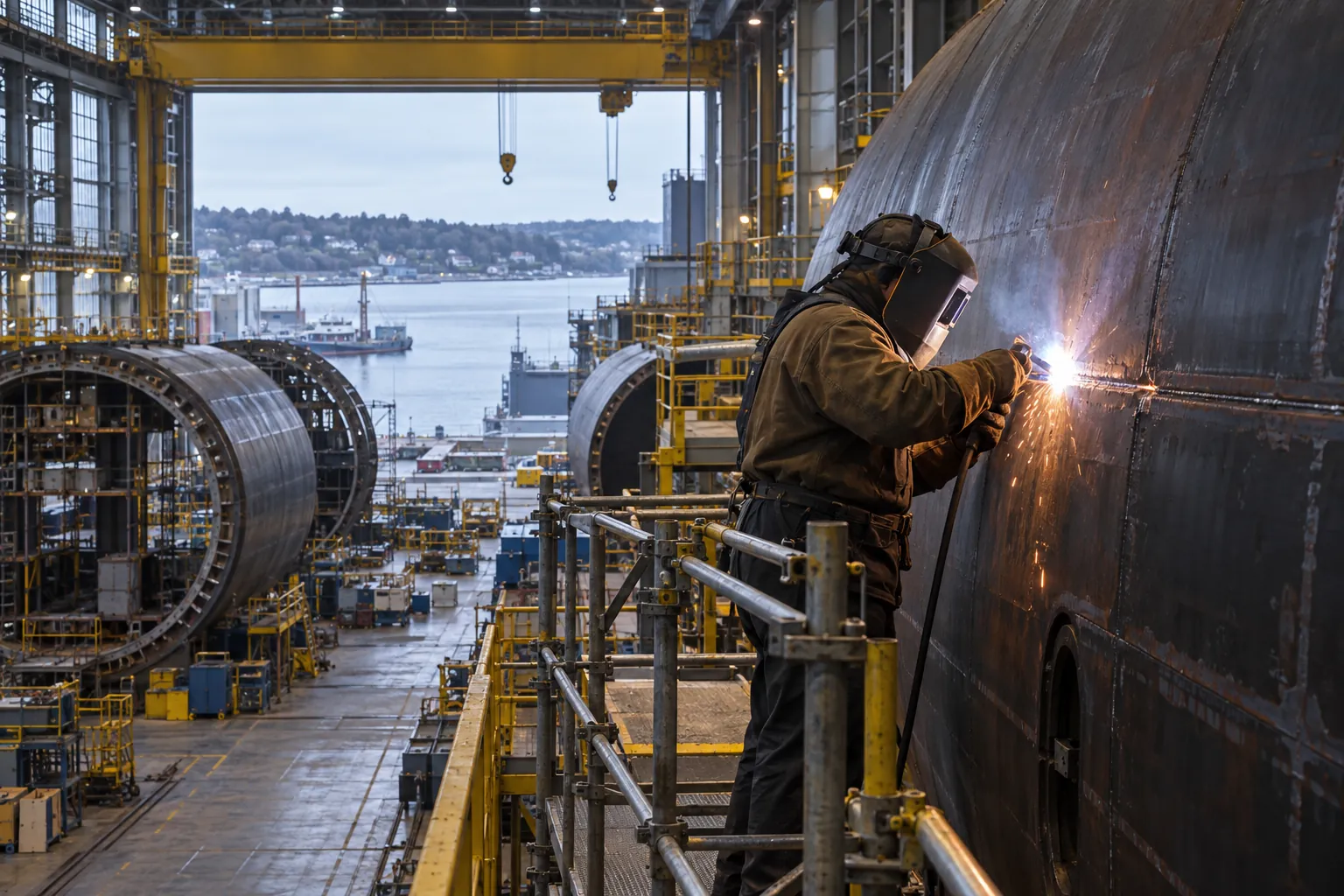
Submarine welding is exacting work, and the qualification tests come before the production work does. EB’s skilled welder posting asks for five or more years of experience in GMAW (MIG) and SMAW (stick), and for availability on all shifts. Most new welders don’t arrive with that: EB trains 700 to 1,000 welders a year in-house (19FortyFive). If you’re starting from zero, our welding career guide and MIG vs. TIG vs. stick explainer cover the basics. Welding programs lists schools nationwide, and the welder career profile covers national pay.
Pipefitters
A submarine is packed with piping systems, and fitting them in a curved hull is slow, exacting work. Entry-level pipefitters in Groton must pass EB’s Nuclear Pipefitter Training, work any shift, work in radiological areas (zones near the reactor plant with radiation monitoring and controls), accept road assignments, and bring their own hand tools (General Dynamics posting). See the pipefitter career guide and pipefitting programs.
Shipfitters
Shipfitters lay out, cut, fit, and tack the steel structure that welders then finish. It’s the trade closest to building the ship itself. BLS counts them as structural metal fabricators and fitters. Few colleges teach shipfitting as a degree. The marine maintenance and ship repair programs that exist are scattered nationally. In southeastern New England, the realistic route is the pre-hire pipeline courses described below.
Outside electricians
“Outside” means aboard the boat, not in a shop. Outside electricians pull cable through tight spaces, terminate it, and install equipment. The electrical systems on a submarine are dense, and the work is done in close quarters. Connecticut electricians earn a median of $77,540, more than $14,000 above the national figure. If you want a path that also works on land, see electrician programs and our guide to electrician career paths.
Machinists
“Inside machinists” run lathes, mills, and CNC equipment in the shops. “Outside machinists” install and align equipment on the boat. Inside machinists start at $23.12 to $28.70 an hour and reach $26.51 to $36.93 at the skilled level, according to the October listings on BuildSubmarines.com. Our CNC machinist guide and machinist career profile cover the trade.
Sheet metal workers, painters, and riggers
These are the trades people forget about. Sheet metal workers build ventilation ducting and enclosures. Painters prepare surfaces and apply coatings in tanks and voids. Riggers move multi-ton loads with cranes and chain falls. Painters and riggers hire at entry level, and all three trades are covered in the pre-hire courses. Connecticut sheet metal workers earn a median of $78,750, the highest of any trade in the table above.
Getting in: the pipelines
Most new hires come through one of three doors.
The Manufacturing Pipeline Initiative (Connecticut and Westerly, RI)
The Eastern Connecticut Workforce Investment Board (EWIB) runs pre-hire courses. They last 2.5 to 10 weeks, 6.5 hours a day, five days a week, in day or evening sessions. There is no tuition. EB-specific tracks cover pipefitting, shipfitting, sheet metal, electrical, painting, rigging, design, and planning (EWIB FAQ).
Classes run at CT State Three Rivers’ advanced manufacturing center at Grasso Tech in Groton, at CT State Quinebaug Valley, and at the CCRI Westerly Education Center. Graduates may receive conditional job offers (CT State Community College).
What to know before you sign up:
- No wages during training. You get attendance stipends plus help with travel and childcare. Budget for weeks without a paycheck.
- Passing the course isn’t the job. You still need to pass EB’s interview, drug test, physical, and security clearance.
- Most trainees are new to the work. About 80% have no manufacturing experience (Area Development). That’s how the program is designed.
CCRI’s Electric Boat trades courses (Rhode Island)
The Community College of Rhode Island offers Maritime Electrical (200 hours), Pipefitting (240), Sheet Metal (200), Rigging (80), and Paint (80) at Westerly, with no tuition. The Quonset track is post-employment and DoD-funded, so you’re hired by EB first and trained after (CCRI).
EB’s own paid training
EB hires some people straight into paid training, starting at $20 an hour in Groton, for select trades at both sites (EB Careers). If you want to try the work before committing, EB’s two-evening “Boat Program” gives you hands-on time with welding, machining, and pipefitting, with no experience needed (EB Careers).
These pipelines are backed by serious money. The Southeastern New England Defense Industry Alliance (SENEDIA) won a follow-on Defense Department contract worth up to $98.3 million over four years, sized to train more than 8,600 more candidates through 2029 (SENEDIA). The partnership passed 10,000 workers trained in July 2026.
What the recruiting posters don’t say
- Citizenship and clearance aren’t optional. All EB positions require US citizenship, and every employee must obtain and keep a security clearance (EB Careers). The clearance means a background investigation. Application to start date runs about 4 to 12 weeks, and longer when a clearance is involved.
- Any shift, anywhere on the boat. Trade postings require working all shifts, entering radiological areas, and handling confined spaces, fumes, and heavy lifting. If you need a fixed day schedule, ask before you accept.
- People do leave. In February, EB attrition was reported to be trending down to about 10% (The Day). Rayha later put it under 5% in Groton (CBIA). Either way, some new hires decide the yard isn’t for them. A taster course before you quit your current job is cheap insurance.
- 2025 fell short. EB hired about 2,300 people in 2025 against a plan of about 3,000 (CBIA). Hiring targets are goals, not guarantees.
- Housing is tight. Southeastern Connecticut needs about 27,000 more homes. The average Groton home value is about $450,000, up 67% since 2020 (NBC Connecticut). Price out rent before you relocate.
- Schedules slip. The Navy’s program office talks about a 2028 delivery for the lead Columbia boat, while the Navy’s FY2027 budget lists March 2029 (19FortyFive). Our read: with 14 boats newly under contract, delays are more likely to stretch the work out than to end it, but overtime can come and go with the schedule.
The supplier shops are hiring too
EB isn’t the only employer. Over five years, about 350 Connecticut suppliers received $1.6 billion of EB work, up 45% from the prior five years. One example: Collins & Jewell, a Bozrah fabricator with about 80% of its work on submarines, is building a 27,000-square-foot addition (Hartford Business Journal). Smaller shops hire fewer people, and the good ones are competitive: Collins & Jewell gets about 400 applications for 10 to 12 openings a year (Area Development).
Where to train in Connecticut and Rhode Island
- Near the yards: Connecticut State Community College runs the pipeline courses at its Three Rivers and Quinebaug Valley campuses. It also reported 135 CNC machining awards in 2024–25, the most in the state (IPEDS). The Community College of Rhode Island runs the Westerly and Quonset tracks.
- Degree and certificate programs statewide: In 2024–25, six Connecticut schools in our database reported 545 electrician awards. The largest were Porter & Chester Institute in Bridgeport (145) and three Lincoln Tech campuses, including Lincoln Technical Institute–East Windsor. Four schools reported 225 welding awards, led by Lincoln Tech East Windsor (121) (IPEDS). Most of these schools are in central and western Connecticut, an hour or more from Groton.
- Browse: trade colleges in Connecticut, trade colleges in Rhode Island, the Connecticut program directory, Norwich-area schools, Providence-area schools, and the ranked list of Connecticut trade colleges.
Short pipeline courses don’t show up in federal completions data, so the IPEDS counts above understate how many people are actually training for the yard.
Shipyards elsewhere are also building submarine parts. Austal USA in Mobile now builds submarine modules too; our Alabama guide covers that market.
What a seasoned hand would tell you on day one
- Pick the trade, not just the employer. Welding, pipefitting, and electrical skills carry over to other shops and construction sites if you ever leave.
- Get your paperwork ready before you apply. Have proof of citizenship on hand, and expect a drug test, a physical, and a background investigation.
- Take the Boat Program or a pipeline course first. It’s the cheapest way to find out whether you can handle the noise, the heat, the heights, and the confined spaces.
- Learn the union contract. The Metal Trades Council and the Marine Draftsmen’s Association negotiate your raises and overtime rules. Our union vs. non-union guide explains the trade-offs.
- Plan for years, not months. The skilled pay bands start where proficiency starts. That’s three to five years in, and the yard has work booked well past then.
Sources
- Lee Howard, The Day (via CT Office of Military Affairs) — “EB to hire 8,000 this year” — February 7, 2026 — https://portal.ct.gov/oma/in-the-news/2026-news/eb-to-hire-8000-this-year
- Connecticut Business & Industry Association — Electric Boat hiring and supplier update — March 26, 2026 — https://www.cbia.com/?p=175203
- Office of Sen. Jack Reed — “Investments in Submarine Production Lead to 3,500 New Jobs Coming to Quonset Point” — February 20, 2026 — https://www.reed.senate.gov/news/releases/reed-investments-in-submarine-production-lead-to-3500-new-jobs-coming-to-quonset-point
- Office of Rep. Joe Courtney — Statement on $76.6 billion contract awards to Electric Boat — July 29, 2026 — https://courtney.house.gov/media-center/press-releases/courtney-statement-new-766-billion-contract-awards-electric-boat-block
- Office of Rep. Joe Courtney — Wage boost for 3,700 metal trades workers — May 22, 2025 — https://courtney.house.gov/media-center/press-releases/rep-courtney-applauds-wage-boost-additional-3700-metal-trade-workers
- Devin Bates, NBC 10 WJAR — Electric Boat $76.6 billion submarine contract — July 29, 2026 — https://turnto10.com/news/local/story/general-dynamics-electric-boat-77-billion-dollar-submarine-contract-newport-news-shipbuilding-virgina-columbia-class-groton-connecticut-quonset-point-rhode-island-department-of-defense-july-29-2026
- Maddie Heimsch, NBC 10 WJAR — Submarine shipbuilding partnership passes 10,000 workers trained — July 1, 2026 — https://turnto10.com/news/local/new-england-submarine-shipbuilding-partnership-passes-10000-workers-trained-electric-boat-southeastern-new-england-defense-industry-alliance-july-1-2026
- Diana Stancy, Breaking Defense — “Navy awards $76.6B in contracts for new Virginia, Columbia-class subs” — July 29, 2026 — https://breakingdefense.com/2026/07/navy-awards-76-6b-in-contracts-for-new-virginia-columbia-class-subs/
- Sam LaGrone, USNI News — “Navy Says Columbia-class Sub Construction Schedule Improving” — February 11, 2026 — https://news.usni.org/2026/02/11/navy-says-columbia-class-sub-construction-schedule-improving
- Congressional Research Service (via USNI News) — Report to Congress on the Virginia-class submarine program and AUKUS Pillar 1 — January 27, 2026 — https://news.usni.org/2026/01/27/report-to-congress-on-the-virginia-class-submarine-program-and-aukus-pillar-i
- Ethan Gossrow, Naval News — Electric Boat receives new floating dry dock — January 7, 2026 — https://www.navalnews.com/naval-news/2026/01/electric-boat-receives-new-floating-dry-dock-to-support-columbia-class-submarines/
- Harry J. Kazianis, 19FortyFive — Electric Boat’s workforce (commentary) — August 3, 2026 — https://www.19fortyfive.com/2026/08/electric-boats-27000-workers-are-what-makes-the-us-navys-nuclear-submarine-force-one-of-a-kind/
- Harriet Jones, Hartford Business Journal — Electric Boat breaks ground at new Waterford campus — August 21, 2026 — https://hartfordbusiness.com/article/electric-boat-breaks-ground-at-new-waterford-campus-renovating-crystal-mall-property/
- Michael Puffer, Hartford Business Journal — “As submarine maker Electric Boat grows, CT suppliers ride the wave” — February 24, 2026 — https://hartfordbusiness.com/article/as-submarine-maker-electric-boat-grows-ct-suppliers-ride-the-wave/
- Area Development — “Connecticut’s Submarine Boom Tests Its Workforce Pipeline” — September 10, 2026 — https://www.areadevelopment.com/manufacturing-industrial/q3-2026/connecticuts-submarine-boom-tests-its-workforce-pipeline.shtml
- Matt Austin, NBC Connecticut — Electric Boat hiring boom and southeastern Connecticut housing — August 5, 2026 — https://www.nbcconnecticut.com/news/local/electric-boat-hiring-boom-brings-new-jobs-and-intensifies-housing-challenges-for-southeastern-connecticut/3761962/
- General Dynamics Electric Boat — EB Careers support and FAQ — updated October 20, 2026 — https://ebcareers.com/support/
- General Dynamics Electric Boat — The Boat Program — accessed October 21, 2026 — https://ebcareers.com/boat-program/
- General Dynamics — Job postings: Welder (Skilled) and Pipefitter (Entry Level), Groton — accessed October 21, 2026 — https://www.gd.com/careers/welder-skilled-groton-ct-us-2026-17304-eb-opportunity
- BuildSubmarines.com — Electric Boat job listings — accessed October 21, 2026 — https://jobs.buildsubmarines.com/jobs/577485574-pipefitter-entry-level-semi-skilled-at-general-dynamics-electric-boat
- Eastern CT Workforce Investment Board — Manufacturing Pipeline Initiative FAQ — updated December 18, 2025 — https://www.ewib.org/pipeline-initiatives/manufacturing-pipeline/mpi-frequently-asked-questions/
- CT State Community College — Eastern CT Manufacturing Pipeline Program — updated August 28, 2026 — https://ctstate.edu/programs/eastern-ct-manufacturing-pipeline-program
- Community College of Rhode Island — Electric Boat trades training — accessed October 21, 2026 — https://ccri.edu/workforce/programs/manufacturingtrades/electric-boat-trades.html
- SENEDIA — Follow-on contract for workforce development — November 18, 2025 — https://senedia.org/senedia-awarded-follow-on-contract-for-workforce-development/
- UAW — Marine drafters ratify contract — May 28, 2025 — https://uaw.org/uaw-marine-drafters-ratify-contract-locking-in-major-gains/
- Connecticut Department of Labor — September 2026 jobs report — October 19, 2026 — https://portal.ct.gov/dol/communications/press-room/2026/job-numbers-reach-new-highs-in-september
- Rhode Island Department of Labor and Training — September 2026 labor force release — October 15, 2026 — https://dlt.ri.gov/sites/g/files/xkgbur571/files/2026-07/release.pdf
- U.S. Bureau of Labor Statistics — Occupational Employment and Wage Statistics, May 2025: Connecticut, Rhode Island, Norwich–New London, and national estimates — released 2026 — https://data.bls.gov/oes/#/area/0900000/2025
- U.S. Bureau of Labor Statistics — OEWS Frequently Asked Questions (wage definitions) — accessed October 21, 2026 — https://www.bls.gov/oes/oes_ques.htm
- National Center for Education Statistics — IPEDS Completions, 2024–25 awards, as compiled in the Trade Colleges database — https://nces.ed.gov/ipeds/