
A data-driven guide for anyone weighing a skilled-trade career in Pennsylvania’s power sector.
TL;DR: Pennsylvania’s power sector is in the middle of a construction wave. Constellation expects to return Three Mile Island Unit 1, now called the Crane Clean Energy Center, to service in the second half of 2027 (ANS Nuclear Newswire). More than 1,800 union tradespeople are building a gas plant on the old Homer City coal site (Washington Examiner). PPL plans to spend $23 billion on its networks from 2026 through 2029 (PPL). The driver is demand. A September 2026 study by the Pennsylvania Public Utility Commission found that the regional grid fails PJM’s reliability planning standard from 2027 through 2030 (PA PUC). The wage data shows who benefits: Pennsylvania’s electrical power-line installers earned a median $106,230 in May 2025, about $11,000 more than the national median (BLS OEWS).
Why Pennsylvania’s grid needs builders
PJM, the regional grid operator that serves Pennsylvania, published a long-term forecast in January 2026. It projects peak demand of roughly 222,000 MW in 2036, a 10-year increase of nearly 66,000 MW. The forecast adds specific data-center load in the utility zones serving Pittsburgh, Philadelphia, and central Pennsylvania (PJM Inside Lines). In August, PJM accepted more than 700 new generation projects into its reformed interconnection queue, led by 99.8 GW of natural gas (PJM Inside Lines).
Supply hasn’t kept pace. PJM’s capacity auctions for the 2027–28 and 2028–29 delivery years both fell short of the regional reliability requirement. The PUC’s study concluded that without new policy action, the grid misses PJM’s planning standard every year from 2027 through 2030 (PA PUC, September 14, 2026).
For trade workers, that shortfall is a construction backlog: new plants, restarted plants, upgraded reactors, and the substations and transmission lines that connect them to customers. PPL alone is targeting about $5.1 billion in 2026 capital spending, including transmission expansion for new data centers (PPL). By August, PPL reported a 31.8-gigawatt data-center pipeline, with more than 6.5 GW of that already under construction (PPL Q2 2026 results).
Data centers are the reason for much of this demand. But most of the trade work they create in Pennsylvania is on the power side: generation, transmission, and distribution. That is what sets this market apart from the data-center build-out we covered in Northern Virginia.
The five projects driving trade hiring
Statuses below are as of mid-October 2026. “Announced” means a company has made a public commitment but construction hasn’t started.
| Project | Location | Status (Oct 2026) | What it means for trades |
|---|---|---|---|
| Crane Clean Energy Center (TMI Unit 1 restart) | Dauphin County | Restoration under way; NRC operating approval expected around May 2027 | 600 permanent jobs; 1,500–2,000 union workers per refueling outage |
| Homer City gas plant and data center campus | Indiana County | Gas plant under construction; AWS campus in county review | 1,800+ direct-hire trades on site now |
| Amazon data center campuses | Luzerne, Bucks, and Schuylkill counties | Two campuses under construction; one pre-construction | Electrical, mechanical, and fiber work; about 1,250 permanent jobs at the first two |
| Nuclear uprates | Beaver Valley and Limerick | Planned; Vistra holds a conditional DOE loan commitment | Engineering, construction, and outage work |
| U.S. Steel Mon Valley upgrades | Allegheny County | Announced; new hot strip mill in air permitting | About two years of mill construction; roughly 3,000 existing jobs preserved |
Crane Clean Energy Center (Three Mile Island Unit 1)
Constellation is restoring the reactor that shut down in 2019. In September 2026 the NRC completed its environmental review of the restart. Constellation told World Nuclear News the project remains ahead of schedule to return 835 megawatts to the grid in 2027. An exemption request and three license amendment requests are still pending before the NRC (World Nuclear News). At a July public meeting, Constellation and NRC staff said they expect the remaining approvals around May 2027 (WITF).
The same meeting produced the most useful figures for job seekers. According to Constellation spokesperson Dave Marcheskie, the plant has 600 permanent jobs, spanning engineers, chemists, maintenance workers, reactor operators, and administrators. Ninety reactor operators are training for NRC licenses, a process that takes 18 to 24 months. Each refueling outage brings 1,500 to 2,000 additional union workers on site for about a month (WITF, July 28, 2026). Rob Bair, president of the Pennsylvania building trades council, wrote that the restart work belongs to electricians, pipefitters, boilermakers, insulators, and laborers (PennLive opinion). Constellation cites an estimate of 3,400 direct and indirect jobs tied to the restart. That figure is an economic projection, not a headcount (Constellation).
Homer City Energy Campus
Homer City Redevelopment is installing seven GE Vernova gas turbines with about 4.4 GW of combined capacity, and says it is targeting first power in early 2028 (Homer City Redevelopment, March 2026). Some September coverage still cites 2027 (Data Center Frontier), so treat the start date as uncertain. In September, crews began moving 15 heat recovery steam generators onto the site (Homer City Redevelopment). Each is a large piece of boiler-and-piping work.
The project also has the state’s best-documented crew. In early September, Homer City Generation said more than 1,800 direct-hire tradespeople were on site. About 95% are local and more than 135 are apprentices, drawn from nine unions: boilermakers, carpenters, electricians, ironworkers, laborers, millwrights, operators, pipefitters, and teamsters. A Boilermakers Local 154 leader told columnist Salena Zito, “we cannot hire fast enough.” Plumbers & Pipefitters Local 354 has combined three aging training schools into a single apprenticeship center (Washington Examiner, September 4, 2026).
The developer projects more than 10,000 direct on-site construction jobs over five years across the plant and the planned data center campus. That is a cumulative count, not the number of people working at any one time. It also projects about 1,000 permanent positions (Homer City Redevelopment). WESA reported that the project could employ about 3,600 people at the height of construction, and that the power plant itself will have about 200 full-time workers (WESA).
The data center campus has not been approved. County filings identify Amazon Web Services as the end user. Construction would begin in December, run about ten years, and create 1,500 to 2,000 full-time jobs (PennLive, October 1, 2026). On October 14, the Indiana County Planning Commission accepted the application for 36 buildings on about 1,100 acres and opened a 90-day review that runs through January 12. One commissioner stressed that accepting an application is not the same as approving it (WJAC).
Amazon’s Pennsylvania campuses
Amazon’s Salem Township campus in Luzerne County has been under construction since October 2025. It is planned for 20 data centers and about 1,000 permanent jobs (Amazon). The Falls Township campus in Bucks County will hold up to 10 buildings (Amazon). Amazon lists a third site, in Kline Township, Schuylkill County, as pre-construction (Amazon). WHYY reported in July that the two active campuses are expected to create about 1,250 permanent jobs plus temporary construction work. It also reported that state regulators plan to approve 280 natural gas-fired generators at the Bucks County site (WHYY).
Union membership shows the electrical demand. IBEW Local 163 in northeastern Pennsylvania has nearly doubled its membership since 2024. The local puts first-year apprentice pay at about $20 an hour and journeyman pay at about $50. Those figures come from a PennLive series funded by the Pennsylvania Chamber Foundation (PennLive Advance Industry). Training capacity is growing alongside it. Amazon paid for fiber-optic train-the-trainer instruction for 13 instructors from northeastern Pennsylvania community colleges and career and technical centers (Amazon). Luzerne County Community College runs a Career and Technology Academy for data-center work, supported by a $1 million state education grant (Penn’s Northeast).
Nuclear uprates at Beaver Valley and Limerick
An uprate gets more output from an existing reactor, and the work is done by outage crews. In October, Vistra received a $4.2 billion conditional loan commitment from the U.S. Department of Energy. It covers uprates at Beaver Valley in Pennsylvania and two Ohio plants, which Vistra says will support about 3,000 engineering, construction, and planned-outage jobs. The applications for Beaver Valley are planned for 2030 and 2031 (ANS Nuclear Newswire). Constellation and Google announced an 11-reactor uprate plan the same week. It includes Limerick and involves more than $4.3 billion of investment and 7,200 construction jobs across the fleet (ANS Nuclear Newswire). Neither job figure is for Pennsylvania alone.
U.S. Steel’s Mon Valley upgrades
U.S. Steel has committed up to $2.5 billion to its Mon Valley Works. The centerpiece is a new hot strip mill at the Edgar Thomson plant in Braddock, which needs about two years of construction. The company says the plan preserves roughly 3,000 jobs (PublicSource). The mill is expected to cost more than $1 billion and start production in 2029 (The Allegheny Front). The Allegheny County Health Department is taking public comment on its air permit until November 18 (The Allegheny Front).
What Pennsylvania pays the trades building it
The table compares Pennsylvania with the nation using a single survey and period: BLS Occupational Employment and Wage Statistics, May 2025 (Pennsylvania; national).
| Occupation | PA jobs | PA median | U.S. median |
|---|---|---|---|
| Nuclear technicians | 310 | $124,070 | $110,240 |
| Electrical power-line installers and repairers | 4,150 | $106,230 | $95,320 |
| Power plant operators | 1,010 | $95,800 | $102,040 |
| Boilermakers | 260 | $86,850 | $76,410 |
| Structural iron and steel workers | 1,610 | $82,970 | $62,780 |
| Plumbers, pipefitters, and steamfitters | 13,620 | $68,080 | $63,800 |
| Electricians | 22,730 | $67,600 | $63,190 |
| Millwrights | 1,700 | $64,410 | $65,700 |
| HVAC mechanics and installers | 15,880 | $62,400 | $61,010 |
| Construction equipment operators | 22,120 | $60,530 | $59,850 |
| Welders, cutters, solderers, and brazers | 17,850 | $52,900 | $53,750 |
| All occupations | — | $49,690 | $50,980 |
Three patterns stand out:
- Eight of the eleven trades out-earn their national peers, even though Pennsylvania’s overall median wage is slightly below the national figure. Line workers lead with an advantage of about $11,000.
- Three trades trail their national medians: welders, millwrights, and power plant operators. For welders, pipefitting and boilermaking (both welding-heavy trades) pay considerably more in Pennsylvania.
- Smaller occupations have less precise estimates. Nuclear technicians and boilermakers fall in that group. BLS publishes no Pennsylvania estimate for nuclear power reactor operators; the national median was $122,890.
Projections are a separate BLS series. Nationally, BLS expects electrician employment to grow 9% from 2025 to 2035, much faster than average (BLS OOH: Electricians). It also projects about 10,900 openings a year for electrical power-line installers and repairers (BLS OOH: Line Installers). For a 50-state comparison, see our highest-paying trade jobs by state.
Six trades Pennsylvania’s power buildout needs
1. Lineworkers and substation technicians
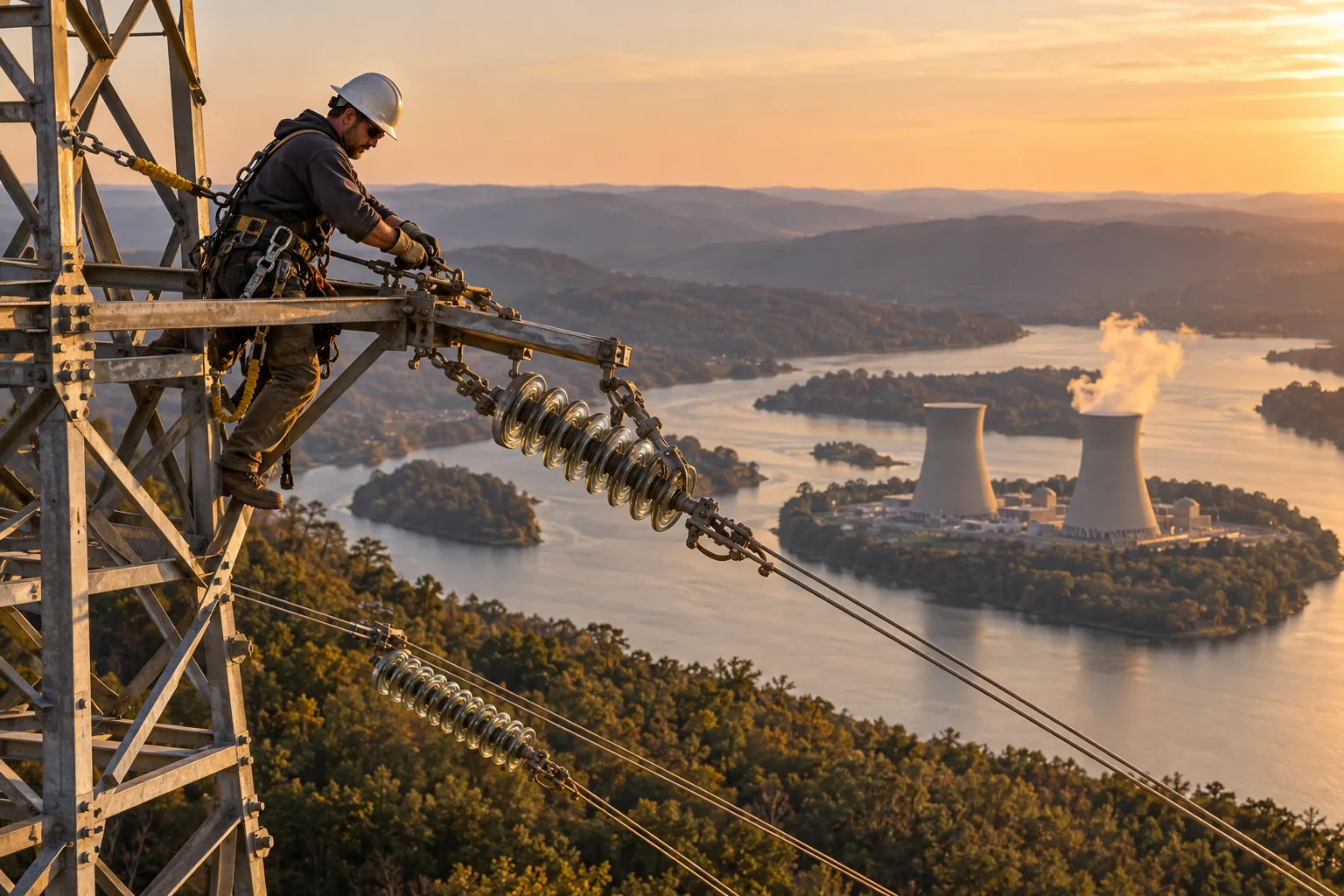
Every new plant, data center, and transmission upgrade needs line crews. Duquesne Light’s lineworkers maintain 690 miles of high-voltage transmission lines and 7,200 miles of distribution circuits. The utility trains overhead lineworkers and underground splicers through its Electrical Distribution Technology program (Duquesne Light). FirstEnergy runs the Power Systems Institute, a two-year program offered with Westmoreland County Community College and Pennsylvania Highlands Community College. As of 2022, it had hired more than 2,400 line and substation workers from its PSI programs (FirstEnergy). FirstEnergy apprentices are paid from the first day of training (FirstEnergy).
Our own data shows where this training happens. Only one Pennsylvania school in our database reported a lineworker award for 2024–25 (IPEDS). Most lineworkers learn through utility programs and union apprenticeships rather than standalone campus certificates. See the power-line installer career profile and lineworker programs.
2. Electricians
Electricians wire switchgear, plant controls, substations, and data halls, at a Pennsylvania median of $67,600. In 2024–25, 19 Pennsylvania schools in our database reported 964 electrician awards (IPEDS). The largest producers were Pennco Tech in Bristol (200), the Community College of Allegheny County (169), and Lincoln Tech in Allentown (116). For the union path, read how to get into an IBEW apprenticeship.
3. Pipefitters and steamfitters
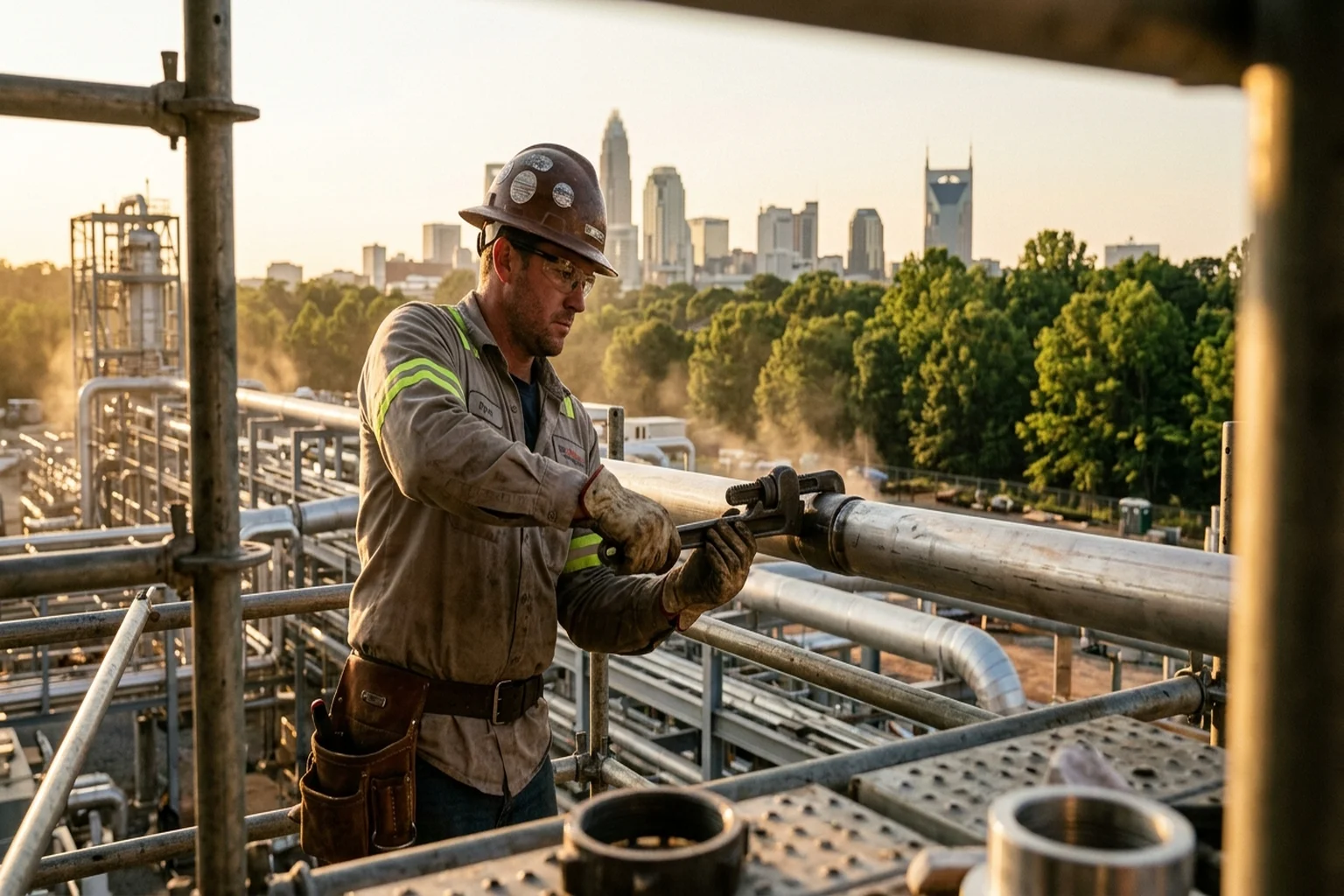
Gas plants and nuclear plants are built from pipe: steam, feedwater, fuel gas, and cooling systems. Pennsylvania pipefitters earn a median $68,080. Like line work, this trade is learned mostly on the job. Only one Pennsylvania school in our database reported pipefitting awards for 2024–25, while Local 354’s new consolidated center shows where much of the training actually takes place. Our pipefitter and steamfitter career guide covers the apprenticeship structure.
4. Boilermakers
Boilermakers erect and repair boilers, pressure vessels, and the heat recovery steam generators being hauled into Homer City. BLS estimates only 260 boilermaker jobs in Pennsylvania, but the median of $86,850 is among the highest in the table. Much of the work is union outage and project work, which can mean travel between job sites. See our boilermaker career guide.
5. Nuclear technicians and reactor operators
Crane’s 600 permanent jobs and the planned uprates at Beaver Valley and Limerick keep nuclear careers growing in Pennsylvania. Nuclear technicians earn a Pennsylvania median of $124,070. Reactor operators are trained and licensed through employer programs, which take 18 to 24 months at Crane. Common starting points include an associate program in nuclear power technology or electrical technology, or Navy nuclear experience. Career data: nuclear technicians and nuclear power reactor operators.
6. HVAC, controls, and power-generation technicians
Data centers run on cooling plants and backup generation, and both need technicians after construction ends. The Pennsylvania College of Technology offers an On-Site Power Generation Technology associate degree focused on installing and servicing diesel generators, and the school reports 100% placement. In 2024–25, 23 Pennsylvania schools in our database reported 604 HVAC awards (IPEDS). The leaders were Pennco Tech (123), All-State Career School in Essington (76), and Thaddeus Stevens College of Technology (48). See the HVAC career profile.
Where to train in Pennsylvania
- Campus programs: Browse the 148 trade colleges in Pennsylvania in our database, the statewide program directory, or the ranked list of Pennsylvania trade colleges. Regional pages cover Pittsburgh and Philadelphia.
- Utility programs: FirstEnergy’s Power Systems Institute and Duquesne Light’s Electrical Distribution Technology program both lead directly to line jobs.
- Union apprenticeships: IBEW locals, Plumbers & Pipefitters locals, and the Boilermakers train journeyworkers on the projects above. If you’re new to the model, start with how apprenticeships work and union vs. non-union trades.
- State money: The 2026–27 state budget adds $10 million for career and technical education and brings workforce development funding to $193 million, a 60% increase. The state also counts 266 new apprenticeship and pre-apprenticeship programs since January 2023 (PA Department of Labor & Industry). As of April 2026, Pennsylvania had 155 registered pre-apprenticeship programs and 3,306 active pre-apprentices (American Institutes for Research).
- Paying for school: Short programs may qualify for Workforce Pell Grants; our guide to paying for trade school covers federal aid. If you were laid off, WIOA training funds can cover tuition.
The honest caveats
- Permitting is the bottleneck. Governor Shapiro’s August 18 executive order says only five of the state’s 100+ data center proposals have every permit needed for their first phase. The order also makes the state’s standards for these projects, which include workforce and economic development, mandatory (Governor’s Office).
- Pipelines shrink. Exelon, parent of PECO, cut its data-center pipeline from more than 60 GW to 36 GW in three months (T&D World).
- Headline totals overstate. A Technical.ly tracker found that some announcements from the July 2025 Pittsburgh energy summit didn’t match what companies actually committed (Technical.ly).
- Dates slip. Homer City’s first-power date is either 2027 or early 2028, depending on the source, and Crane’s May 2027 license target still depends on the NRC.
- Construction peaks, then ends. Homer City’s crew of 1,800-plus will shrink to about 200 full-time plant jobs. Lasting careers come from the utilities, the plants, and union work that moves from project to project.
How to get started
- Decide what kind of work you want. Project and outage work (pipefitting, boilermaking) pays well and moves around. Utility and plant jobs (line work, operations) are more stable.
- Watch application windows. Union apprenticeships and utility programs take applicants in cycles. Prepare with our apprenticeship aptitude test guide.
- If you choose a school, ask about employers. Ask which utilities, contractors, or plants hire its graduates, and what share of graduates find jobs in the field.
- Line up funding before you enroll. File the FAFSA and check Workforce Pell and WIOA eligibility.
Pennsylvania’s power buildout will take years. The PUC study shows the supply gap running through at least 2030. Starting training in 2026 means finishing an apprenticeship while that gap is still open.
Sources
- Pennsylvania Public Utility Commission — “PUC Study Warns Rapid Data Center Growth Could Pose Serious Risks to Electric Reliability” — September 14, 2026 — https://www.puc.pa.gov/press-release/2026/puc-study-warns-rapid-data-center-growth-could-pose-serious-risks-to-electric-reliability-09142026
- PJM Inside Lines — “PJM’s Updated 20-Year Forecast Continues to See Significant Long-Term Load Growth” — January 14, 2026 — https://insidelines.pjm.com/pjms-updated-20-year-forecast-continues-to-see-significant-long-term-load-growth/
- PJM Inside Lines — “Over 700 New Generation Projects Accepted Into First Cycle of Reformed Interconnection Process” — August 3, 2026 — https://insidelines.pjm.com/over-700-new-generation-projects-accepted-into-first-cycle-of-reformed-interconnection-process/
- PPL Corporation — 2025 earnings and business plan update through 2029 — February 20, 2026 — https://investors.pplweb.com/2026-02-20-PPL-Corporation-reports-2025-earnings-results-provides-business-plan-update-through-2029,-extending-EPS-growth-targets
- PPL Corporation — Second-quarter 2026 earnings — August 7, 2026 — https://investors.pplweb.com/2026-08-07-PPL-Corporation-Delivers-Solid-Second-Quarter-2026-Earnings-Reaffirms-Guidance-and-Long-Term-Growth-Outlook
- World Nuclear News — “NRC completes environmental review of Crane restart” — September 28, 2026 — https://www.world-nuclear-news.org/articles/nrc-completes-environmental-review-of-crane-restart
- WITF — “Three Mile Island reactor restart progresses through environmental review, public comments” — July 28, 2026 — https://www.witf.org/2026/07/28/three-mile-island-reactor-restart-progresses-through-environmental-review-public-comments/
- ANS Nuclear Newswire — “Second-quarter updates from Constellation: New PPAs, Crane restart, and more” — August 13, 2026 — https://www.ans.org/news/2026-08-13/article-8291/secondquarter-updates-from-constellation-new-ppas-crane-restart-and-more/
- Rob Bair, PennLive (opinion) — “Three Mile Island restart clears major hurdles and promises hundreds of skilled-trades jobs” — July 2, 2026 — https://www.pennlive.com/opinion/2026/07/three-mile-island-restart-clears-major-hurdles-and-promises-hundreds-of-skilled-trades-jobs-opinion.html
- Constellation — Crane Clean Energy Center — accessed October 16, 2026 — https://www.constellationenergy.com/about/locations/crane-clean-energy-center.html
- Homer City Redevelopment — “Homer City Redevelopment Reaches 1,000 Workers on Construction Site” — March 26, 2026 — https://www.homercityredevelopment.com/post/homer-city-redevelopment-reaches-1-000-workers-on-construction-site
- Homer City Redevelopment — “Heavy Equipment Transport to Homer City Energy Campus Begins September 16” — September 2026 — https://www.homercityredevelopment.com/post/heavy-equipment-transport-to-homer-city-energy-campus-begins-september-16
- Salena Zito, Washington Examiner (column) — “How 1,800 local tradespeople are powering Pennsylvania’s ultimate energy and data innovation campus” — September 4, 2026 — https://www.washingtonexaminer.com/opinion/columnists/4713636/1800-local-tradespeople-powering-pennsylvania-ultimate-energy-data-innovation-campus/
- David Chernicoff, Data Center Frontier — “From Coal to Compute: How Pennsylvania Is Rebuilding Power for AI Data Centers” — September 30, 2026 — https://www.datacenterfrontier.com/energy/article/55404954/from-coal-to-compute-how-pennsylvania-is-rebuilding-power-for-ai-data-centers
- Rachel McDevitt, 90.5 WESA — Homer City data center and permit reform — May 8, 2026 — https://www.wesanews.org/environment-energy/2026-05-08/pa-sen-dave-mccormick-homer-city-data-center-permit-reform
- Rudy Miller, PennLive — “One of the largest data centers being built in Pa. has an end user” — October 1, 2026 — https://www.pennlive.com/news/2026/10/one-of-the-largest-data-centers-being-built-in-pa-has-an-end-user-and-its-a-big-name.html
- WJAC-TV — “Indiana Co. officials discuss plans for proposed data center” — October 15, 2026 — https://wjactv.com/news/local/indiana-co-officials-discuss-plans-for-proposed-data-center
- Amazon — Salem Township, Falls Township, and Kline Township campus pages — accessed October 16, 2026 — https://www.amazoninnovationinpa.com/salem-township-innovation-campus/
- Sophia Schmidt, WHYY — Amazon data center in Bucks County and gas generators — July 15, 2026 — https://whyy.org/articles/amazon-data-center-bucks-county-pa-gas-generators-impact/
- Giavanni Alves, PennLive Advance Industry (funded by the PA Chamber Foundation) — “Electrician jobs surge amid data center boom in Pennsylvania” — June 11, 2026 — https://www.pennlive.com/advanceindustry/2026/06/electrician-jobs-surge-amid-data-center-boom-in-pennsylvania.html
- Amazon — “Amazon Web Services helps build Northeast Pennsylvania’s homegrown fiber optics workforce” — August 6, 2026 — https://www.amazoninnovationinpa.com/community-event/amazon-web-services-helps-build-northeast-pennsylvanias-homegrown-fiber-optics-workforce/
- Penn’s Northeast — “LCCC and Amazon collaborate to train workers for expanding data center industry” — January 23, 2026 — https://pennsnortheast.com/news/article/lccc-and-amazon-collaborate-to-train-workers-for-expanding-data-center-industry
- ANS Nuclear Newswire — “Vistra gets $4.2B DOE loan for planned uprates in Ohio, Pennsylvania” — October 6, 2026 — https://www.ans.org/news/2026-10-06/article-8464/vistra-gets-42b-doe-loan-for-planned-uprates-in-ohio-pennsylvania/
- ANS Nuclear Newswire — “Google, Constellation reach 11-unit uprate plan” — October 6, 2026 — https://www.ans.org/news/2026-10-06/article-8467/google-constellation-reach-11unit-uprate-plan-constellation-to-invest-43-billion/
- Lucas Dufalla, PublicSource — U.S. Steel’s Mon Valley investment plan — June 8, 2026 — https://www.publicsource.org/us-steel-plan-mon-valley-investment/
- Reid Frazier, The Allegheny Front — U.S. Steel Mon Valley upgrades — July 24, 2026 — https://www.alleghenyfront.org/us-nippon-steel-mon-valley-braddock-upgrades/
- Reid Frazier, The Allegheny Front — Edgar Thomson hot mill permit hearing — October 16, 2026 — https://www.alleghenyfront.org/us-steel-mon-valley-edgar-thomson-hot-mill-permit-hearing/
- U.S. Bureau of Labor Statistics — Occupational Employment and Wage Statistics, May 2025, Pennsylvania and national estimates — released May 2026 — https://data.bls.gov/oes/#/area/4200000/2025
- U.S. Bureau of Labor Statistics — Occupational Outlook Handbook: Electricians; Line Installers and Repairers — updated August 2026 — https://www.bls.gov/ooh/construction-and-extraction/electricians.htm
- Duquesne Light — Craft and skilled worker careers — accessed October 16, 2026 — https://duquesnelight.com/company/about/careers/craft-skilled-workers
- FirstEnergy — “West Penn Power adds new line and substation employees from Power Systems Institute” — July 25, 2022 — https://www.firstenergycorp.com/newsroom/news_articles/west-penn-power-adds-new-line-and-substation-employees-from-powe.html
- Pennsylvania Department of Labor & Industry — “Shapiro Administration highlights record $193 million investment” in workforce development — July 23, 2026 — https://www.pa.gov/agencies/dli/newsroom/shapiro-administration-highlights-record—193-million-investment
- American Institutes for Research — Pennsylvania pre-apprenticeship case study — May 2026 — https://www.air.org/sites/default/files/2026-05/Pre-Apprenticeship-Case-Study-May2026_0.pdf
- Office of Governor Josh Shapiro — Executive order on data center development — August 18, 2026 — https://www.pa.gov/governor/newsroom/2026-press-releases/governor-shapiro-signs-executive-order-on-data-center-developmen
- T&D World — “Exelon weeds out data center pipeline” — August 3, 2026 — https://www.tdworld.com/utility-business/news/55395407/exelon-weeds-out-data-center-pipeline
- Alice Crow, Technical.ly — Pennsylvania $90B data center investments tracker — February 17, 2026 (updated May 6, 2026) — https://technical.ly/entrepreneurship/pa-90b-data-center-investments-updates-tracker/
- Pennsylvania College of Technology — On-Site Power Generation Technology (A.A.S.) — accessed October 16, 2026 — https://www.pct.edu/academics/et/diesel-truck-heavy-equipment-power-generation/on-site-power-generation-technology
- National Center for Education Statistics — IPEDS Completions, 2024–25 awards, as compiled in the Trade Colleges database — https://nces.ed.gov/ipeds/